
| ABOUT US | ARCHIVES | LINKS | RSS FEED | MONDAYS | |

3quarksdaily

An Eclectic Digest of Science, Art and Literature

« Monday Poem | Main | Wrong arm of the law »

October 19, 2009

Seriousness is the New Black

Editor's Note: Today we welcome a new writer to 3QD. Sue Hubbard is a freelance art writer based in London writing for a variety of publications from The Independent to the New Statesman. An award-winning poet, she has published two collections of poetry, Everything Begins with the Skin (Enitharmon) and Ghost Station (Salt), as well as a novel, Depth of Field (Dewi Lewis) and a recent collection of short stories, Rothko’s Red (Salt).

The Turner Prize at Tate Britain and Anish Kapoor at The Royal Academy

Sue Hubbard
Turner%20Prize%2009%20Press%2003 Many factors have lead to London’s pre-eminence in the contemporary art world: the importance of Goldsmith’s College to the Hirst generation of YBAs, Saatchi’s ubiquitous influence as a collector, Jay Joplin’s White Cube gallery, the founding of the annual Frieze art fair, and of course, the Turner Prize, that annual award set up in 1984 to celebrate new developments in contemporary art presented each year to a British artist under fifty for an outstanding exhibition in the preceding twelve months. It has always been a controversial affair. There was, of course, that bed (it didn’t win) and Martin Creed’s minimal light bulbs that simply went on and off. Last year, the shortlist was universally derided as opaque and pretentious. But looking back over its history, love it or hate it, The Turner Prize has become a barometer of the British art scene. Those nominated, often previously unknown outside the art world, usually end up as household names.

This year the short list feels subtly different, not only is there an absence of videos (accident not design, it is claimed) but the work is thoughtful, complex, crafted and, in several cases, rather beautiful. There is little irony. Seriousness, it seems, is this season’s new black.

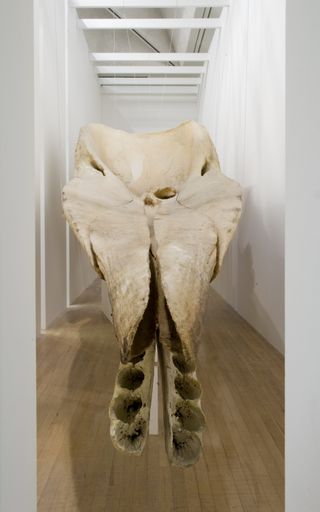
Glaswegian artist Lucy Skaer (the only woman) has named her installation Thames and Hudson, a reference to both those mighty rivers as well as to the celebrated art publisher. Yet, somehow, the whole feels made up of rather too many disparate parts. A dismantled chair has been used to make some rather obtuse prints, while her Black Alphabet is a version of Brancusi’s 1923 sculpture Bird in Space, caste 26 times in compressed coal dust - though her purpose and message remain rather a mystery. Her pièce de résistance, however, is the skull of an adult male sperm whale (a comparison with Damien Hirst’s formaldehyde shark is unavoidable) on loan from a Scottish museum. Suspended so that it is only partially visible through a series of screens, its sad bony hulk is reminiscent of those Victorian curiosities peered at through fairground peep holes.

[Image Credit: Lucy Skaer, Thames and Hudson 2009, including Leviathan Edge 2009, on loan courtesy of the Trustees of the National Museums of Scotland. Photo credit: Sam Drake and Gabrielle Johnson, Tate Photography.]

Enter the second gallery and, at first, it seems to be mostly white. Yet, at the far end, a baroque style design made of gold leaf has been applied straight onto the wall. Standing in front of it patterns begin to emerge: a pelvis, a spine and even female genitals. Elsewhere the gold bursts into a sunray, which made me think of Louis XIV, The Sun King, which then started me musing about the transient nature of power and provoked the thought that this rather beautiful piece would last only as long as the exhibition, before being painted over and returned to being just another gallery wall. It could, therefore, be seen as a sort of contemporary vanitas painting. All this beauty, we are subtly reminded, will be erased to become so much white wash. Just as we, too, will eventually be erased. This is decorative art with a serious twist.

The next gallery comes as a complete contrast. Enrico David's installation, titled Absuction Cardigan is fun, annoying and serious in about equal measure. I did not go much for his humpty dumpty black figures set on skis but his mis en scène, raised on a sort of stage, is deeply unnerving. A huge black, stuffed doll-of-a -creature, with a neck and tail the length of the room, lies draped over a variety disquieting props. Its face, a flat wooden mask, is comprised of nothing but bore holes. Part floppy toy, part dead animal and sexual playmate, it draws on Louise Bourgeois and Annette Messager’s transgressive figures, and on Hans Bellmer’s erotic dolls.

Roger Hiorn’s work inhabits the final space. Here lumpy sculptures of cast plastic have been injected with bovine brain matter, so that what was once sentient has been rendered inert and mummified. Metaphors of death are also strong in his beautiful, evocative landscape, in subtle shades of grey and black, made from an atomised passenger jet engine and scattered on the floor to resemble the Himalayas or the surface of the moon. Ashes to ashes, dust to dust; like all good art it evokes a number of readings that range from the disaster of 9/11 to a globally warmed and violated earth.
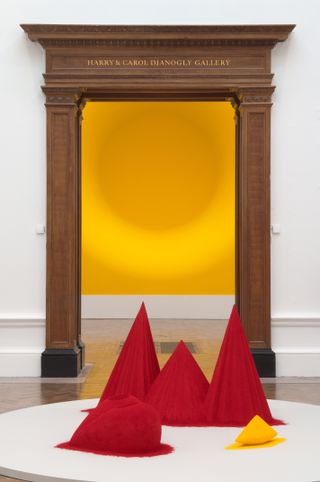
Kapoor_Yellow%20&%20'As%20if%20to%20Celebrate Proof that the Tuner prize does sometimes get it right can be seen at the Royal Academy where the 1991 Turner Prize winner, Anish Kapoor, has one of London’s most outstanding exhibitions. There have been those who have complained that is sensationalist, too male and too reliant on gadgets and props. I admit that I never much liked his Masaryas that filled Tate Modern’s turbine hall - too much bravura engineering and not enough poetry. But this is one of the most evocative exhibitions I’ve come across in a long time. Not only technically brilliant and thought provoking, its scale is heroic. It starts in the courtyard with a major new sculptor Tall Tree and the Eye, inspired, according to Kapoor, by the words of the German poet Rainer Maria Rilke. Made of, apparently, precariously balanced steel balls that reflect back the surrounding Palladian architecture, this signals that Kapoor is not afraid of beauty. An unfashionable component in much contemporary art, there is much to be found inside Burlington House.

In the first room is a group of early pigment sculptures from the 70s and 80s, strongly influenced by his Indian origins, and which reinforce his reputation as a colourist. The unmixed heaps, built into pyramids and ziggurats of bright blue, cinnamon yellow and cayenne red, resemble rather sophisticated sandcastles and evoke piles of Indian spices in a way that, although not particularly demanding, stir a remembrance of things past.

[Image credit: Anish Kapoor, Yellow, 1999, fibreglass and pigment, 6 X 6 X 3 m, courtesy of the artist and Lisson Gallery. Photo Dave Morgan.]

Move through the galleries and you will find a barely visible pregnant lump protruding from the white gallery wall, and another huge large yellow wall where the indentation is concave. The effect is like standing in front of some Aztec shrine where one is seductively sucked into the sun-like void, and invited to think of beginnings and endings, origins and destruction.

Then there is Shooting into the Corner, a new work where gobbets of red wax are fired from a canon through one of the Royal Academy’s elegant 18th century doorways. This happens three times an hour. Many visitors seem simply to have been taken up by the drama in a man-fired-from -cannon sort of way. But I found it very disturbing. A gallery assistant dressed in black stands with military bearing stuffing cartridges into the canon. The explosion, when it comes, is deafening. In this palatial setting, as the red wax splatters the white walls and the surrounding Adams style doorway, like the visceral effluvia of executed bodies, I kept thinking of the final moments of the last Tsar and his family or Manet’s Execution of Maximilian.
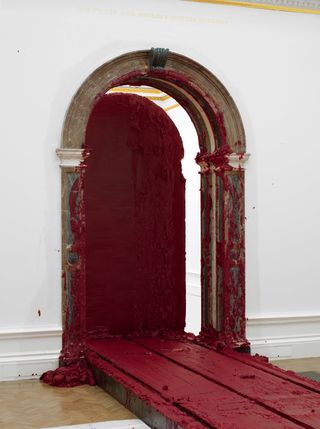
Kapoor_Svayambh,%20Royal%20Academy A multiplicity of readings can also be applied to the monumental work Svayambh (2007). Already shown in previous locations this is probably its most dramatic setting. Svayambh means ‘self-generated’ in Sanskrit and the piece reinforces Kapoor’s interest in sculpture that actively explores this process. Again many viewers were taken with the theatre of the moving mechanism, running between galleries to watch as the vast block of red wax was slowly squeezed, like a great juggernaut, through the doorways of Burlington House. And certainly one is reminded of those huge Indian carts from which the name juggernaut comes, and of the annual procession at Puri in east-central India where worshipers throw themselves under the wheels of the huge wagon on which the idol of Krishna is carried. But for anyone with a poetic imagination, this red gash of an object, moving relentlessly along the rail tracks like a piece of raw meat, covering the doorways along the way with coagulated red carnage, must have historical resonances, evoking the trains that took thousands to their death in the Nazi transports or those who gave their life’s blood in acts of enforced labour to build railways in the Far East during the last world war. Huge and monumental, its movement almost imperceptible, it marks, as it slowly lumbers its way through the gallery like a slow birthing of the building itself, the passing of time. And yet despite all the layers of meaning that it invites, it is, ultimately, an abstract work of art, an act of the imagination and an exploration of the possibility of materials.

[Image credit: Anish Kapoor, Svayambh, 2007, installed at the Royal Academy of Arts, 2009, wax and oil-based paint, dimensions variable, courtesy of the artist and Lisson Gallery, London. Photo: John Bodkin.]

The exhibition is huge. There are beguiling sculptural mirrors that reflect the gold leafed ceiling and the self back to the self, blurring the lines between perceived and actual experience; and piles of coiled cement, which suggest the history of pot making and the touch of the human hand, but which, in fact, have been arrived at by a rough sketch being fed into a computer and attached to a cement-mixer, which, in turn, has been attached to a machine adapted from the food industry to excrete the cement like icing; and a vast, rusted steel Richard Serra-like sculpture Hive, an enormous pod, splayed open at one end to reveal a deep central void, which is at once both erotic and chthonic.

Kapoor is not a philosopher, nor does he claim to have anything, as a visual artist, particular to say. The power of this work lies in its ability to provoke questions about origins, perception, belief and self definition. Comparison can be made with the spiritual leanings of Yves Klein (homage is surely paid in Kapoor’s early blue pigment works) but where Klein’s spirituality was derived from the arcane complexities of alchemy and Rosicrucianism, Kapoor’s work is never didactic. There is an openness about his quest which is not wedded to a single belief system, but reminds us, as Keats once did, that there is, indeed, truth in beauty.

This year’s Turner short listed artists still have some way to go.

Posted by Sue Hubbard at 03:39 AM | Permalink

Comments

What a good essay! Where has Sue been all our lives?? Is she coming back?

Posted by: Elatia Harris | Oct 19, 2009 1:07:33 AM

plus... one of the worst tragedies in the History of Art

Saudades..

Posted by: Pamela | Oct 19, 2009 2:25:40 AM

Welcome to 3quarks Sue. It's great to have a piece here about art... Art in London!

I haven't seen the Turner Prize this year. The buzz at Goldsmiths (where I currently study art) revolves around Roger Hiorn, an ex-student at the college. I had the pleasure of seeing his 'Seizure' last year: a south London flat flooded with 70,000 litres of copper sulphate and left to crystallise.

From what I know of his work, and the connections you draw to Kapoor's large-scale wax sculptures, it seems that art is passing through a grand interior of the mind right now. Organic, ethereal structures allowed to breed with their environments. Walking around 'Seizure' is like entering a shimmering amethyst. I was reminded of Aldous Huxley's musings in 'Heaven and Hell' where he talks about the innate desire the human mind has for the glint of precious stones, evoking as they do the eternity of the heavens in a token that can be held between forefinger and thumb.

Kapoor's exhibition enthralled me as much for the looks on the faces of the crowd as for its grand wax juggernaut. Like 'Altermodern' last year, it was a pleasure to wander through the mental-space of the gallery, to be one amongst the enthralled throng.

I was taken by Kapoor's scales of 'making'. A vast monolith composed of tiny remnants of wax; geometrically precise structures made of dust. Whether the wax was organic or not, it called to my mind the millions of bees trundling from their nests to collect nectar. How many trips from beehive to flower does it take to make a Kapoor sculpture?

Thanks again Sue. I look forward to your future musings.

Posted by: Daniel Rourke | Oct 19, 2009 6:43:22 AM

I saw the Kapoor exhibition at the Royal Academy yesterday. I enjoyed it, but at a visceral, childlike level. Svayambh, for instance, reminded me of the sort of thing I'd daydream as a twelve-year-old in an art gallery tired of looking at paintings stuck to walls. Like, what would happen if you pushed a huge quantity of wax through the arch? Oh look, they all line up, you could push it through all three arches. And here it actually is, and it's so satisfying to see the locomotive/loaf/lump fit so cleanly through the arch back the way it came.

And hey, what about firing big chunks of wax from a cannon, what kind of a mess would it make all over the walls and floors and other not-the-art parts of a gallery? Also much like the sort of thing I used to daydream, also viscerally satisfying in the obvious way.

The bright colours and bold clean shapes are part of that, and appeal in a similar way for the other works. There's a sort of childish, almost Asperger-ish glee to it all: Yellow is perfectly square and perfectly yellow, with a perfectly round depression pefectly in the centre. And it's big. The mirror pieces again are precise: of course I couldn't resist putting my eye at the exact centre of the spherical mirror, to see it reflected as multiple blue irises. Everything lines up just so.

The vulvic shapes one can see in Hive and Slug add a flavour that is both warm and pornographic, especially respectively, but again in a clean precise way. It's all reassuring, there's no sense of you don't understand my alienation that I get with a lot of other art. Indeed "readings" seem beside the point, but it's still compelling.

Posted by: Sagredo | Oct 21, 2009 1:30:31 PM

Sagredo -- "Asperger-ish glee..." Just lovely!

Posted by: Elatia Harris | Oct 21, 2009 5:27:17 PM

Why is this article titled "Seriousness is the New Black"? Kapoor is not serious; it's art as decoration, as fairground attraction. This is why Sagredo's honest response in the commments ("I enjoyed it, but...") is better than the article itself, which doesn't even take the first step in thinking about why Kapoor is one of the preeminent establishment artists. He is guilty of reducing art's potential to spectacle, and it is not only a shame but also offensive.
What we get instead of a thoughtful reflection on the function of his art is the most hackneyed and outdated quotation from Keats, and an outright welcoming of Kapoor's lack of thought, how he doesn't have anything to say. Hubbard could go over to the Baldessari at the Tate for a corrective: there is both humor and enlightenment; Kapoor by comparison pales for having neither, and is exposed for his ultimate shallowness (unfortunately celebrated here).

Not only for how evident it is that Hubbard has not been challenged to back up her sentimental take on Kapoor's art, the article shows a woeful need for editing, not only to hone its argument but also for such misspellings as "Tuner Prize" and "Masaryas." The latter makes one think that she missed the reference to the Greek legend that offers the only potentially valid legitimation for the Turbine Hall piece, however flimsy it was.

Posted by: Big Tree | Oct 23, 2009 3:13:46 PM

I haven't been to either of the exhibitions which feature in Sue Hubbard's essay. On the strength of her astute, frequently poetic, comments on each of them, but the Kapoor one especially, I will now make the effort. Sue's superior reputation as an art critic is well known from her many contributions over the years to the New Stateman & Independent. This is a typical of her: principled, fair and perceptive, and very well written.

Posted by: David Halpin | Oct 26, 2009 11:15:51 AM

smart website

could you please send me your "search Engine" code?

I want add this search engine on my website.

Posted by: sachin | Nov 10, 2009 1:27:14 AM

Post a comment


Subscribe to this blog's feed  

PayAnywhere with iphone credit card swiper

Android Tablet

Bluetooth Headset

2013 New Style Dresses

Compare Car Rental Prices

DHgate.com Wholesale

3QD on Facebook

3QD on Kindle

3QD by Daily Email

Receive all blogposts at the same time every day.

Enter your Email:


Preview 3QD Email

3QD on Twitter

Miscellany

Lijit Search

AddThis Social Bookmark Button

Add to Google

Recent Comments

Sumiran on Sunday Poem

Ethan on Getting Smarter

Pacificklaus on NORTH KOREA’S NERVE WAR

Félix E. F. Larocca, MD on POETRY IN TRANSLATION: CORDOBA

Shane on That's not music – that's just noise!

seth edenbaum on Habermas, Adorno, Politics

Raza Husain on If Only We Had A Leader Like Chavez, Who Solved Real Problems -- Instead Of Debating Fake Ones Like The Deficit

Raza Husain on Think About Nature

Raza Husain on Getting Smarter

johnnyred on Getting Smarter

Lou on Throwing away ancient wisdom, painting with sound and staying awake: a conversation with radio dramatist and ZBS Foundation president Thomas Lopez

Sundar on If Only We Had A Leader Like Chavez, Who Solved Real Problems -- Instead Of Debating Fake Ones Like The Deficit

flowers rainbows on Lift up your voices: The century-long battle for women's freedom

mr.ed on wagner in new york?

mirel on Here’s how to change the world

mirel on If Only We Had A Leader Like Chavez, Who Solved Real Problems -- Instead Of Debating Fake Ones Like The Deficit

X on Getting Smarter

Ross Williams on Getting Smarter

oroboe on Lennon's "Imagine" and McCartney/Wings' "Band on the Run" overlaid: One way of reuniting (some of) the Beatles

Richard H. Randall on Obama must Make Fighting Climate Change National Project, or Die the death of a thousand Scandals

waqnis on Thursday Poem

seth edenbaum on The First New Atheist? Kierkegaard

waqnis on Mortify Our Wolves

nogodrod on KFC smugglers bring buckets of chicken through Gaza tunnels

waqnis on Here’s how to change the world

Acclaim For 3QD


"I couldn't tear myself away from 3 Quarks Daily, to the point of neglecting my work. Congratulations on this superb site."—Steven Pinker, Johnstone Professor of Psychology, Harvard University.

"I have placed 3 Quarks Daily at the head of my list of web bookmarks."—Richard Dawkins, Charles Simonyi Professor of the Public Understanding of Science at Oxford University.

"Just wanted you to know I’m one of many who reads and enjoys 3 Quarks....almost daily."—David Byrne, musician, former lead-singer of the Talking Heads, artist, intellectual.

Read more here.

The 3QD Prizes

Subscribe to this blog's feed