by Tolu Ogunlesi
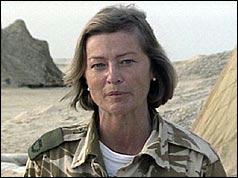 She was the only woman on the frontlines during Gulf War 1, surrounded by 43,000 men. So how did she cope with doing that thing that men can do in public but women can’t? “Nudity is tolerable, using the loo in front of other people isn’t,” she explained to a wine-sipping group of us gathered around her at a Nairobi house in August; as we awaited the start of a dinner party to end the 2009 Storymoja Hay Festival.
No war without Kate
In 2001 Britain’s Independent newspaper described Kate Adie OBE as “the best-known, most respected woman reporter in the UK.” She came to national prominence in 1980, reporting – from behind a car door – the siege of the Iranian embassy in London, in May 1980. In 1986 she covered the American bombing of Tripoli, and in 1989, in Tiananmen Square she was hit in the arm by a bullet which went on to kill a young man. During the first Gulf War a British newspaper published a cartoon showing two soldiers preparing to go into battle. “We can’t start yet, Kate Adie isn’t here,” one says to the other.
A day before the dinner party I had the privilege, alongside Ugandan journalist David Kaiza, of interviewing Adie in a packed tent on the grounds of Nairobi’s Impala Club. After four decades of reporting – which saw her rise from studio technician at a local BBC radio station in Durham to become the BBC’s Chief News Correspondent in 1989, covering wars everywhere from Armenia to Bosnia to Rwanda to the Middle East – she is eminently qualified to lecture on grand concepts like “news” and “war”.
“Ninety percent of wars are about land,” she said. “In the future it will be [about] land with water, land you can build on; live on.” She also hinted at the capacity of ‘war’ to feed the human predilection for euphemism – which would explain Kenya’s “post-election violence”, and Northern Ireland’s “troubles”.
The making of a journalist
But “international media” is one concept that doesn’t deserve an explanation. “There is no such thing as the international media,” she said.”You are all paid by somebody, you are all working for somebody… there is no such thing as international journalism reporting for the world. CNN’s target audience is middle America; it just happens that other people are subjected to it.” The BBC is “British in origin, and in orientation.” And for her “there really isn’t any kind of war that sees journalists as neutral. Whose side are you on – that’s the first question. Are you for us or against us?”
Adie didn’t set out with dreams of becoming a famous journalist. She finished a degree in Scandinavian studies at Newcastle University, and life had to go on. “I started as someone who desperately needed a job,” she said. Forty years later she’s “never done a day’s course in journalism” and “[doesn’t] do shorthand.” Media degrees simply hadn’t been invented when she was a student, she explained. It is obvious, hearing her speak, that she doesn’t for a second imagine that nurture (i.e. fancy degrees) can trump nature.
Journalists are people “forever asking the question why?” and journalism is “really the extension of curiosity, lots of questioning and a good pair of eyes and ears… you must also like people; want to listen to stories…”
And there is the need for speed, because “the very essence of news is that it is new, it’s got to be fresh.” It is this necessity that explains “why journalists don’t often make good novelists.”
Pros and cons of war
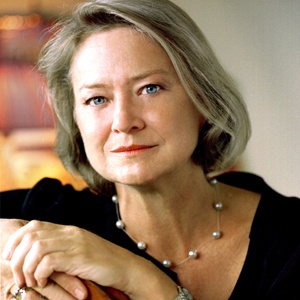
“Women improve their circumstances in war – they can do the things that the men used to do,” she told us. I’d never seen it that way before. Perhaps she explains more in her 2003 book (the second of three): “Corsets to Camouflage: Women and War”.
War has other benefits as well, for certain classes of persons: “No war happens without the black market, without people getting rich.” And “some people will love and enjoy war – travel places, do things they never imagined they’d do.” Travelling places is something she knows an awful lot about, enough to make her say, deadpan, that “international airports are not normal places… they are full of anxious people.” And that Kolkata [Calcutta], India is a place where “the poor die in public.” Of the Japanese, she said: “If you ever watch Japanese television you will see things on it you will never see anywhere else.”
Apparently it’s not only Japanese television that can be unusual. Irecall her telling me, on our first meeting, a day before the Storymoja interview, of a warfront encounter with Japanese journalists. On meeting her, they took their time to perform the customary Japanese bow, blissfully – or stubbornly – oblivious to the bullets and shells that whizzed past.
This year Adie returned to Tiananmen Square, to see what had changed in the two decades since the crushing of the rebellion. She tried to ‘explain’ China to me. Her description of it as a land of “800 million peasants” – overwhelming the population on the other side of the economic divide (beneficiaries of the much-trumpeted capitalist boom) – has stayed with me since then.
Adie has previously described herself as “an old-fashioned reporter”, firm in the belief that a reporters should keep herself out of the reportage. “You don’t give labels to things, you describe what people are doing,” she said.
As we stood in that Nairobi house, someone asked her how she handled sexual desire at the warfront. Never one for euphemistic dilly-dallying , she answered: “You can’t have sex unless you survive. You can’t have pleasurable sex unless you win.”
You shouldn’t listen to Kate Adie unless you want to learn something new.
Tolu Ogunlesiwas awarded the 2009 CNN Multichoice African Journalism Arts and Culture Prize. His fiction, poetry and journalism have been widely published online and in print, and translated into Italian, Norwegian, Dutch and Swedish. He works in Lagos, Nigeria as a journalist.
