

September 07, 2009
Rumination on the Life, Death, and Particularly the Legacy of a Man Barely Necessary to Introduce to Y’All, Beyond Mentioning (1) His Initials, D, F, and W, and (2) The Fact That This Very Headline Owes Him, Obviously, Everything
Watching the legions of Michael Jackson fans make pilgrimages to and build cairns of flowers and stuffed toys at the Neverland Ranch in southern California, I can’t say I shared their sorrow exactly. I did sympathize: Boy, had I been there. When David Foster Wallace hanged himself at his own southern California home on September 12, 2008—that’s the closest I’ve ever been to crying over the death of someone I didn’t know. What roiled my emotions all the more was the now-too-late conviction that I’d betrayed Wallace.
DFW called himself a novelist, wanted to be remembered as a novelist, corresponded with novelists about the craft, labored for years over the 2.75 novels he managed to finish (the last 0.75 of which unfinished novels is being molded in a full 1.00 novel called The Pale King by editors at Little, Brown, his publishing company, at this very moment). But as of September 12, 2008, beyond the disappointing exception of a 3,209-word New Yorker story (“Good People”), I hadn’t read more than a few spare sentences of the fiction Wallace considered his life’s work. Instead, all the riffs on dictionaries and tennis and John McCain and porno award shows that I’d committed to memory practically (I don’t even play tennis), all the lines I quoted to uncomprehending family members and the pieces I forwarded incessantly to friends who never read them, were from magazine articles. I loved Wallace for journalistic essays—what in less polite terms novelists often refer to as hack work—that Wallace did for mercenary reasons, because an editor dangled a paycheck, and he was polite, and he needed money like the rest of us.
Now there’s no reason to think Wallace loathed writing nonfiction—it just wasn’t his passion. He aligned himself with Dostoevsky and Pynchon, not Capote and Talese, and there’s even scuttlebutt out there that he killed himself in despair over his unshapely mess of a last book and the pressure of never living up to, well, himself. I will read that last book when it comes out, for sure, and since last September I’ve decoded a fair number of his hermetic short stories and even committed a month to finishing (and I did finish!) all 1,079 pages of Infinite Jest, down to every last little cross-eyed footnote’s footnote. I felt less guilty after finishing, but yet finishing only reinforced what I’d suspected. When the Library of America editors get around to selecting a picture of the long-haired, bandana-ed, tobacco-cheeked Wallace for its 2050 catalogues, they’re not going to spotlight his fiction in this first volume. It’ll be the nonfiction he composed during spare hours.
But here’s the thing: It may work out better for Wallace. Because if this is the way it all shakes out, DFW, instead of having to ride the stock exchange of literary taste in dead white male novelists, will find himself in a distinguished little nook of odd artists who labored to produce highbrow work—but who sort of ass-backwardsly won permanent and inarguable fame in lower-browed fields.
Some quick examples include C.S. Lewis (“Chronicles of Narnia”), A.A. Milne (“Winnie the Pooh”), and Roald Dahl (“Charlie and the Chocolate Factory”), who considered themselves, respectively, a theologian, playwright, and fiction writer, but who ended up as brilliant children’s fabulists. There’s Theodore Geisel, who chose a silly pen name like “Dr. Seuss” because he wanted to reserve his given name for the Great American Novel he had in him. One Arthur Sullivan composed the music for “Onward, Christian Soldiers” among other bombasts, but is chiefly remembered nowadays, along with his impish partner Gilbert, for his musically innovative spoof operas. The best example of talent sprouting in a different field than where it was sown was Johann Wolfgang von Goethe, the German panmath and belles lettrist, who would have been crushed to learn that his scientific and philosophical treatises are now barely readable (much less read), and that people read him “only” for his literary value.
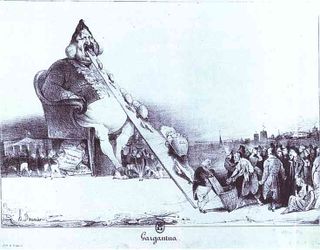
Perhaps the most apt comparisons with Wallace are Honoré Daumier and John Berryman. As a painter Daumier is considered very good but decidedly AAA. He’s remembered primarily as the greatest caricaturist who ever lived. I can snicker at his arrogant socialites and politicos without knowing a word of French—without knowing anything more about these bygone froggy contretemps than I do about the Teapot Dome Scandal. Daumier had a brilliant instinct for satire and could encapsulate all the foibles of French politics and high society in a few strokes of ink. In the same way Wallace was at his sharpest analyzing the contradictions and foibles of American culture, that loose, baggy monster that took over the world. Having seen it happen while he was growing up, he dissected exactly what television had done to literature (“E Unibus Plurum”), and even one favorite part of Infinite Jest was the inset essay explaining the reasons why live, vis-à-vis video telephony will never replace the toe-picking- and unmentionable-body-zone-scratching-anonymity of good ol’ audio-only telephones. Neither Daumier nor Wallace disavowed his gift of scrutiny, and in fact those skills informed and expanded their highbrow work. At the same time, for each, there was a disjunction between what he loved and what most people loved him for.
Then there’s Berryman. Though Berryman won Pulitzers and high praise for his poetry—he basically invented a new form of sonnet, an 18-liner, for use in his Dream Songs—he is read sparingly now. Again, this would have crushed him. There’s a pathetic story about Berryman hearing of the death of Robert Frost, in 1963. Instead of mourning or at least taking a moment to reflect, Berryman begged the bearer of the news, “Well, who’s number one now?” Who’s the number one poet? Berryman suggested “Cal,” i.e., Robert Lowell, but only in the hopes he would be contradicted and reassured that, No, he, John Berryman, was the number one greatest living poet now. Most people would indeed have ranked Lowell and Berryman nos. (1) and (1a) at the time, but the constellations always shift around us after we’re gone. For all the richness of a few of the Dream Songs—which are so right they make you want to sit right down and do the work of memorizing them, just so you can carry them around (try: “Life, friends, is boring. We must not say so.” or “There sat down, once, a thing on Henry’s heart so heavy...”)—but for all that, too, too many of them are overwrought, or obscure, or not sketched in enough, or written in a minstrel-speak that’s frankly sort of embarrassing to have to read nowadays. Berryman liked to talk about writing in terms of being “hot”: Hot was when he was his own muse, and all the literary and neurological pistons fired in synch. Berryman may have been hot less often than he hoped.
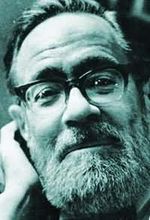
And yet what a man! By all accounts Berryman was an epic, once-in-a-century teacher and explainer of poetry. Was, as someone said of Wallace, a giant comet cruising at a low altitude through the space the rest of us inhabit. Anyone who ever had a class with Berryman recalls his performances with an awe bordering on worship, as if their years were to be cleaved into B.B. and A.B. Some semesters he’d taxi straight in from his room at the psyche ward just to teach a seminar, then collapse afterward in a sweat, taking two days to pull himself back into shape. Berryman taught at my alma mater in Minnesota until he leapt off a bridge on campus one January day in 1972, and some professors there still talk about just seeing him, once. Berryman’s mesmerizing even via YouTube. At first he looks just odd, a puppet reciting poems through his bivalve mouth and beard, and he rolls about in his chair like he’s either on some drug he shouldn’t be on or not on some drugs he needs to be on. But then, just listen. His cadence and rocking and diction and rhythm are magically weird, and they explain everything you need to know about why he’s not read much now: He was his poems, was his own instrument, and when he died there was only the libretto leftover.
Berryman drew people into his orbit despite—or actually probably because of—his inelegance. It gave you the sense you were watching some alternative, and possibly higher, form of human being, stripped of pretension. Wallace, a misfit in front of a crowd himself, had the same draw. (Little, Brown understandably elided this in the official book version, but Wallace’s first words in his now famous commencement speech at Kenyon College, This is Water, were actually, “If anybody feels like perspiring [cough], I’d advise you to go ahead, because I’m sure going to.”) Fiction is necessarily a second-hand enterprise: The author has to establish a narrative persona that, however similar to his/her own thoughts, is distinct. There’s a remove there, and even when it works, you really end up adhering more the narrator (or your interpretation of the author-as-narrator) than the author him/herself. But Wallace often wrote his nonfiction in a sort of omniscient first-person—“a giant floating eyeball” hovering over the scene, as he once said—and it was this illusion, of an unfiltered connection to a brilliant, idiosyncratic mind, that made his essays so endearing. Admittedly, the one thing Wallace was better at than practically anybody—capturing the distinct voices of people, including mean, ugly, hideous people you’d rather not have to talk to, and then embodying those voices in dialogue—doesn’t come through as well in nonfiction. But there are moments. Read the aside (in a footnote) about ‘Mondo and the “serious mind-f***” in that Atlantic cover story about talk radio, “Host.” Anyway, classify Wallace’s fiction according to any literary rubric you must—postmodernist, ironist, satirist, pseudo-sci-fi—he was, in real life, in non-fiction, a decent, shy, emotive, high-strung Midwestern guy with the cranial capacity of a Cray. What I wanted as a reader (and got; that’s why he was/is a brilliant writer) was a chance to shadow him for a spell, and see the world like he saw it.
Like serial killers, artists invite long-distance psychological profiling. But I’m not sure you can make a satisfying taxonomy of the temperaments and inner natures of all the artists here, those quirky ones who aspired to genius in one area and settled for immortality in another. They had different motivations for persisting in their chosen line, and you can’t even find a consistent consequence for their lives. Some, like Seuss, accepted their fate and lived happily; some, like Milne, grew more and more bitter (which crotchetiness added to his literary appeal among younguns); others, like Goethe, died secure and never had a twinkling of how much would crumble. But if we can tease out any common fiber it’s that their “high art” was too important to them. They felt they had to do something really grand, and their talents stiffened. With the lower art form, they relaxed. With Wallace specifically, nonfiction forced him to engage with the larger world (which he often didn’t do in short fiction, much of which reads like writing exercises, albeit outstanding ones) and yet also forced him to pare and focus (which he often didn’t do in, say Infinite Jest, which was actually cut down to the 10^3 pages you heft home from Barnes & Noble). In nonfiction Wallace couldn’t resort to narrative trickery or spiral off into inner labyrinths of plot, and (with all due and sincere respect, David) this work was better for that.
There’s nothing crueler the gods can do to an artist than misalign his talents and passion. Perhaps it’s not a coincidence that the final thing Berryman and Wallace shared was a sad, suicidal end. But whatever deity, entity, energy, or random genetic flux produces such anguish also produced David Foster Wallace, and like Goethe and Sullivan and Daumier, we’ll remember him: On nearly every page of Consider the Lobster or A Supposedly Fun Thing I’ll Never Do Again he wrote something startling and funny and true that made me stop and announce, even to myself, Just look at what he did there. Look at that.
Posted by Sam Kean at 01:23 PM | Permalink


Comments
really insightful..thank you. i share the same dfw guilt...and a few others.
Posted by: terese amig | Sep 7, 2009 9:24:02 AM
Abolutely brilliant, Sam. Bravo. And coincidentally, a copy of A Supposedly Fun Thing I’ll Never Do Again arrived in my mailbox an hour ago from Amazon.uk ...
Posted by: Abbas Raza | Sep 7, 2009 10:17:31 AM
Great post, Sam! Thanks!
Posted by: Elatia Harris | Sep 7, 2009 10:25:09 AM
I think you've badly misjudged his fiction. IJ is and will be remembered as one of the most important novels of the late 20th century. Broom of the System is a wonderful book and his short stories and frequently brilliant. To claim DFW's talents and passions were misaligned is to pretend that he didn't establish a reputation as the foremost literary author of his generation, win a MacArthur for it, or exert an enormous influence over a huge swath of the more ambitious young fiction writers working today. I don't think it's worth fighting over what part of his work will be more read in the long run, but it is indisputable that DFW became a public figure on the strength of his fiction. Regardless of what happens, that fiction ought to remain a key part of his legacy.
Posted by: Ben | Sep 7, 2009 11:25:34 AM
"...scuttlebutt out there that he killed himself in despair over his unshapely mess of a last book and the pressure of never living up to, well, himself."
I find this notion unfortunate.
DFW had a history of severe depression that, in the end, did not respond to treatment, including electro-convulsive shock. It will suprise no one who has treated or had severe depression that failure is not necessarily causal to a suicidal outcome.
That being said,your essay resonated with my experience and felt betrayal, and led me to read IJ. I spent every night for 6 weeks laughing out loud. If you pick up IJ and don't have that experience then you will not likely finish the book. I found Gates and his wraith to be memorable. Others will have different favorites, but I don't think the book will fade.
For the analytically inclined reader don't forget his wonderful nonfiction book on infinity "Everything and More: a compact history of infinity", which, by the way, is filled with footnotes. In his demonstration of Cantor's Diagonal Proof on page 254-255 his prose brims with excitement. "The proof is both ingenious and beautiful-a total confirmation of art's compresence in pure math."
Posted by: tom | Sep 7, 2009 12:06:35 PM
IJ is and will be remembered as one of the most important novels of the late 20th century
Well I hope not, but...maybe it would have been better if he'd finished it?
Can't wait to read his compact history of infinity though. Thanks for the tip tom.
Posted by: Carlos | Sep 7, 2009 3:14:49 PM
IJ _is_ one of the most important books of the 20th century.
Posted by: builder | Sep 7, 2009 4:56:12 PM
Great post. I read A Supposedly Funny Thing and had the same thoughts. It's easy to see this tortured man writing this book, and it's fascinating in a way his fiction can't achieve. It really fucking sucks he killed himself, and I really really hope it had nothing to do with disappointment over his last novel, because that would be extremely disheartening.
Posted by: No More Mucus | Sep 9, 2009 3:11:11 AM
If you managed to finish _Infinite Jest_ it seems you managed to do so with your eyes closed. It's the only way to make sense of your third paragraph, where you explain "I felt less guilty after finishing, but yet finishing only reinforced what I’d suspected. When the Library of America editors get around to selecting a picture of the long-haired, bandana-ed, tobacco-cheeked Wallace for its 2050 catalogues, they’re not going to spotlight his fiction in this first volume."
Also, if you had read his collection _Oblivion_ you might not have been surprised by his death. I had and so wasn't.
Posted by: mistersquid | Sep 15, 2009 12:43:36 PM
I would just like to note that Sir Arthur Sullivan did not compose "The Battle Hymn of the Republic". He did, however, write "Onward, Christian Soldiers".
Posted by: Frank George | Sep 15, 2009 11:55:45 PM
Intriguing post and well-written but I think the comparisons are specious. There is no way Dfw will be remembered for his journalism, as great as it's been. I say this because what magazine journalism has really really been remembered? Some--but not a lot. Frank Sinatra Has a Cold, by Talese, there's one. As much as I liked Consider The Lobster or Federer as Religious Experience, it is foolish to think that these works, as fine as they are, will be, fifty years from now, the thing that Dfw is remembered for. His reputation, without doubt, will be built on Infinite Jest.
Posted by: David Ebner | Sep 16, 2009 5:52:28 PM
I agree. It's incredibly comforting to read someone express thoughts so similar, especially when I felt so alone in feeling such intense sadness about his death.
Well, I agree with everything except that I don't think his non-fiction is lowbrow. And his non-fiction may or may not be what DFW would want to be remembered by, but using his own work as an indicator, it seems to show that he would be okay if people remembered mostly his essays. A lot of his non-fiction is in purpose, subject and occasion non-literary. When I think of other artists that struggled with the non-fiction/fiction issue, such as Milton with his political tracts, T.S. Eliot and his criticism, Orwell and politics and journalism, or the philosophical examinations of Coleridge and Shelley, these were still authors concerned primarily with literary work, even in their non-fiction creations, whether or not one category was superior to the other. Many of DFW's non-fiction texts, however, function independently of the poetic and fictional world. And they are complex and beautiful not because they reflect on the art of literature, but because they are themselves works of art.
Posted by: L Cohen | Sep 16, 2009 7:09:32 PM
The ideas expressed here remind me of Neal Stephenson's fascinating, lengthy but easy-to-read pieces for Wired a few years back (for instance, when he traveled the world learning about underseas cables and wrote it up in a 45-page article), compared to his turgid recent books.
The comments here remind me of Stephenson's apologists on Amazon and elsewhere who insist that his recent books are not turgid.
I'm not a druggie though, so in the case of DFW it may just be a cultural disconnect with me.
Posted by: MIke | Sep 17, 2009 6:42:16 AM
Lewis was no theologian. He was a Romance literature specialist. His theology is basic, simplistic and I think probably heretical in the terms of his own church.
Posted by: John Wilkins | Sep 27, 2009 1:30:24 PM
Reading this article now has put me into a funk, and I think I'm going to have to go pull out one of DFW's books just to pull out of the funk (yes, verbiage intended). Reading DFW was just ... he was, and that's the sucky part of writing this here.
Posted by: Gale Lang | Oct 8, 2009 9:13:50 AM
Post a comment