
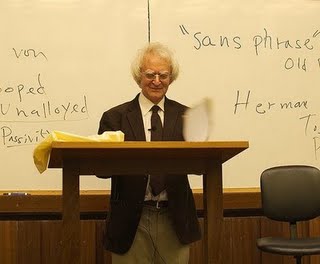
by Gerald Dworkin
Last week I learned, while lecturing in Spain, of the sudden death of my closest friend, and best philosophical interlocutor, Jerry Cohen. A graduate student once asked me for what audience I wrote my philosophical papers. Was it for all philosophers, for just moral and political philosophers, for the general public? I replied that I wrote for three people. Jerry was one of them. He was one of the most distinguished political philosophers of my generation. He was also an extraordinary person whose kindness, wit and integrity will be remembered as much by those who knew him as his intellectual brilliance.
I first met Jerry in 1962 on the way back from Moscow where I had participated in a sit-down in Red Square to protest the Soviet resumption of atmospheric nuclear testing. It was a brief acquaintance but it was clear that we would be friends. We were close in age, both political philosophers of an analytic bent, and we were both “red-diaper” children, i.e. raised by Communist mothers to believe that historical progress was inevitable and that its engine was the working-class. As important a factor was that we shared a sense of humor; knowing a funny joke, or making a clever pun, was as natural and important for us as making a good argument or knowing the details of a text. Last, and least, we were both Gerald’s who were always, and only, called Jerry’s.
The next time we met was in 1964 when I was living in London writing my PhD thesis. Jerry was then an assistant lecturer at University College London where he stayed for 22 years. I would travel down to UCL from my flat in Golders Green to spend many hours discussing, arguing, yelling, philosophy with Jerry. At that time he was beginning to think about the issues that would eventuate in his great book Karl Marx’s Theory of History: A Defense. I had recently published a critique of the philosophical methodology –dialectics—of Marxism in a journal Studies on the Left. Jerry had no quarrel with that criticism but he thought there was much of value to be found in the idea of historical materialism and it was obvious that if one was going to separate the wheat from the chaff he was the person to do so. And he would apply the most rigorous intellectual standards to the task. He , and his fellow scholars such as John Roemer and Phillipe van Paris, would refer to themselves as “no-bullshit Marxists.” wearing a pin with a picture of a bull crossed out to manifest their view.
But in addition to philosophy our topics would range over Broadway Musicals ( of which Jerry had an encyclopedic knowledge of music and lyrics), the relative merits of Montreal and New York smoked meats ( if this were a law suit it would be Schwartz vs. Katz), why the schmoo ( a cartoon character drawn by Al Capp) was oppressed by the capitalists, the aesthetic merits of Nazi uniforms ( whose obvious superiority over those of the Allies I argued for) , and the attractions of trans-sexual pornography (which Jerry championed).
This last illustrates one of the features of his personality which was most unusual—particularly in an academic. Nothing was too inappropriate, private, bizarre, or embarrassing to be suddenly brought into the conversation. At any moment Jerry might burst into song, pinch my cheek, complain about the state of his itchy ass or launch into one of his amazing parodies of Oxford philosophers. His riff on Isaiah Berlin lecturing at 200 words a minute on the influence of the neglected von Pooped on the forgotten von Supine was side-splitting. His parody of the Oxford Don who is always saying to the visiting American professor that “we must have lunch” and then always finding some excuse for not doing so was both accurate and hilarious. His narration of the boxing match between two eminent philosophers, Quine and Strawson, one American , the other British, arguing about the nature of analytic truths, was done in the exact voice of Johnny Addie whose distinctive New York accented tenor announced boxing matches in Madison Square Garden. His recounting of an actual conversation with Gilbert Ryle, mimicking exactly Ryle’s tone of voice and style, that Ryle once put forward the thesis to Jerry that “ unlike “pain” , “pleasure” does not have a bodily location.” When Jerry presented as a counterexample the cases of sexual pleasure, Ryle retorted: “Well, yes, there is that case. But I was thinking of something more interesting.” (For a wonderful sampling of Jerry’s wit and humanity you can listen to a talk he gave after the conference given in honor of his retirement this January.)
We had contests to see who could come up with the best question after a philosophical paper. Jerry’s best– “I would like to make a distinction here. Unfortunately, I cannot think of one.” We would make up titles for philosophical articles. Mine: an article criticizing John Stuart Mill and his father “The Dark Satanic Mills.” Jerry’s: an article by Norman Malcolm (a rather phlegmatic man who wrote on the logic of dreaming) “Am I , all appearances notwithstanding, not Dreaming?”
The next time we met was in 1971 when I was again in London on a sabbatical. Jerry was working on his reconstruction of Marx’s theory of history. In the interim I had spent time discussing philosophy with Bob Nozick who was working on his brilliant defense of libertarian political philosophy—Anarchy, State and Utopia. In my conversations with Jerry I would kid, taunt, challenge him to “stop with the Marx, already” and turn his enormous talents to the substantive work which needed to be done to challenge Nozick’s views from a more egalitarian position. I presented Jerry with Nozick’s famous Wilt Chamberlin example: If each of his fans chose to contribute money freely to Wilt in order to watch him play, and as a result his income was far above that of his teammates, what could be wrong about the resulting inequality of income? It was, in Nozick’s phrase, simply capitalism among consenting adults. Jerry’s eventual reply was , very roughly, what they consented to were individual transaction not the consequences of the eventual inequality.
In the introduction to his book Self-Ownership, Freedom and Equality, Jerry writes: “I had never heard an argument against socialism for which I did not (so I thought) already have an answer in my pocket. Then one day in 1972, in my room at University College, Jerry Dworkin nudged me. He began a process that, in time, roused me from my dogmatic socialist slumber.”
I am very pleased to have played the role of philosophical nudger in starting what I believe will be his most lasting contribution to political philosophy—the normative defense of some form of egalitarianism.
Our next extended meeting was in 1988 when Jerry encouraged me to apply to be a visiting Fellow of All Souls College, Oxford. By then Jerry was the Chichele Professor of Social and Political Theory which is attached to All Souls. I, of course, always addressed my letters to him as the Chiclet Professor. It is difficult to convey the stuffiness and ritualization of daily life at All Souls in 1988. One example will suffice. Fellows were entitled to their meals in College but were only allowed to bring their spouses twice a term on what was officially designated “Ladies Night” In fact the title was appropriate as it wasn’t until some years later that Susan Hurley, a philosopher, became the first woman elected to All Souls.
Of course ties had to be worn to dinner—although since I did not own one Derek Parfit suggested I might seek a loophole under the “native dress” exception intended for those who wore African tribal robes. On my first day I was taken to lunch by the Warden who remarked to me afterwards, having observed that I took both a piece of fruit and some cheese from the tray offered by the waiter, that “ dessert is meant to be taken in the alternative.” To my surprise I found that Jerry , although repulsed by some of the more egregious features such as “Ladies Night”, was quite fond of many of the rituals and customs of All Souls. He quite liked the idea of the historical continuity of its character which could only be maintained by honoring its customs and rituals. In fact, one of the last papers he wrote is a defense of a kind of conservatism—keeping valued things as they are and accepting the given– and he begins it with the following: “Professor Cohen, how many Fellows of All Souls does it take to change a light bulb?” “Change?!?
We continued to meet for brief periods—in New York, in Davis, in Chicago (where he took my wife and me on a wonderful architectural tour of our own city). But when we were not in personal contact we maintained extensive e-mail contact. At the beginning because of his technological conservatism all correspondence had to go through his lovely wife, Michelle. Perhaps some excerpts from this correspondence will illuminate some aspects of Jerry and of our relationship.
We were always both very critical of each other’s work and, as a result, the most supportive. Supportive because our praise was hard won. In response to his paper on conservatism I wrote Jerry that it was really fine work. He responded:
“That means an enormous amount to me because I know how discriminating and skeptical you are. I am very grateful.”
And, of course, I found his brief comment on some blogs on lying that I sent him—“very sharp”—to be all that I needed. His criticism of a paper of mine “Morally Speaking” contained in an, as yet, unpublished paper “Notes on Ways of Silencing Critics” was entirely convincing .My only comeback was to point out that the line in Born Yesterday he quoted was not spoken by Broderick Crawford’s character but by his lawyer!
Shortly after May Day this year I sent Jerry the URL of Peter Miller’s brilliant documentary on the history of the Internationale—the global anthem of the international socialist movement. I mentioned to him that although my political commitments had changed I could not but tear up on hearing those words and music from my youth. He replied:
“It’s wonderful. I am so grateful to you. I listened crying because it didn’t work out. Would it have been such a terrible thing, raboinu shel oylim, to let it happen?”
By “let it happen” he meant the socialist revolution he envisaged and hoped for. I wrote back that I didn’t understand the Yiddish phrase. Here is his reply.
“Raboinu shel oylim” is actually Hebrew, though often used in Yiddish as a kind of interjection, like “Jesus Christ!” It means “Lord of us all!” and in the case below it is in the vocative, that is, the Old Mamzer (I take it you know that one? If not: bastard) is being addressed.”
Love,
Gerhardt
This very brief e-mail contains so much of Jerry. First, he corrects me about my mistaking Yiddish for Hebrew. Second he gives a concise explanation of the phrase including a somewhat pedantic—as Jerry sometimes was—use of “vocative.” Then he nicely admits I might know some Yiddish, but if not gives me the information I need. Finally, and typically, he expresses his love but also signs off with an eccentric form of his name.
Jerry had a profound knowledge of poetry and could recite at great length from memory. I do not recall ever reciting to him one of the (very few) poems I know by heart. It was written by Ralph Chaplin, an activist in the International Workers of the World, who was jailed four years for hindering the draft in 1917. I learned it from my mother. It seems to me appropriate for expressing a view Jerry held to his death.
Mourn not the dead that in the cool earth lie
Dust unto dust
The calm earth mothers all who die
As all men must
Mourn not your captive comrades who must dwell
Too strong to strive
Within each steel-bound coffin of a cell,
Buried alive;
But rather mourn the apathetic throng
The cowed and the meek
Who see earth’s great languish and its wrong
And dare not speak.