
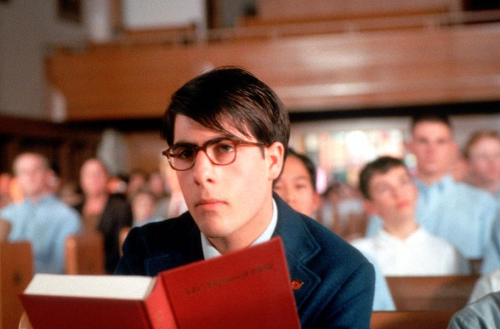
Because thousands of a certain generation's cinematic lives have been changed by this film, its territory is best approached with caution. Mine, however, happens to be among those thousands, 1998 marking as it did the opening of my prime window of cultural absporpton. Cinephilic teenagers of the 1960s had The 400 Blows, Breathless, Dr. Strangelove; cinephilic teenagers of the 1970s had Harold and Maude, Chinatown, Taxi Driver; cinephilic teenagers of the 1980s had Repo Man, Blue Velvet, Stranger than Paradise; cinephilic teenagers of the 1990s had Rushmore.
The impact of Wes Anderson's second film didn't propel me immediately from the screening room to a new, theretofore unseen world illuminated by pure light cast forth by the angels of cinema. Its effects were those of a gradually-dissolving ingested substance, working only in the fullness of time. I knew I'd seen something epiphanic, but damned if I could put my finger on what or why. While it has sparked and continues to spark in young viewers as much of a fanatic enthusiasm for film, both its appreciation and its craft, as the most radical, stylistically transgressive piece of deliberate provocation, it does so within a shell of relative normality. But though translucently thin, this shell appears to have confused almost as many filmgoers as it's blindsided with slow-acting inspiration.
“You can't tell if it's a comedy, or if it's a drama, or what it is!” complained some with whom I excitedly sought to discuss the movie. While my adolescent mind couldn't counter this grievance, I now realize that coming up with a genre to fit Rushmore into is an exercise not only doomed to futility but ignorant of the very seat of the film's strength: you can't tell if it's a comedy or a drama or what because it isn't. It is, strictly speaking, a film without genre, which is to say, a film without any of the bundles of clichés that constitute the genres' membership qualifications. This must have rendered marketing a futile ordeal, which would account for the movie's unimpressive domestic box office performance. (But since genre is a labor-saving marketer's device in the first place, perhaps this is a simple case of reaping what's been sown.)
Even celebrated critic Pauline Kael, quoted by Anderson himself in his account of privately screening the film for her, expressed bewilderment:
''I don't know what you've got here, Wes.''
I nodded.
''Did the people who gave you the money read the script?''
I frowned. ''Yeah. That's kind of their policy.''
Then again, she was the one who continually dismissed Terrence Malick, so, grain of salt. From Kael's exalted position to that of the lowliest Netflix user-reviewer (“What is this movie? Funny? Quirky? Coming of age? How about none of the above,” writes one, lodging also her doubt “if the people that make these things have their head skrewed [sic] on”), what seems to set off uneasy viewers isn't just the picture's casual disregard for the artificial boundaries of genre, style and mood but its proprietary — to use Anderson's own words — “heightened reality” that, perhaps for some, falls into the uncanny valley between mundane realism and wild fantasy.
Rushmore's world superficially resembles, but is not, our own. Its story takes place over half a year in a region with verdant, unnaturally season-reponsive campuses and crumbling concrete public structures; cheerfully seedy laundromats and barbershops with wall-mounted payphones; vertiginous, wind-wrapped skyscrapers and sprawling industrial complexes; run-down, chintzily brimming cottages and silent, isolated mini-mansions. Its people don everything from tweed on tweed to blue blazers to vintage athletic wear to hunting hats to red berets to brown ski parkas to school uniforms to baggy jeans to pinstripes to green velvet. They drive Beetles and Bentleys and bicycles of highly specific makes and nationalities. They watch monochromatic television sets and use 16-millimeter projectors. Their cultural references include Jacques Cousteau, Serpico and Budweiser. The fulcrum of its music rests somewhere around the year 1970. Though not, strictly speaking, timeless or placeless, it spans wide temporal and geographical ranges without lacking its own distinct qualities.
At this small world's center stands Max Fischer, a man not without qualities himself. But is he a man, really? He's scripted as a 15-year-old high school student and shot in such a way as to appear significantly shorter than the adults with whom he associates. And yet, in a larger sense, he is a man, the man of the film, more poised, articulate and confident than any of his elders. One might well ask of the protagonist what they ask of his story: which categorizations could possibly apply? His just-so attire, chunky brown spectacle frames and occasionally wonky haircut suggest a nerd, but he expresses no stereotypical nerd qualities. He's not an underachiever: a yearbook montage lists his privileged positions in myriad student organizations including “French Club”, “Piper Cub Society”, “Yankee Racers” and “The Max Fischer Players”. Nor is he not an underachiever: a transcript reveals grades that hover, in every class from geometry to botany, around the 50-percent mark, and rapidly falls into “sudden death probation,” under which one more failure means expulsion.
But so what? Find a new school, new friends and the expelled student is, with a clean slate, right back when he began. Not so, alas, for Max Fischer. Rushmore Academy, the prep school he's attended for a dozen years on a scholarship granted on the merit of a play written in early childhood — “a little one-act about Watergate,” Max reminds the exasperated headmaster — has become his raison d'être, the very core of his identity, the institutional escape pod from his otherwise drab lower-middle-class existence. When a local millionaire, observing that Max seems to have life pretty well figured out, asks him what his secret is, Max replies: “I guess you've just got to find something you love and then do it for the rest of your life. For me, it's going to Rushmore.”
That millionaire is Herman Blume, the self-made founder of a successful steel firm who will become both Max's best friend and greatest living enemy. The willingness to explore a friendship — or rivalry — between a middle-aged, Vietnam-hardened tycoon and a hard-dreaming kid outsider is representative of Rushmore's unusual brand of craftsmanship, a controlled freewheelingness that treats cinema's almost unseen yet stubbornly routine-hardened barriers as immaterial without descending into tiresome creative indiscipline. Blume seems to see something of himself in Max, be it tenacity, sneakiness or raw ambition; he at once admires it and is vaguely repulsed by it. And at the same time, Max seems to pull the whole act off with more panache than does blume; hyperambitious child, to echo a tired point, is the father to drained man.
Their qualities united are formidable; when divided, things get quite ugly, quite quickly. The wedge comes in the form of Rosemary Cross, Rushmore's young, widowed, long-skirted, English-accented first-grade teacher. Not long after she meets Max does the pursuit of her rise to his foremost extracurricular activity. Noting her slight wistfulness at the school's cancellation of Latin, he fights tooth and nail to have the courses reinstated — despite the fact that he campaigned to end them in the first place. Stepping it up, he observes Miss Cross' love of marine life and sets wheels in motion on the construction of a multimillion-dollar on-campus aquarium, financed by Blume. Given the ludicrously inflated scale of Max's stage productions — an ultrastylized drama of gats and lowriders, a roilingly pyrotechnic Vietnam piece, a faithful adaptation of the aforementioned Sidney Lumet film — it comes as no surpise that he would build an aquarium just to win over a woman. But indeed, what drive has ever built more aquaria?
Bemused by her teenage would-be suitor's grand gestures, Miss Cross distances herself, all the while attracting, and eventually reciprocating, Blume's interest. After learning of their assignations through his diminutive former chapel partner, Max shunts all that club-founding, play-producing energy toward but one goal: revenge. Miss Cross and Rushmore itself are the movie's two obscure objects of desire, neither of which Max ultimately finds knowable or attainable, not that it stops him from trying. Repeatedly rebuffed by the teacher for whom he's hot and stripped of Rushmore Yankee status after breaking ground on the aquarium without permission, Max finds himself at paralyzingly loose ends when his strikes at Blume — his brake line-cutting, his bee attacks, his informing Blume's wife of the affair — fail to drive Miss Cross into his own arms. Despite possessing the drive and ability to accomplish much of what he sets his sights on, he's been robbed of his desiderata. The question becomes, as it so often does with the driven and able: what now? “She's my Rushmore, Max” explains an importunate Blume. “I know,” replies Max. “She was mine too.”
Eleven years on from Rushmore's release, Anderson's detractors have unfairly (but not wholly groundlessly) labeled him a shallow, finicky production design fetishist fatally attached to a dwindling stable of pet themes; a 2007 Onion headline sardonically heralds that a new Wes Anderson film features “Deadpan Delivery, Meticulous Art Direction, Characters With Father Issues”. He has defended himself, and articulately so, as merely a craftsman who understands and accepts what he wants to make and thus looks to improve with each iteration rather than to diversify for the sake of diversification, much as a cabinetmaker seeks to produce a superior cabinet on each job instead of, say, a shoe rack just for the hell of it. (In this, he's very much the artistic cousin of the criminally under-recognized Sang-soo Hong.) Should he deny the accusations of deadpan delivery, meticulous art direction and characters with father issues? He shouldn't, and in any case probably couldn't. Admirably, he owns them.
But that said, it must be admitted that he hasn't, at least in my judgment, topped himself since. While Anderson's three more recent pictures have built upon what's to be found in his first two, the other entries in his oeuvre lack Rushmore's equipoise. The charming Bottle Rocket was thematically both engaging and slightly inchoate — “thrown together,” in Kael's mildly harsh words — and the lush The Royal Tenenbaums, The Life Aquatic and The Darjeeling Limited, while all products of an ever-growing filmic skill set, suffer under a low-ish signal-to-noise ratio. With sharper focus than its predecessor and clean economy relative to its successors, the movie manages to convey itself in just the right number of brushstrokes, never overreaching, plodding or condescending. Though its main character is given to sometimes damaging grandness, calculation and overreach, the picture itself is decidedly not.
And oh, what a main character. Volumes could be written on Max Fischer alone. Try as one might to identify direct ancestors or descendants, only superficial similarities present themselves; the reality is that there is no other character like him, not in any meaningful sense. Plenty of stories have been written about social outcasts, about the willfully institutionalized, about rule-free rebels, about awkward nerds, about junior achievers, about academic slackers, about lovelorn youngsters, about Gatsbyesque pretenders. Here we have a story about someone who is all these things and more besides. But perhaps most importantly, Max is all these things in the service of his visions, of the dreams he wants to — nay, must — realize, and they happen to be his very own, not a shrinkwrapped set pulled down from the stock ambition shelf. As Anderson himself put it in a 1999 Salon interview:
I like characters that are trying to realize their projects. They have a strong idea of something they want to execute and they just won't let anybody shut 'em down. It might seem ridiculous or it might seem too big — I mean, building an aquarium, that's crazy; putting on a Vietnam play with explosions from the stage is crazy — but [Max] does that. Of course, it's a movie, so I can have whatever I want to have happen. But I do like that kind of thing of people with unrealistic ambitions and their ambitions are not just to be rich. They have ideas and projects that they want to do.
This clearly resonates with the filmmaker. It may resonate with you. It certainly resonates with me.
Rushmore has, after countless viewings over more than a decade, revealed its imperfections: it gets too plotty, especially around the Max-Blume rivalry; the ending's a bit neat; many sequences use thirty shots where one would have done. But time has not diminished its aesthetic and human richness, nor the refreshing boldness of its willingness to simply be itself, a work that exists on its own terms without dictating them to the audience. Walter Benjamin once wrote that all great works of literature dissolve a genre or found a new one. Though of a different medium, Rushmore is indeed a great work and thus does the former, the latter or quite possibly both. But, much more importantly, it was the first film ever to feel as if it were made for me. And I'm hardly alone in the sentiment.
Feedback happily accepted at colinjmarshall at gmail