
Elatia Harris
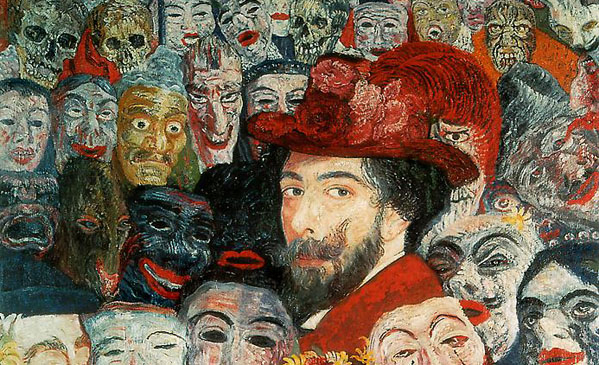
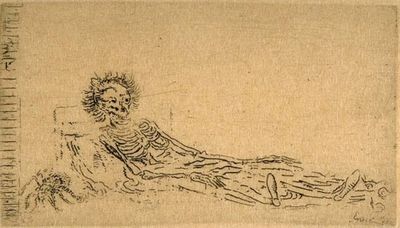
James Ensor, the Belgian painter, died in 1949, having done his last searing work half a century earlier. The man in the sea of masks, above, was wrapping it up in the studio even as he painted this self-portrait at age 40. In two decades of furious industry, he had cast himself as Christ, as John the Baptist, as an insect, a skeleton and a herring. Crucified, beheaded, rattling but undead, made a meal of by critics or simply subhuman, he spared a thought for how he might appear a century after his birth. My Portrait in 1960, below, is an etching on woven paper. It's no self-portrait — the actual sight of his remains would necessarily be recorded by some other guy. This is just a nudge.
Ensor kick-started Surrealism and Expressionism, driving Flemish painting forward from its roots in the Renaissance to its foundational place in Modernism. In him, Bosch, Bruegel and even Rubens found an heir who would poke holes through the possibilities of paint, and figure forth a vision powerful enough to impel artists a century later to engage with it en route to terra incognita of their own. And that's not all. While it is common to feel repelled by art considered in exquisite taste in the late 19th century, uncommon it is for an artist of that era to step neatly outside taste once and forever, offending a certain high idea of painting with lasting sureness of touch. As the song, Meet James Ensor, written by They Might Be Giants, urges us — “Appreciate the man.”
With the first major Ensor show in the United States in more than 30 years, the Museum of Modern Art in New York makes that very easy to do, through September 21. I have had a lifetime with James Ensor, one of my mother's art gods. Mother was a Southern lady, the kind that naturally thrills to the transgressive in art. And I am brought to my knees, again and again, by this painter so utterly uningratiating.
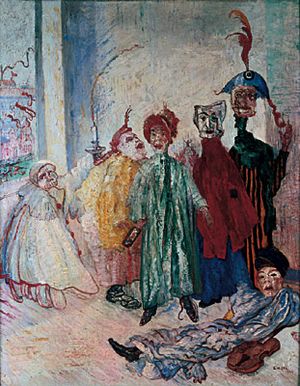
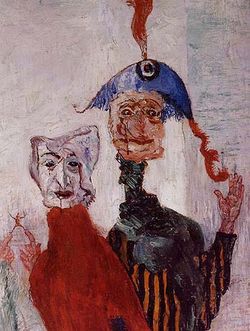
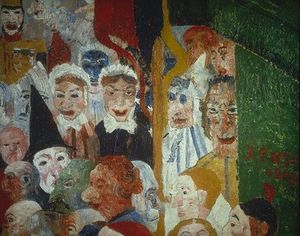
The Strange Masks, (detail, right), 1892
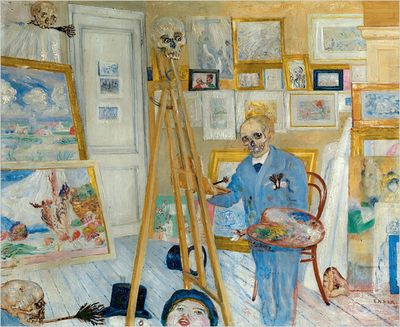
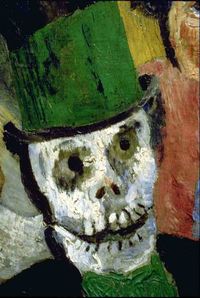
The Skeleton Painter, 1895-6, Koninklijk Museum voor Schone Kunsten, Antwerp
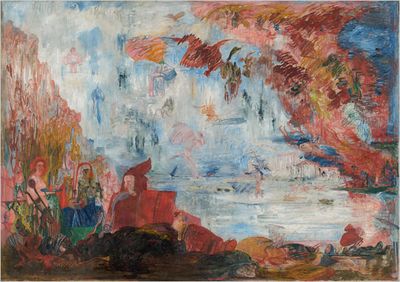
Tribulations of St. Anthony, 1887, Museum of Modern Art, New York
Are these paintings beautiful? Or even good? Those are questions that fence-sitters keep on asking — with reason. In The Strange Masks, poor Pierrot, Europe's wan clown, slumps to the left, rotting within his white tulle glad rags as the other maskers rot, their shoulders liquefying, their masks peeling away from the bone. A shaft of pearly white light makes it all much too visible. Daylit too is the artist as a dapper skeleton, grimacing at the easel in his bright attic, brushing away at a phantom canvas as Ensor himself would later do: 50 years of painting just about nothing.
In The Tribulations of St. Anthony, the red-hooded saint is beset by pests swirling like microbes. No accident — the mother of a friend of Ensor's youth, Ernest Rousseau, Jr., was a professor in Brussels, and it was she who gave him his first look at the microscopic world. While death, torment, rot and the skull beneath the skin were Ensor's great themes, he also painted critters that were a microscopic affair, adding to them fantastical flourishes and enlarging them to occupy the same pictorial space as human subjects. From time to time, he gave himself and others human heads and insect bodies, and he painted as few painters ever have crowds that do not mass or advance, but sub-humanly swarm.
Long after his brief stint in art school, Ensor learned etching, for a feeling of permanence. The hardness of copper plates reassured him, he said, compared to the fugitive nature of paint. The etching below, Death Chasing a Flock of Mortals — it pops up, please click! — shows what kind of graphic artist he had the dedication to become, his eye trained on Rembrandt and Goya. Even people who find him not only a distasteful but a clumsy painter are filled with respect — and terror — by his graphic oeuvre.
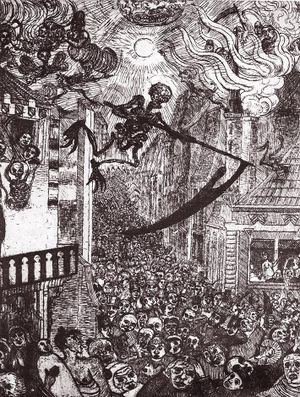
Death Chasing a Flock of Mortals, 1896, Etching and drypoint, Museum of Fine Arts, Ghent
In his letters and in his imagery, as his second decade of adulthood wore on, one senses Ensor knew on some level that painting was slipping away from him. The fury in his canvases is not all a matter of his chosen subjects, or of their being presented to confront us in a way no one could find agreeable, but of how the paint is laid on — it is smeared, it is scraped, it is thick like slabs or streaked. As if the painter could only fitfully decide whether to hurl the stuff or snatch it back. His 8 by 14-foot masterpiece, The Entry of Christ into Brussels, was painted when he was 28. He was never to be parted from it. For one thing, no one else would have it. (Click to pop it up.)
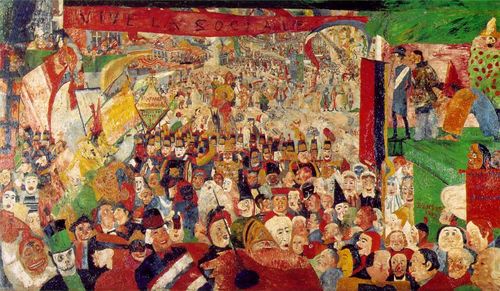
The Entry of Christ into Brussels, 1888, J. Paul Getty Museum, Santa Monica
Christ is the tiny figure in the middle distance, mounted on a donkey, set off by an ochreous halo. Fabulously insulting to the burgers of Brussels — and by extension to every Belgian — was the implication they were the gaudy, malicious and deathly rabble surrounding Him. (Details below, click to pop up.)
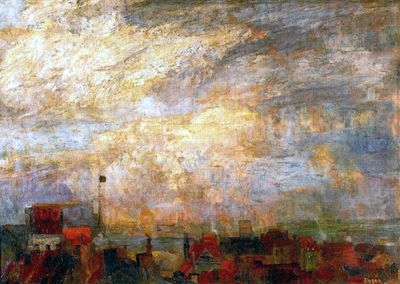
Deep in his youth, Ensor had painted Post-Impressionistically: diners tucking into shellfish; light passing through glass; lunch tables enlivened by cut flowers; and, big skies luminous over red roofs.
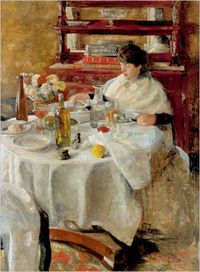
L., The Oyster Eater, 1882, Koninklijk Museum voor Schone Kunsten, Antwerp
R., Rooftops of Ostend, 1884
These paintings are conventional enough, are they not? Well, they were not, according to the art establishment of the day, when Impressionism and its spawn were still a risky business. Painting like this, Ensor got himself nowhere in terms of acceptance or a career, and it is interesting to see if these early works herald the changes to come. Pop up The Oyster Eater — oh, yes — look at the shadows cast by the dresser against the wall. They are writhing. Look to the far right strip of the painting, and you will see the great disquiet they hated at the Brussels Salon. My mother always told me — look at the edges of a painting to tell where the artist is headed next. But for North Sea light on gleaming white linen, as proper a subject for art as the 19th century ever saw, this is no bad painting.
Simon Schama, writing about the present show at the MoMA for the Financial Times, calls Rooftops of Ostend “breath-taking.” And it's true — there's nothing to forgive here before finding it beautiful. Yet the freedom and vigor, the arbitrary use of color, the palette knife that suggests but does not describe — all that delights our eye, and that of Simon Schama — seemed antic to art lovers of the 1880s. Just that crucial bit off-key.
Inside a few short years, Ensor would cease to underwhelm and start in earnest to offend his countrymen. What is the route, then, from the matron soon to eat the oyster in her grasp, from the anodyne eventful sky, to the confrontational and hideously truthful paintings of the next two decades? Paintings that will never fully gain acceptance as long as we can find them rather jokey. Paintings that still repel. If you don't like Ensor — or, as with many, you don't completely like him because you are not looking at art to be made so uncomfortable — then you can always take refuge in classifying him as an extremely unfunny joker in the idiom of the poorest possible taste. With images such as Doctrinal Nourishment, a rare hand colored print of 1889/95, Ensor himself will invite you to be disgusted with him.
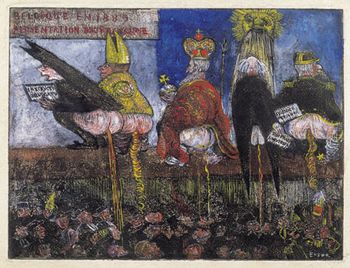
Doctrinal Nourishment, 1889/95, hand-colored etching, Los Angeles County Museum of Art
Yes, it's what you think. The king of Belgium, the personifications of the Church and the Military all sit in a row and defecate into the open mouths of Belgians. Today, this may not look worse than an editorial cartoon — but it was once considered subversive. Bodily fluids — excrescence and the process of deliquescence especially — were Ensor territory. He was as unafraid as a Plague-rattled fresco painter of the 14th century to address the filthy and the malodorous. This distinctly uncharming print fits into a long tradition of art that curiously dried up in the pre-Modern times Ensor inhabited, a tradition that looked unflinchingly at vile bodies, at all their terrible news.

The scene above, a detail from the vast fresco of the 1330s, The Triumph of Death, is in the Camposanto of Pisa. Painted by either Francesco Traini or Buonamico Buffalmacco, it shows a gaily dressed party on horseback holding their noses. They and their staring, balking horses are literally stopped in in their tracks by an awful sight and stench, three rotting bodies in open coffins. I've been to see the fresco, and there are, perhaps fortunately, no good photos — a viewer is likely to be overcome. That was the point. Throughout the 14th century, Europe was ravaged by Plague, and no one was safe. Paintings on this theme — “As you are, I once was; as I am, you shall be” — were commissioned to remind everyone in finery or in rags to keep their mind on Last Things. To be ready at any moment to leave their corrupt flesh behind to explode, deliquesce and frighten the horses, because their true business was elsewhere. One contender for the title of creator of this fresco cycle, Buonamico Buffalmacco, was known as a practical joker. If this is not his work, but that of Francesco Traini, then none of his work survives. Now that's a good joke.
More than two centuries later in 1562, when Bruegel painted his own Triumph of Death, the danse macabre was in full sway, with skeletons riding in and reaching out to haul everyone, from paupers to cardinals, off to their mortal fates. While Bruegel is not without humor, he is quite without mercy: a dog chews at a dead child's face. The concept of the hellscape that would throw a proper scare into into the illiterate — most people, that is — had evolved through the Bosch years, the time leading up to the Reformation. Bruegel painted skeletons whereas Bosch had instinctively preferred fiends.
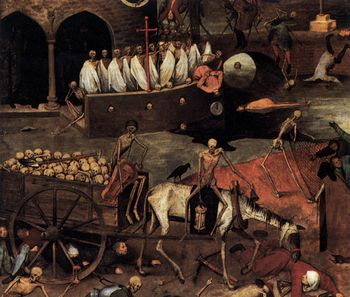
For a later comer wanting to conjure with these themes, it's quite a dilemma to contemplate: skeleton or fiend? Ensor's answer, as demonstrated in Masks Confronting Death, from 1888, was — both.
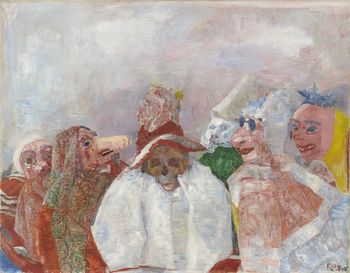
The dark sky of the typical Flemish hellscape is forsaken by Ensor for that milky, corrosive all-directional light known to habitues of northern beaches. It's not less hellish, just hell by the light of day. In Venice, it's called water light — the reflection of sky in vast water, doubling the light.
Ostend, the Belgian city on the North Sea where Ensor was born, and which he almost never left, was beachy indeed, but had a tragic past. The Siege of Ostend (1601-1604) left more dead than any battle of the Eighty Years' War, and was one of the longest sieges in history — a “long carnival of death,” it was called. At its ruinous end, there was for 12 years a negotiated peace that was also the peace of exhaustion between Spain, the technical victor, and the United Provinces.
By Ensor's time, Ostend was focused on the kind of carnival that ushers in Lent, and it was taken very seriously there, as it was and is elsewhere in Belgium. Below are the “Gilles” of the town of Binche, a medieval city with one of the oldest and most famous carnivals in Europe. The dark green spectacled Gilles Binchois is referenced by Ensor again and again. Now that carnivals have tourist rhythms, and meanings pried well away from their ritual beginnings, it might be useful to look briefly at why Carnival was ever noncommercially important.
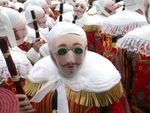
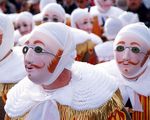
It was after all very important to Ensor. The masks that fill his paintings, that stare up from the very floors when not covering the faces of his subjects, are both fiendish and comical, and were entirely familiar to him. Not from a loud seasonal festival but from his childhood home, where his mother operated a souvenir shop out of the ground floor. There, she sold chinoiserie and tourist trinkets, and in the deep winter, masks for the coming Carnival. Many of these found their way upstairs, and stayed there 12 months a year, year after year. The only studio Ensor ever had was the attic room of his boyhood home, higher than most of the rooftops of Ostend, high enough for the water light, with its property of making everything it reached both garish and pale, to enter freely.
Carnival signals a reversal of ordinary times of the year. Starting as early as January, but usually not earlier than a week before Ash Wednesday, there is great pressure to eat up the stored foods of winter. These are rich and meaty foods that, suddenly, do not have to last. They wouldn't last, in any case, in the slowly warming weather, and Lent, the season of purification, is coming on. Through the early spring, butchers wander the countryside replenishing their stocks, so none of the old year's animals eaten for meat will escape the feeding frenzy. A possible etymology of the word is “Carne + vale” or “Farewell to meat.” After Carnival, there will be many weeks of porridge.
But Carnival revelers bid farewell to meat in another sense, too — to the meat-suits they habitually wear, to the stations in life they occupy, to the order under which they live, and, if they like, to their genders and identities. Here, the mask is key. For a masker may take certain liberties, and for a few precious and frantic overfed days, be someone else behind a false face, living “as if” in a meat-suit not his own. In the Middle Ages, Carnival involved the whole town — beggars were exalted, nobles played low-born, women barked out orders like men. As when death chases everybody down, making a joke of the inequalities we live by, Carnival is subversion and, finally, leveling. It was an intoxicating collective performance and dream, long before it devolved into spectacle.
In Rabelais and His World, Mikhail Bakhtin characterizes the carnivalesque as overturning the ready-made via energies that are normally suppressed, yet suddenly available and ferocious. The temporal arts, cinema especially, have embodied this concept more than the visual arts, and Ensor in his carnivalesque aspect has reached as deeply into cinema as into painting.
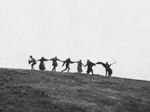
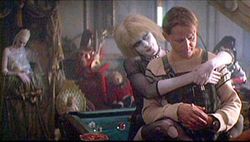

Much has been made of James Ensor's improbable life story. In his early 20s, he joined forces with a Symbolist-leaning group of avant-gardistes, Les Vingt, and had for a time the stimulation of peers. But for most of the next two decades, he was an isolate painting in an Ostend attic, living off his mother's earnings, reading Rabelais and Poe to his heart's content. He couldn't stick school, spent a bare three years there. Gaining entrance into the Academie des Beaux Arts in Brussels, he left early, calling it a school for the blind. A bachelor dressed always for a funeral in a black suit and purple cravat, Ensor was neither formed for academic painting nor theory-laden enough for the avant-garde. He was of course a Wagnerite. Throughout his long strange youth, he was a figure of fun in provincial Ostend. Children in the street had choice things to say about him as he passed.
It has been suggested this is the kind of life to make the person who lives it angry. I'll bet. But without knowing any of that, you can tell as much from the throbbing satirical impulse in his painting, from his long private engagement with the outrageous. It may be smarter, anyhow, to save our pity for eccentrics whose subsequent histories have not transpired, who were misfits without genius.
As he climbed towards 40, a mystery overtook Ensor. The establishment he had reviled in such paintings as Dangerous Cooks, wherein art critics serve up his severed head, began to embrace him, the far-seeing Emile Verhaeren first among them. His pictures began to sell. By 1896, the Musees Royaux in Brussels had purchased Lamp Boy, a very early oil. In 1898, fifty-five of his paintings were exhibited by the avant-garde Salon des cents in Paris, the show accompanied by a special issue of La Plume. Only seven years earlier, his paintings — the scatological ones involving the Belgian king especially — had been declared impossible to exhibit. “The prosecutor would swoop down on us,” the critic Maus remarked.
But this was not the only mystery, and it was nothing that might not be explained by observing that success in Paris warms the provincial heart to even its craziest sons. The greater mystery is the diminution of Ensor's inventiveness as an artist at precisely the time he began to achieve recognition. By the time he was made a Chevalier of the Order of Leopold, in 1903, his work had taken a classical turn, with some forays into the rococo. Always a music lover, but never musically literate, he composed by ear a ballet, The Scale of Love, and designed the costumes — more Watteau than Bosch. Beneath the masterpiece of his youth from which he would never be parted, The Entry of Christ into Brussels, he played his harmonium, improvising ceaselessly, voicing mild regret he had not pursued music instead of art.
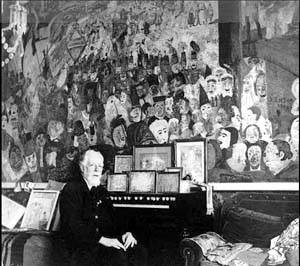
Among the newsy conditions he experienced as he became an eminence was that of financial success. His mother, who died in 1915, thereby inspiring one of his few original compositions of that era, had labored throughout the 1880s and 90s to support his father, himself, and his sister, Mitche, pregnant and abandoned by her husband. For almost twenty years before her death, Ensor had earned enough — and then some — to secure the small family. And, perhaps fatally to his painting, to secure a life of honored leisure for himself.
Did Ensor buy himself out of the struggle? Something subtler happened, I believe. All artists work for recognition, and some work better and longer without it. Ensor might have been one of those. In the catalog for the last major Ensor show in the United States — at the Guggenheim, in the late 70s — John David Farmer proposes that Ensor might simply have wearied of accepting the personal and psychological risks of painting as he did. That's a very good guess, but the unknowable truth is a story for Balzac.
Ensor was given the title of Baron by King Albert I in 1929. By then, he was very much Belgium's grand homme. When he made day trips from Ostend, it was almost never to go further afield than De Haan, a charming resort town on the North Sea only a short distance away. It was at De Haan, in 1933, in the garden of the Restaurant Coeur Volant, that the photograph below was taken.
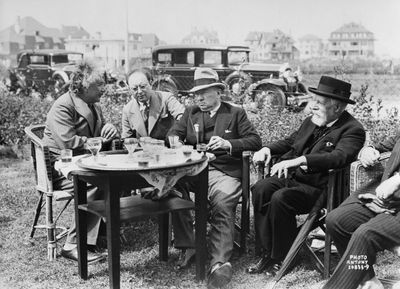
That's Einstein on the far left, Ensor, in the black hat, on the right. In August of that year, the German Jewish philosopher Theodore Lessing had been murdered by the Nazis in Czechoslovakia, where he had fled for his safety. Einstein and his wife, traveling in Southern California, got wind that their home in Germany had been ransacked. Belgium seemed a safe enough place to stop and think what to do. King Albert provided a little villa at De Haan, and the Belgians did everything possible to make Einstein welcome. That included arranging a luncheon with James Ensor. As befits a man likely wondering what new alliances might save his life, Einstein is engaged, leaning into the group. Ensor, whom the camera always set apart from any others present, leans back, almost ceremonially displaying the large bony hands that had for decades done nothing but knot cravats and noodle on the harmonium. If the two visionaries had a conversation amounting to more than pleasantries, it was not transcribed, but much Belgian speculation has gone into making it a substantive affair.
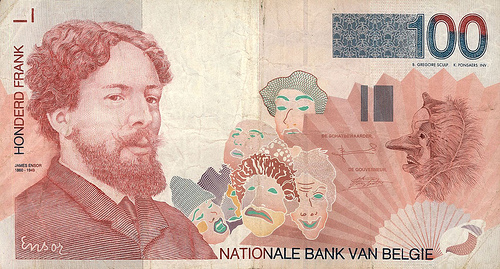
Most surreal of all, James Ensor, the painter of such repugnant subjects that “the prosecutor would swoop down,” has made an appearance on the Belgian 100 franc note. The English have a way of de-horning their artist mavericks by knighting them, but this is extreme rehabilitation.
Ensor was a letter writer, and it will soon be possible to read every word he ever wrote, translated into English. But, even in the privacy of correspondence he had only the most evasive remarks to make about his own work. The proof of his engagement with the great artists of the past is in his paintings, and he was notoriously close-mouthed about whether the artists of his own day mattered to him. He had parted company with Les Vingt when they wanted to exhibit Georges Seurat, and that's a very bad sign. Also, he had no students — influence, but no students. So his art thoughts were not passed on. All an artist can know of Ensor is what that artist determines to find out. But, to paint in the 20th century and simply bypass Ensor, it was necessary to have taken a completely rationalist path.
Too much is made, in my view, of the vaulting respectability of his last five decades, and the departure of the muse. When the wonder is what the muse enabled him to do while she was present. For good or ill, the story of the Modern in art is the story of greater and greater freedom from unthinking convention for form and color. If you like the way that's going, you will appreciate the route it took through an Ostend attic. But even if you don't — like the song says, appreciate the man.