
July 27, 2009
a coupla robot heads sitting around watching tv (or, i caught a bad meme this weekend)
When it comes to "memetics," which some say is the new science of studying "memes," consider me a skeptic. Doesn't a science need to have a clearly defined subject and verifiable findings? At this point the "meme" concept seems more or less to be where the "artificial intelligence" idea was twenty years ago: That is, it's not so much a hypothesis as it is an analogy - a somewhat vague and fluid analogy - one that lets people think in some new and smart ways but leaves them subject to flights of excessive rhetoric.
Which means it's useful ... but not exactly real.
The uninitiated among you may be wondering what, exactly, is meant by the word "meme." You're not alone. Meme advocates are still arguing about that. The word was first used by Richard Dawkins in his book The Selfish Gene, as a contract of "mimeme" (meaning imitated behavior.) Dawkins was suggesting that cultural behaviors, reproduced as one person mimics the actions of another, could be considered analogous to genes.
What are some examples of memes? Opinions vary. But the word has caught on in the blogging and Internet world, where its definition seems to be indistinguishable from "fads" or "catchphrases." Lolcats is described as a "meme" on the Web, for example, and so is "rickrolling." Expressions like "Jump the shark" and "FAIL" are memes in the online universe, too. A more rigorous and universally agreed-upon definition appears to be lacking.
In addition to his scientific work, Dawkins is one of the finest science writers we have. But it's not clear (at least to me) how seriously he expected the idea to be taken. It's being taken very seriously indeed, however. Consider this sentence: "In a given population of people, memes compete to be copied." It was written by Dr. Susan Blackmore, a noted researcher in altered mind states and well-known debunker of paranormal phenomena. The sentence reflects the mind-set of someone who is notably and eloquently skeptical about many phenomena, yet is somehow willing to impute agency - and something that sounds very much like volition - to cultural behaviors.
The Oxford English Dictionary's online definition of compete is "strive to gain or win something by defeating or establishing superiority over others." So, by this theory, LOLcats and rickrolling strove to prevail over other websites and Internet pranks that have been less successful. A less successful website - like Men Who Look Like Old Lesbians, for example - apparently lacked either the proper attributes ... or maybe the will ... to succeed as its fellow memes have succeeded. It is a loser in the cold Darwinian battle for our head space.
Look ... it's entirely possible I'm being unfair about all this. I've caught a nasty virus and I feel lousy. It feels like I'm typing this from inside a six-foot sphere made entirely of lint. Dr. Blackmore's done some very interesting work. Maybe there is something called a meme, and maybe it does have agency. But the virus that has attacked my body can be seen on an electron microscope. It can be defined. It reproduces and competes for definable and limited resources.
Let's look at this "meme" thing a little further. (And forget about Men Who Look Like Old Lesbians. I know why that didn't succeed - because, judging from a quick scan, pretty much any man over fifty qualifies. It's bound to annoy both older men and lesbians. You call that a meme?)
Dr. Blackmore's paper on "consciousness in meme machines" points us to the exceedingly cool work being done by researchers such as Luc Steels, who has used computer science and robotics to experiment with creating and reproducing language.
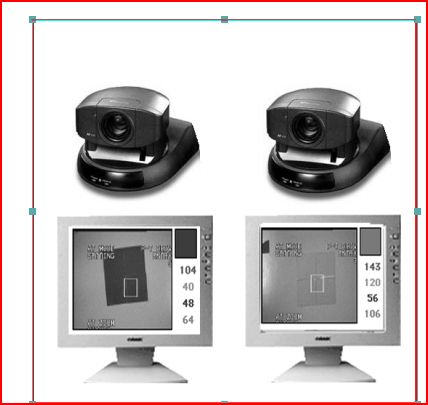
In their paper "Bootstrapping Grounded Word Semantics," Steels and Frederic Kaplan describe their research on "robotic agents interacting with real world environments through a sensory apparatus." (See illustration, above.) Specifically, they connected "Talking Head" robots via the Internet and gave them the ability to exchange "agents" that could move from one unit to the other. Both robots had visual access to a series of colored shapes on a whiteboard, which they viewed via an electronically relayed imaging system.
In other words, the robots were watching TV ... and talking about it.
It should be noted that the Steels/Kaplan paper does not use the word "meme." They are attempting to reproduce the genesis and evolution of linguistic forms using programmed software, combined with video technology and robotics. The subjects of their experiment clearly do have identity and agency, even if it is programmed from an external source (and therefore could be said to be an expression of Steels' and Kaplan's actions, not the expression of their own volition.)
Are there really "selfish memes"? Isn't that like saying the different pairs of pants in my closet "compete" to be worn by me every morning? And that the plaid ones my mom bought me are being selected against on a regular basis? Isn't that really just an analogy?
Well, analogies are alright. Analogies are good and proper and useful - provided we remember that they are analogies. I'm not on board the "meme" bandwagon as reality - at least not yet. Apparently the "meme" meme's efforts to reproduce itself in my mind have been unsuccessful so far. But then, is there a "me," independent of the memes that have coagulated in my general direction? Dr. Blackmore suggests not, that the illusion of self is created by hordes of selfish memes: "The illusion that we are a conscious self having a stream of experiences is constructed when memes compete for replication by human hosts."
It's a fascinating idea, one that owes much to Dr. Blackmore's past studies of Buddhism and which I can more easily grasp because of my own. But I'm not prepared to make the leap of faith required to consider it a reality.
Maybe it's just this virus slowing me down. I certainly feel lousy - that is, if there really is an "I" who feels anything. Maybe the "feeling sick" meme just needed to replicate and I was an available host. Which is to say, maybe I just came down with a bad meme.
Posted by Richard Eskow at 12:24 AM | Permalink


Comments
I don't think anyone believes memes have agency, just like no one believes genes have agency. But I think it's pretty common for an evolutionary biologist to say something like "in a given population of people, genes compete to be copied". It's only meant as shorthand, and I think the same thing's true of memes. The theory deserves criticism, but probably not on this point.
Here's the link to Blackmore's paper, and I think it contains a good overview of memetic theory.
Posted by: billy | Jul 27, 2009 2:44:54 AM
The problem with the meme theory is similar to the problem with the Selfish Gene Theory: these theories arbitrarily assume that there is one structure that determines the biological outcome, while everything else is instrumental to it. So, SGT has it that the individual, the group and the species are all instruments for the perpetuation of genes. But SGT was conceived before the advent of epigenetics, which has revealed that organisms can switch certain genes on or off, with the effect lasting several generations. Epigenetics entails neo-Lamarkian inheritance, by which organisms are in partial control of their genes, and how these will be expressed in the offspring.
This means that, while an organism is a complex structure brought into existence by its own (simpler) genes, it can then itself become a "selfish" agent and manipulate genes to perpetuate itself. After all, I could always counter the SGT by going down the scale and suggesting that individual nucleotide pairs in DNA are being selfish, and that genes are merely instruments to their perpetuation.
Groups and societies can likewise manipulate individuals to perpetuate their collective selves. While SGT proponents turn somersaults to explain altruism and social cooperation using kin selection arguments (eg: people agree to wait in line at foreign airports because their 10,000 year-old hunter-gatherer minds think the guy in front must be a close gene-sharing relative, so why not help him out) it makes much more sense to view society as a super- individual with a collective thinking process that encourages member individuals to cooperate (and sometimes to sacrifice their own lives), so advancing the survivability of the society as a whole.
So we come to memes, which are usually used just as arguments against the phenomenon of consciousness. Dave Ranning keeps calling thoughts that he doesn’t like "parasitic memes". Overdosed determinism not only denies the existence of any real decision making but also fails to see the structures that make these decisions as having their own existential agenda.
So memetics is just an erroneous assumption that fashionable or trendy thoughts have their own perpetuation goals, while larger, more complex structures like societies or philosophies – do not.
Posted by: aguy109 | Jul 27, 2009 4:33:16 AM
Billy, words mean something. They matter. Dr. Blackmore imputes agency to memes, just as Dr. Dawkins and others impute it to genes.
I find the idea more acceptable with genes. But in the end, an analogy should be acknowledged as such. Dr. Blackmore does the opposite, using the 'competition' concept throughout her paper. If she does not believe that is what memes do, why say it?
But I provided a link to Dr. Blackmore's paper so that readers could judge for themselves.
Posted by: RJ Eskow | Jul 27, 2009 12:47:12 PM
Well, no, Dawkins doesn't impute agency to genes. He uses the language as a shortcut is all, much like you might say that water wants to flow downhill. Of course water has no desire, it just follows the laws of gravity, but it's natural, or at least convenient, to describe it like that.
Actually the link to Blackmore's paper was broken, which is why I put it in my first comment. Sorry I wasn't explicit about that.
Posted by: billy | Jul 27, 2009 1:32:50 PM
Well, now we're in a tricky area. Actually I believe Dawkins DOES give "agency" to genes, but not "motivations" (such as "selfishness"). They do propagate. But, granted, it is a ultimately a metaphor in his eyes.
In my opinion Blackmore goes too far with her talk of "competition" etc., especially since the competitors in question are ill-defined, with an unproven existence. And she is writing in an academic paper, not a popular science book like Dawkins'.
But, as I said, maybe I'm being too intellectually rigorous because I'm feeling lousy. I can't shake this meme to save my life!
(and thanks for the info on the link - I THINK I fixed it.)
Posted by: RJ Eskow | Jul 27, 2009 1:57:17 PM
Just trying to find some places where Blackmore addresses this point, found this:
Note that when I say the memes are ‘selfish’ I do not mean that they are little magical entities sitting around in our heads thinking ‘now I must get myself copied’. Not at all. Just like genes, memes are only information, but they can be selfish in this sense and this sense alone. If they can get copied they will. And they do not care (because they are only bits of information and cannot care) what are the consequences for us, for our genes, or for our planet. They just go blindly on using us to get themselves copied, and along the way create our complex modern world. [...] There is no need to think of the memes themselves as having intentions or desires (obviously they are only little bits of information and cannot have intentions and desires).
Posted by: billy | Jul 27, 2009 2:05:20 PM
Thanks, Billy. I would expect her to acknowledge, as she does her, that they are not truly 'selfish.' Something can have 'agency' without having emotions, though - 'bots' and similar programs like computer viruses are good examples. She seems to place memes in that category, which is what I expected.
Blackmore commits the particular fallacy I'm describing again in this quote, when she says "they just go blindly on using us to get themselves copied.' She is saying they actively seek to be replicated, like a computer virus, even though they lack 'intentions and desires.'
I don't buy it - not without more explication than Blackmore offers here.
Best, R
Posted by: RJ Eskow | Jul 27, 2009 2:33:50 PM
Hmm. I'm not sure I understand your objection, but here's a try.
OKAY: "A successful meme is one that gets copied more often."
BAD: "A successful meme is one that gets itself copied more often."
Is that right?
Posted by: billy | Jul 27, 2009 9:32:39 PM
That's closer, certainly, but I'm still not sure there is something called a 'meme.'
Posted by: RJ Eskow | Jul 28, 2009 1:07:17 AM
…I'm still not sure there is something called a 'meme.'
Well since a meme is merely an element of culture that may be passed on by non-genetic means, I guess the answer is yes. Are there any agreed upon qualifiers that can narrow the field enough to make it a useful topic of discussion?
Posted by: Carlos | Jul 28, 2009 8:44:32 AM
That definition would be fine with me, Carlos, if it were fine with advocates of 'memetics.' After a great deal of research, however, I was unable to find any commonly agreed-upon definition of a 'meme' among would-be 'memeticists.'
If there is such a definition, and it resembles yours, it makes sense to me.
Posted by: RJ Eskow | Jul 28, 2009 11:23:57 AM
The rest of the definition is that it is "copied from person to person by imitation." This is where I get off the train. What, exactly, is being copied when I hear the first notes of Beethoven's 5th symphony? Or if I whistle it later on the way home from the concert hall? (Blackmore says "information" is being copied, though I don't think even the more robust variants of the computational model of mind purport to show this copying in action.)
Scott Atran argues that beliefs don't "propagate" by imitation, but by inference, and I tend to agree, but even here we've already ceded the level of agency to the meme-level. Susan Blackmore goes so far as to claim that memes are real, but minds or selves are illusory. I as big a fan of Buddhist "no-self" as anyone, but when the when the rest of the cultural world is left standing, ontologically, something important has been lost along the way.
I think the best critique of memetic theory is Midgley's, since it points out that memes have no explanatory power beyond tautology. Why do we believe (and say and do) what we believe now and not what people believed Five thousand years ago? To answer that new memes drove out old ones in the meme pool is not very insightful or satisfying.
Posted by: Chris Schoen | Jul 28, 2009 2:54:30 PM
The Scott Atran paper on "The Trouble with Memes" is here:
http://sitemaker.umich.edu/satran/files/human_nature_01.pdf
Posted by: Vicki Baker | Jul 28, 2009 3:46:28 PM
Memes exist by definition, for example from Blackmore's paper: Memes are ideas, habits, skills, stories or any kind of behaviour or information that is copied from person to person by imitation. There are issues (as others have pointed out) about the degree to which our mental lives are defined by imitation, and how well the "essence" of behaviors are copied. (This is where I think there are deserved criticisms.) The usefulness or applicability of memetic theory will depend on how well it addresses these issues.
But going back to agency, I think memeticists like Blackmore use the 'okay' and 'bad' versions interchangably. There are few memes that explicitly say "copy me", but many successful ones have the property that they're successful: the people who hold them are more likely to create conditions where that particular meme gets copied to more people (or makes the meme more important to those people, etc.). To say that the meme uses people to create this advantageous environment is, again, I think, just shorthand. Blackmore talks this way because it's useful to talk and think this way, as if memes had this power.
Posted by: billy | Jul 28, 2009 5:05:45 PM
Chris, do you have a reference for Midgley? Thanks.
Posted by: billy | Jul 28, 2009 5:15:41 PM
Billy,
The critique I have in mind is a chapter in her 2003 "Science and Poetry," which may be accessible via Google Books. She has a few shorter treatments of it online, which I was able to find with the search string "Mary Midgley memes"
Posted by: Chris Schoen | Jul 28, 2009 7:02:23 PM
Billy,
I recommend the Atran paper Vicki cited to challenge the notion of "copying" within Blackmore's thesis.
Posted by: Chris Schoen | Jul 28, 2009 7:04:58 PM
I had tried looking through her books on google but unfortunately some of the pages were missing. (Only 10% were missing though, the other 90% were there. What sense does that make?) I know I've read Atran's paper before, but I don't remember all the arguments, and don't feel like reading the 30+ pages again.
Posted by: billy | Jul 28, 2009 7:55:15 PM
Atran may be infected by a meme set that is protecting his religious convictions.
see: Gods We Trust: The Evolutionary Landscape of Religion
Also, his views possibly being meme protected can be viewed in the Beyond Belief gathering, a fascinating presentation.
I agree, the jury is still out. but this is a game changer.
Posted by: Dave Ranning | Jul 29, 2009 12:49:37 PM
Dave - You're kidding, right?
Posted by: RJ Eskow | Jul 29, 2009 1:33:24 PM
RJ-
Why do you ask?
Not so much his "convictions", but the belief that religion is essentially good, which may be meme driven.
Not dismissing his good analysis-- or Midgley's strong opposition to reductionist and scientistic philosophies, which is a condition that flavors her equanimity.
Posted by: Dave Ranning | Jul 29, 2009 2:07:52 PM
PZ sums Atran's position up precisely:
"I particularly liked his response to the claim that "people need religion". No, they do not. I don't, Dawkins doesn't, and it's not as if we are weird mutants. You could say that people need stories, people need reconciliation, people need consonance with their world, and religion tries to provide those things, but the message we need to get across is that religion is a flawed, illusory, and erroneous strategy for providing for human needs, and we can do better."
Posted by: Dave Ranning | Jul 29, 2009 2:30:47 PM
PeeZee has spoken!
Posted by: Louise Gordon | Jul 29, 2009 2:53:56 PM
I'd have to read the specific citation PZ is paraphrasing before I could conclude he has accurately summarized Atran.
The reason why I asked whether you were kidding, Dave, is because it appeared to be an attempt to dismiss Atran's arguments against memes by alluding to other beliefs or positions he had taken. That felt a little ad hominem. Adding the "infected by memes" phrase made me wonder if you were being ironic.
It's just as easy to say that PZ has been infected by an anti-religion meme. That is to say, it's a black-box argument that doesn't address the question at hand.
And since I haven't heard a compelling reason to believe memes exist, much less "infect" people, I didn't know how that question could be resolved by saying "the guy with an argument against memes is only making it because he's infected by one."
With all respect and civility, isn't that a little like saying I don't believe in Jesus because the Devil has invaded me? I mean, don't you have to accept the premise in order for the statement to appear meaningful?
Posted by: RJ Eskow | Jul 29, 2009 4:49:15 PM
RJ-
I'm just putting forth a premise, and even prefaced it with "possibly".
I know memes present a dangerous concept, that if true, would designate things like religion health problems, rather than philosophical arguments.
Seriously, if you didn't see the debate between Harris and Atran, which can be viewed at the Beyond Belief< i> conference archive, it would be worth your time, if you have any interest in this subject.
Posted by: Dave Ranning | Jul 29, 2009 7:48:18 PM
oh dave
the tag meme again?
Posted by: Carlos | Jul 29, 2009 7:53:06 PM
Abbas. Did you try my idea?
Posted by: Carlos | Jul 29, 2009 7:54:04 PM
Carlos-
As the cultural meme producer Britney would say:
"Whoops, I did it again"
(I'm using a different Laptop and OS, and must really check my sloppy tag closes)
Posted by: Dave Ranning | Jul 29, 2009 8:35:02 PM
Post a comment