
| ABOUT US | ARCHIVES | LINKS | RSS FEED | MONDAYS | |

3quarksdaily

An Eclectic Digest of Science, Art and Literature

« The Empire Estate | Main | The Winners of the 3 Quarks Daily 2009 Prize in Science »

June 22, 2009

The Dearth of Artificial Intelligence

By Namit Arora

(A slightly modified version of this article appeared in Philosophy Now, Nov 2011. Here is the PDF.)

AI_figure As a graduate student of computer engineering in the early 90s, I recall impassioned late night debates on whether machines can ever be intelligent—intelligent, as in mimicking the cognition, common sense, and problem-solving skills of ordinary humans. Scientists and bearded philosophers spoke of ‘humanoid robots.’ Neural network research was hot and one of my professors was a star in the field. A breakthrough seemed inevitable and imminent. Still, I felt certain that Artificial Intelligence (AI) was a doomed enterprise.

I argued out of intuition, from a sense of the immersive nature of our life: how much we subconsciously acquire and call upon to get through life; how we arrive at meaning and significance not in isolation but through embodied living, and how contextual, fluid, and intertwined this was with our moods, desires, experiences, selective memory, physical body, and so on. How can we program all this into a machine and have it pass the unrestricted Turing test? How could a machine that did not care about its existence as humans do, ever behave as humans do? In hindsight, it seems fitting that I was then also drawn to Dostoevsky, Camus, and Kierkegaard.
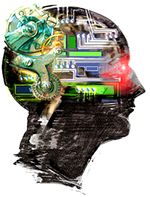
Artificial_intelligence My interlocutors countered that while extremely complex, the human brain is clearly an instance of matter, amenable to the laws of physics. They posited a reductionist and computational approach to the brain that many, including Steven Pinker and Daniel Dennett, continue to champion today. Our intelligence, and everything else that informed our being in the world, had to be somehow ‘coded’ in our brain’s circuitry, including the great many symbols, rules, and associations we relied on to get through a typical day. Was there any reason why we couldn’t ‘decode’ this, and reproduce intelligence in a machine some day? Couldn’t a future supercomputer mimic our entire neural circuitry and be as smart as us?  Recently, Dennett declared in his sonorous voice, “We are robots made of robots made of robots made of robots.”

Today’s supercomputers are ten million times faster than those of the early 90s. But despite the big advances in computing, AI has fallen woefully short of its ambition and hype. Instead, we have “expert” systems that process predetermined inputs in specific domains, perform pattern matching and database lookups, and algorithmically learn to adapt their outputs. Examples include chess software, search engines, speech recognition, industrial and service robots, and traffic and weather forecasting systems. Machines have done well with tasks that we ourselves can pursue algorithmically, as in searching for the word “ersatz” in an essay, making cappuccino, or restacking books on a library shelf. But so much else that defines our intelligence remains well beyond machines—such as projecting our creativity and imagination to understand new contexts and their significance, or figuring out how and why new sensory stimuli are relevant or not. Why is AI in such a brain-dead state? Is there any hope for it? Let’s take a closer look.

***
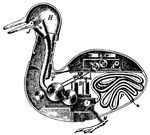
Duck_of_Vaucanson René Descartes, who held that science and math would one day explain everything in nature, understood the world as a set of meaningless facts to which the mind assigned values. Early AI researchers accepted Descartes’ mental representations, embraced Hobbes’ view that reasoning was calculating, Leibniz’s idea that all knowledge could be expressed as a set of primitives, and Kant’s belief that all concepts were rules.[1] At the heart of Western rationalist metaphysics—which shares a remarkable continuity with ancient Greek and Christian metaphysics—lay the Cartesian mind-body dualism. This became the dominant inspiration for early AI research.

Early researchers pursued what is now known as ‘symbolic AI.’ They assumed that our brain stored discrete thoughts, ideas, and memories at discrete points, and that information is “found” rather than “evoked” by humans. In other words, the brain was a repository of symbols and rules which mapped the external world into neural pulses. And so the problem of creating AI boiled down to creating a gigantic knowledge base with efficient indexing, i.e., a search engine extraordinaire. That is, the researchers thought that a machine could be made as smart as a human by storing context-free facts and rules which would reduce the search space effectively. Marvin Minsky of MIT AI lab went as far as claiming that our common sense could be produced in machines by encoding ten million facts about objects and their functions.

It is one thing to feed in millions of facts and rules into a computer, another to get it to recognize their significance and relevance. The ‘frame problem,’ as this problem is called, eventually became insurmountable for the ‘symbolic AI’ research paradigm. One critic, Professor Hubert L. Dreyfus, expressed the problem thus:

If the computer is running a representation of the current state of the world and something in the world changes, how does the program determine which of its represented facts can be assumed to have stayed the same, and which might have to be updated? [1]

GOFAI — Good Old Fashioned Artificial Intelligence — as symbolic AI came to be called, soon turned into a degenerative research program. It is unsettling to think how many prominent scientists and philosophers held (and continue to hold) such naïve assumptions about how human minds operate. A few tried to understand what went wrong and looked for a new paradigm for AI. No longer could they ignore the withering critiques of their work by Professor Dreyfus, who drew inspiration from the radical ideas of the German philosopher Martin Heidegger (1889-1976). It began dawning on them that humans were far more complex than they had earlier allowed for, with our subconscious familiarity and skillful coping with the world, nonlinear decision-making, ability to assess and adapt to new situations, and the role of things like purpose, intention, and creativity that shaped, and were shaped by our organization of the world.

***

TermiteHill A hammer, Heidegger pointed out, cannot be represented by just its physical features and function, detached from its relationship to nails and the anvil, the experience and skill in hammering of the person using it, the hammer's role in building fine furniture and comfortable houses, etc. Merely associating facts, values or function with objects cannot capture the human idea of an object, with its particular role in the meaningful organization of the world as we experience it. As Professor William Blattner writes in Heidegger's Being and Time (2006), “Heidegger argues that meaningful human activity, language, and the artifacts and paraphernalia of our world not only make sense in terms of their concrete social and cultural contexts, but also are what they are in terms of that context.”[3].

Consider hi fi speakers. One way to represent them, in the manner of rationalists, is as objects with physical properties—shape, dimensions, color, material, attached wires—to which are then assigned a value or function. But this is not how we actually experience music speakers. We experience them as inseparable from the act of listening to music, from the ambience they add to our living room, from their impact on our mood, and so on. We do not understand them as context-free, object-value pairs; we understand them through our context-laden use of them. When someone asks us to describe our speakers, we have to pause and think about their physical attributes.

According to Heidegger, writes Professor William Blattner:    

The philosophical tradition has misunderstood human experience by imposing a subject-object schema upon it. The individual human being has traditionally been understood as a rational animal, that is, an animal with cognitive powers, in particular the power to represent the world around it … the notion that human beings are persons and that persons are centers of subjective experience has been broadly accepted … Where the tradition has gone wrong is that it has interpreted subjectivity in a specific way, by means of concepts of ‘inner’ and ‘outer,’ ‘representation’ and ‘object’ … [which] dominates modern philosophy, from Descartes through Kant through Husserl. [2]

So in many ways, Heidegger stood opposed to the entire edifice of Western philosophy. According to him, the Western philosophical tradition “has been focused on self-consciousness and moral accountability, in which we experience ourselves as distinct from the world and others.” Such ‘subject-object dualism’ dominates modern science, but fails to describe how humans relate to the world in their experience of it, which is quite holistic. Heidegger claimed that the subject-object model of experience, in which we see ourselves as distinct from the world and others, “does not do justice to our experience, that it forces us to describe our experience in awkward ways, and places the emphasis in our philosophical inquiries on abstract concerns and considerations remote from our everyday lives.”[4] As Heidegger contends, “we are disclosed to ourselves more fundamentally than in cognitive self-awareness or moral accountability. ... Our being is an issue for us, an issue we are constantly addressing by living forward into a life that matters to us.” For Heidegger, our being in the world is “more basic than thinking and solving problems; it is not representational at all.” For instance, when we are absorbed in work, using familiar pieces of equipment, “the distinction between us and our equipment—between inner and outer— vanishes.”[6] Or as Prof Blattner says,

[Heidegger] argues that our fundamental experience of the world is one of familiarity. We do not normally experience ourselves as subjects standing over against an object, but rather as at home in a world we already understand. We act in a world in which we are immersed. We are not just absorbed in the world, but our sense of identity, of who we are, cannot be disentangled from the world around us. We are what matters to us in our living; we are implicated in the world. [5]

In other words, it makes no sense to believe that our minds are built on basic, atomic, context-free sets of facts and rules, objects and predicates, and discrete storage and processing units. This is why the methods of natural science, which look for structural primitives such as particles and forces, fail to describe our experience. Therefore, contrary to the implicit beliefs of much Western philosophy and AI research, a ‘computational’ theory of the mind may be impossible. Isn’t our common sense “a combination of skills, practices, discriminations, etc., which are not intentional states, and so, a fortiori, do not have any representational content to be explicated in terms of elements and rules?” [7] The older Wittgenstein agreed, adding in Last Writings on the Philosophy of Psychology (1948): “[N]othing seems more possible to me than that people some day will come to the definite opinion that there is no copy in the ... nervous system which corresponds to a particular thought, or a particular idea, or [a particular] memory.”

***

A conceptual advance for AI came when some researchers recognized that a computer’s model of the world was not real. By comparison, the human ‘model’ of the world was the world itself, not a static description of it. What if a robot too used the world as its model, “continually referring to its sensors rather than to an internal world model”? [6] However, this approach worked only in micro-environments with a limited set of features which could be recognized by its sensors. The robots did nothing more sophisticated than ants. As in the past, no one knew how to make the robots learn, or respond to a change in context or significance. This was the backdrop against which AI researchers began turning away from symbolic AI to simulated neural networks, with their promise of self-learning and establishing relevance. Slowly but surely, the AI community began embracing Heideggerean insights about consciousness.
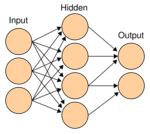
NeuralNet Starting with a blank slate (unlike humans), machine neural networks attempt to simulate biological brains using a connectionist approach capable of continually adapting its structure based on what it processes and learns. In symbolic AI, a feature “is either present or not. In the [neural] net, however, although certain nodes are more active when a certain feature is present in the domain, the amount of activity varies not just with the presence or absence of this feature, but is affected by the presence or absence of other features as well.” [7] Here, learning is guided using one of three paradigms: supervised learning in controlled domains, unsupervised learning using cost-benefit heuristics, or reinforcement learning based on optimizing certain outcomes.

But the results are not promising. Supervised learning, for instance, remains mired in very basic problems—such as the neural net’s inability to generalize predictably in terms of categories intended by the trainer (except for toy problems which leave little room for ambiguity). For example, a net trained to recognize palm trees in photos taken on a sunny afternoon may learn to pick them out by generalizing on their shadows, and thus fail to detect any trees in photos from an overcast day. The sample size can be enlarged but the point is that the trainer doesn’t know what the net is precisely training itself to do. Another neural net trained to recognize speech may crash when it encounters a metaphor—say, “Sally is a block of ice.” [6] Outside its training domain, the net is also unable to recognize other contexts, and therefore cannot know when it is not appropriate to apply what it has learned—problems that humans dynamically solve using their social skills, biological imperatives, imagination, etc.

Reinforcement learning has its own pitfalls. For instance, what is an objective measure of reinforcement? Even if we take a simplistic view that humans act to maximize “satisfaction” and assign a “satisfaction score” to all foreseeable outcomes, we need some way to model and artificially reproduce how “satisfaction” may be impacted by our moods, desires, body aches, etc., as well as their modeling their correlation with inputs in a diversity of situations (weather, familiar faces, noise, motion, etc.). But does anyone know what ‘model rules’, if any, humans obey in their daily behavior? Dreyfus sums it up:

“Perhaps a [simulated neural] net … If it is to learn from its own "experiences" to make associations that are human-like rather than be taught to make associations which have been specified by its trainer, it must also share our sense of appropriateness of outputs, and this means it must share our needs, desires, and emotions and have a human-like body with the same physical movements, abilities and possible injuries.” [7]

In other words, the success of neural nets will depend not only on our understanding of how we breathe significance and meaning into our world (which was Heidegger’s endeavor), and finding a way to capture this understanding in the language of machines: in order to have a shot at behaving like humans, these nets also need to come into a social world similar to that of humans and project themselves in time the way humans do with their physical bodies. How to achieve any of this is not even remotely clear to anyone, nor is it clear that these things are even amenable to modeling on digital computers. To insist otherwise is not only an article of faith, it also seems to me increasingly obtuse and wild. [8]


Notes & Bibliography:

[1] Hubert L. Dreyfus, "Why Heideggerian AI Failed and how Fixing it would Require making it more Heideggerian ," 2006.
[2] William Blattner, "Heidegger’s Being and Time," Continuum, 2006, p.9.
[3] ibid., p.4-5.
[4] ibid., p.48.
[5] ibid., p.12.
[6] Hubert L. Dreyfus, "What Computers Still Can’t Do: A Critique of Artificial Reason," MIT Press, 1992.
[7] Hubert L. Dreyfus and Stuart E. Dreyfus, "Making a Mind vs. Modeling the Brain: AI Back at a Branchpoint," UC Berkeley.
[8] Think Ray Kurzweil, Nick Bostrom, and Bill Joy, with their fantasies of the technological singularity, mind uploading, etc.
[9] Jonathan Ree, "Heidegger," Routledge, 1999.
[10] Ari N. Schulman, "Why Minds Are Not Like Computers," The New Atlantis, Number 23, Winter 2009, pp. 46-68.
__________________________

More writing by Namit Arora?
__________________________

Posted by Namit Arora at 12:36 AM | Permalink

Comments

Can't say I completely agree. Have you ever heard of the PSI-Theory by Doerner?

http://en.wikipedia.org/wiki/Psi_theory

It's a rather complete theory about how humans learn, how their brain works etc. And they managed to back up their theory by programming an agent in a simulated enviroment, which actually works, and doesn't rely on any pre-fabricated rules.

Take a look if you are bored.

Posted by: me | Jun 22, 2009 7:41:35 AM

Dear Namit,

This is an interesting and well-articulated expression of a view that I disagree with. This is, of course, not a factual disagreement, but more that my sense (through my thinking and reading about a lot of these problems) of these things is very different from yours. I hope you'll take the following as respectful dissent.

In my view, while pointing to the many failures (which I and everyone accept) and giving a good account for the lack of success of various particular approaches that have been taken in AI, you then generalize too much by doubting that ANY attempts will ever succeed at simulating brains.

You don't even attempt to provide an answer (naturalistic OR philosophical) to the question (which you acknowledge) that if our brains are physical machines (and I have no reason to believe otherwise, do you?), then what reason is there to believe that we cannot decipher (or reverse-engineer) their structure and build them out of other materials, or simulate them on universal Turing machines?

You also take, for my taste, a bit too much of a romantic tone about human creativity, meaning, context, etc. This only serves to make the discussion an emotional one and appeals to human vanity. Almost as if any of the awe we feel at human abilities and achievements somehow even dents the fact that all this is done by physical machines (our brains) designed by natural selection (just like a eye), not some supernatural or uniquely "human" forces. (And like most computer scientists, I find ideas like Penrose's microtubules with quantum effects pretty unserious. Putnam has done a great job dismissing these ideas.)

You also seem a bit unfair to me deriding Pinker and then Dennett's "sonorous" declarations without giving them any context. These people are not as scientistically silly as you make them seem. As you must know, Dennett is a diehard holist about meaning, and hardly deserves to be implicitly portrayed as naive about the web of meaning, or a champion of simple-minded approaches to AI.

In other words, despite your discussion here, I remain optimistic about the prospects of AI. I think the key breakthroughs will come from neuroscience and a conceptually hierarchical description of the functions of the parallel processing brain. And once all the parts of understanding are in place, I believe we will very quickly advance to the point of human-like intelligence.

That's my two cents!

Thanks for a very intesting discussion.

Posted by: Abbas Raza | Jun 22, 2009 9:20:26 AM

Interesting article, but I believe that the leading edge of AI research is both well-aware of the issues you raise, and making substantial progress in addressing those issues. The field is called "Embodied Cognition" or "Embodied AI", and it takes very seriously the idea that cognition is only meaningful in the context of action in the real world. You can't reason about objects unless you can see them; you can't learn language unless you are exposed to the referents of the words you're learning; etc.

For an intro, I'd suggest:

Anderson, M. L. Embodied Cognition: A field guide Artificial Intelligence, 2003, 149, 91-130

http://citeseerx.ist.psu.edu/viewdoc/download?doi=10.1.1.95.5859&rep=rep1&type=pdf

Posted by: Harlan | Jun 22, 2009 12:08:34 PM

Abbas,

I think you are asking Namit to answer a question he doesn't accept the terms of. His invocation of Heidegger appears to me an attempt to explain why we have good reason to disbelieve that our brains are best thought of as "physical machines." A writer can only be so philosophically rigorous in such a short space, but I think he sketches the point well, even if we might want more detailed exposition.

I also don't see the despair you allude to when you write that Namit "generalize[s] too much by doubting that ANY attempts will ever succeed at simulating brains." Now that so many of the early suppositions that originally led to AI theory have been called into question in the way Namit relates, on what grounds do we continue to predict such a success, apart from a vague conviction of our own omnicompetance in the fullness of time (which seems to me far more an article of faith than science)?

Namit,

I am very surprised to see such an affirmative statement by Wittgenstein, who is usually much more cagey about what we can predict or know with such certainty. But it is a prescient remark all the same. The question of where meaning (upon which all intelligence must rest) "comes from" remains a very complex one, that AI theory does not seem to have yet come to grips with.

Posted by: Chris Schoen | Jun 22, 2009 12:58:42 PM

I don't think we should assume that artificial intelligence in machine "brains" will "think" and be "intelligent" in the same way that humans think and are intelligent. This seems to me like the fallacy of assuming that any alien life would somehow mirror our conception of life on earth. In fact, it may still be impossible at this point to fully conceive what AI will be like.

Repent, for the singularity approaches!

Posted by: eli | Jun 22, 2009 1:08:03 PM

The problem with proclaiming the death of AI like this is that you don't seem to appreciate that the field of AI is not a static set of theories. Instead, you should think of it as a growing, evolving scientific and engineering field. So when you claim that "The robots did nothing more sophisticated than ants." and cite a 1992 philosophy book, you're implicitly assuming that nothing of note came about in the field of robotics in the last 17 years. Same thing with humanoid robots, an expression you put in quotation marks presumably because you think no such thing exists. But hundreds of labs around the world are working on humanoid robots, and their abilities are far greater than those of an ant. You should check them out! No, they aren't yet capable of passing any version of the Turing test, but that's not the sole measure of progress. In fact, it's a very poor, binary measure of progress that has become almost irrelevant in modern AI research.

Most AI researchers are not even interested in creating a human-level intelligent machine. Instead, they are coming up with automated solutions to problems that would require intelligence were a human to solve them. And in the meantime, figuring out many small pieces of the big intelligence puzzle.

Basically, rumors of AI's death have been repeatedly and greatly exaggerated. Meanwhile, scientists and engineers continue their work.

Posted by: Paulina Varshavskaya | Jun 22, 2009 1:24:27 PM

If you think AI is dead, you have not been paying attention. Every time there's a major breakthrough in AI, it gets checked off as a minor accomplishment.

See Kurzweil's cartoon at http://www.kurzweilai.net/articles/images/KurzweilAI50_Image1.jpg showing how accomplishments have been checked off, one by one.

Then spend a day reading AI articles on Kurzweilai.net, and you'll see how the basic premise of your blog post is fundamentally flawed.

Posted by: Bob | Jun 22, 2009 1:54:55 PM

I personally resonate with eli's comment--There seems to be several threads of thought running through the conception of AI: Are we talking about manufacturing a human brain? How is intelligence defined? Are ant, cat and human intelligences the same? Is compassion an intelligence? Is consciousness? What I hear the author saying is that previous conceptions of intelligence, born from a mechanistic model of human brain function, are being found too simplistic, and that AI is having to correspondingly redefine itself to something that has as yet not been nailed down. If anything, I see the conceptualization of intelligence as being blown open, which could be seen as raising some serious questions of intention, like, what is AI supposed to do?

Posted by: Lambness | Jun 22, 2009 3:16:26 PM

Most of us already make use of artificial intelligence - a simple example is the average programmable household thermostat which knows enough and has the real work interfaces and physical capability to enable it to interact with the world in such a way as to regulate the temperature of our residences.

Namit Arora asserts that this kind of artificial intelligence, no matter how powerful the processes, programs and networks of such become, will never be able emulate fully emulate an average human being in the real world.

There are further good reasons for believing this besides the ones mentioned in his article, the most important of which is the existential aspect of being human.

A universal Turing machine, which is a combination of hardware and software, must have a start state. Humans do not have a start state but are part of a continuous chain of life going back billions of years.

Computers have off buttons. After months of inactivity on a shelf, a computer may be restarted but a human cannot. We call this final human state "death" from which there is no restart notwithstanding the christian claim.

Singularity enthusiasts, usually citing Moore's Law which is not a law but an observation on a historical trend in integrated circuit size, computational power and price, believe that this trend in the density of integrated circuits will continue indefinitely. Furthermore there is a belief that computer programming will parallel circuit size and speed in sophistication, efficiency and applicability. There is no compelling reason for this belief. Indeed Malthus and teleological readily come to my mind when confronted with these ideas.

Namit Arora's point is that the optimistic predictions of Minsky et al regarding ai have not kept up with the increase in computational power that have since been achieved - hence the dearth in the title of the article.

When I was in high school over 40 years ago, we were taken to see a state of the art IBM 360 computer that filled a space the size of our gymnasium. The computational power of that machine was less than that of the average cell phone today. The computational power of the latest "supercomputers" today is many magnitudes greater than a cell phone. Would anyone like to suggest that these multi-teraflop machines are any closer to being intelligent than your average hand-held calculator? Hence the failure of ai.

Posted by: Richard | Jun 22, 2009 4:50:46 PM

Harlan,

Yes, the leading edge of AI research is well-aware of the issues I raise, which several others have raised for a while—the failure of GOFAI made ignoring them difficult (sure, many researchers are still in denial). Thanks for that great article; I am still reading it and others here should too.

On the very first page, Anderson says that Embodied AI's "Heideggerian approach to being in the world, in which agency and interactive coping occupy center stage, is an extremely important development, the implications of which are only just beginning to be fathomed [by AI researchers]." (Italics mine.) So while I agree that this new thinking best accounts for how humans operate in the world, I disagree with you that "substantial progress in addressing those issues" has been made (can you cite any real-world examples?). Even in his conclusion, the author notes rather modestly:

[Embodied Cognition] suggests that intelligence lies less in the individual brain, and more in the dynamic interaction of brains with the wider world—including especially the social and cultural worlds which are so central to human cognition ... this re-conception of human cognition has implications not just for the project of creating artificial intelligence, but for the related project of harnessing computation to enhance human intelligence. Whatever the next step is to be in human cognitive progress, it ought to be based on a better and more thorough understanding of intelligence than we have so far managed. Research in [Embodied Cognition] promises one important component of that eventual understanding.

I'll respond to others later today.

Posted by: Namit | Jun 22, 2009 7:56:49 PM

"A universal Turing machine, which is a combination of hardware and software, must have a start state. Humans do not have a start state but are part of a continuous chain of life going back billions of years.
"Computers have off buttons. After months of inactivity on a shelf, a computer may be restarted but a human cannot. We call this final human state "death" from which there is no restart notwithstanding the christian claim."

I thought this was funny: Evidently you think that humans have an end state but no start state, and computers have a start state but no end state.

(Not that I think start/end states have anything to do with intelligence.)

Posted by: billy | Jun 22, 2009 8:20:14 PM

Paulina,

Thanks to Google, I understand that you are an AI / robotics researcher employed at MIT. Imagine, then, my bewilderment at your response. One might think that you are uniquely positioned to take on the substance of the issues I raise and cite real-world examples to show how wrong I am. Your Ph.D. research was on distributed reinforcement learning algorithms and in your professional research statement you say, "Intelligent control algorithms need to be designed for and validated in embodied systems in the physical world; and I intend to pursue this validation in future research." You could tell us how this is coming along, or how other research you know of—at least conceptually if not also experimentally—addresses the serious methodological objections that folks like Dreyfus and Anderson have raised. Do you even acknowledge the objections that Dreyfus has raised, as Harlan above does? How would you respond to the last three paragraphs of my essay?

What's not going to convince are statements like: "hundreds of labs around the world are working on humanoid robots" and "scientists and engineers continue their work." So what? GOFAI researchers also worked in hundreds of labs and have little to show for it. With flawed assumptions, it's garbage in, garbage out. And no, my statement about the robots doing little more than ants is not from 1992, but from the 2006 paper by Dreyfus, and it refers to the outcome of an important old experiment that was a stepping stone of sorts between GOFAI and neural nets.

What I found most interesting in your comment is this: "Most AI researchers are not even interested in creating a human-level intelligent machine." Why is that? Wasn't this once the main goal of AI, the dream, the holy grail? If we have abandoned it and are instead doing expert systems in limited domains, as I believe we are, that's a significant shift! To give up on strong AI is a kind of defeat, is it not? What do you think of those who still persist in the strong AI dream?

Posted by: Namit | Jun 22, 2009 10:49:58 PM

Abbas,

Thanks for your thoughtful comment. I accept it as respectful dissent. As a start—what Chris said.

I think we can't be certain whether strong AI will eventually work or not. With decades of scientific research giving no reason for hope, we can only examine the weight of reasoned arguments from philosophy, which I take as a larger inquiry in the light of the sciences, and in the light of everyday experiences. I mention one approach that I think might work in my last para, at least conceptually, and note that we have absolutely no idea how to implement it (today, and perhaps ever).

> You also take, for my taste, a bit too much of a romantic tone about human creativity, meaning, context, etc.

Really? I thought it was cold, hard logic. :-) When MIT embraces Heidegger to account for creativity, meaning, context, etc. in its AI program, it ceases to be a romantic argument, wouldn't you say? I recommend the Dreyfus articles or that Anderson article Harlan linked to, or better still, Heidegger himself. If you read with an open mind, as I have no doubt you will, you may emerge from it a different man and start making sarcastic noises about Pinker and Dennett! And 3QD readers may be surprised to see Stuart Kauffman as the judge of the 2010 Quark award for science!

Posted by: Namit | Jun 23, 2009 1:00:57 AM

As you recommend, Namit, I'll read some of the stuff that has come to light thanks to this discussion.

By the way, I've read all of Kauffman's books, who happens to be a close friend and collaborator of my sister Azra (and my friend Justin Tom-Friedman-clogged-my-toilet Smith's uncle). Small world! :-)

I hope that I'll be replaced by an AI much smarter than me for the next round of arguments! :-)

Abbas
P.S. I give you points for chutzpah for implying I have not read Heidegger. Maybe I should get around to the late Wittgenstein too? Thanks for the recommendation! ;-)

Posted by: Abbas Raza | Jun 23, 2009 5:05:58 AM

Namit,

The reason I mention "hundreds of labs around the world" working on robots, is not to tell you that hundreds of monkeys can't be wrong. Of course that's not the argument! Instead, it's to point out that a lot of research is focused on things like embodiment, affordances, behavior in the unmodified world, -- all that stuff that you say is so important, but then you either ignore or dismiss any advances along those lines.
So you cite a 2006 Dreyfus paper instead of his 1992 book. Why do you assume he's right and robots can only do what ants can do in 2006? What I'm telling you is he's wrong, you're wrong. Go to the source instead of going to philosophers. Go check out the papers published by humanoid and other robotics labs (e.g., at MIT -- Rod Brooks in the late 1990s and early 2000s, Russ Tedrake now -- but also at Stanford, Berkeley, CMU (DARPA Urban Challenge winner - does that behave like an ant?) at U Tokyo, at Tsukuba, at Max Plank Institute in Germany, ETH Zurich, EPFL, etc. etc. etc.). If you can use Google to look me up, use it to find recent research papers in intelligent robotics, look at the videos, see what researchers report. If you don't understand something, ask them. Don't trust Dreyfus to tell you what the state of the art is.

Meanwhile, my PhD research is extremely narrow and technical and not germane to this discussion.

I would also like to point out that no other scientific or engineering field gets as many proclamations of death as AI, ever. Can you imagine anyone seriously saying "Physics has not given us a full understanding of how the universe works. Therefore, the fundamental principles underlying physics are all wrong, and physics is dead." Why is AI treated differently? If some assumptions don't lead to expected results, then researchers change assumptions and go to work again. That's how the field evolves. If theories don't result in expected intelligence of behavior, then different theories are formulated. That's how the field is working, and that's what I'm urging you to see.

Why have goals changed? Because the magnitude and complexity of the subject-matter have become more and more obvious. Meanwhile, some early goals (e.g., chess, theorem-proving, logic puzzle-solving) have been fully achieved and therefore ceased to be of interest. Why would anyone not expect goals to change?

But my two main points remain: 1) go to the source for what's going on in the field, and 2) don't dismiss (even incremental) advances because they don't yet solve the entire problem.

Posted by: Paulina Varshavskaya | Jun 23, 2009 1:39:32 PM

Paulina is right. Much progress has been made, and Heidegger or Dreyfus have little to do with it. One day the problem will be solved. Imagine Google builds more and more data centers, and suddenly they discover they have so much computational power that they will be able to simulate an AI with it.. That's one possible route.

Posted by: jofr | Jun 23, 2009 4:55:46 PM

"I would also like to point out that no other scientific or engineering field gets as many proclamations of death as AI, ever."

Well the other field(s) that gets even more is neuroscience & the unraveling of consciousness/human intelligence. < / Bold Declarative Statement > Or if not more, then produces arguably fewer success stories. Coincidence?

That said, seems like I regularly converse with AI help/booking systems online these days (not that they aren't idiots); specific facial recognition (an insurmountable hurdle a few years back) is suddenly a commonplace (even iPhoto can do it); Big Dog can run, jump and maintain his balance on ice or while being kicked in the rear; certainly many pieces are coming together. Sure, these bits and pieces aren't consciousness, but to dust off Dennett's analogy, they are the robot underpinnings of yet more integrative robots to come. I doubt true consciousness is going to happen but I don't doubt that someday we won't be able to tell the difference in many day to day interactions, I.E. chatty robot cab drivers "Bloomboig! Don't get me staated!!"

Posted by: Carlos | Jun 23, 2009 8:42:44 PM

Paulina,

> Why do you assume he's right and robots can only do what ants can do in 2006?

Let me try again. I tried to explain to you that the quote "refers to the outcome of an important old experiment that was a stepping stone of sorts between GOFAI and neural nets." As "old" suggests, that happened a while back. I mentioned it as a historically significant event described in a 2006 paper, in order to illustrate how we arrived at learning via neural nets, which also happened a while back. Neither Dreyfus, nor I have suggested that no technical innovations have occurred since then. That would be absurd (I cited expert systems in my essay).

Also, you keep accusing me of proclaiming the death of AI. I haven't used the word "death" anywhere, have you noticed? Just above, in my response to Abbas, I said, "I think we can't be certain whether strong AI will eventually work or not." What's with the defensiveness?

I understand the goals of AI have shifted away from strong AI to realizing algorithmic intelligence in targeted domains (some of which Carlos outlines, as I did too). Between where we are today and the "[solution to] the entire problem" lies a rather massive gulf spotted by some philosophers, a gulf that was, and still is, ill-understood or ignored by too many AI enthusiasts and pop science outlets. We also need to be careful drawing comparisons between AI and physics, especially between strong AI and physics. Physics has thrived under the subject-object dualism of Western metaphysics, unlike strong AI. Explaining why this is so is perhaps Heidegger's most important contribution to AI.

Posted by: Namit | Jun 23, 2009 9:54:16 PM

Abbas,
Small world, indeed. What an accomplished family you have.

Pardon my impertinence in assuming you have not read Heidegger. Your comment, which contrasted sharply with Heideggerean insights, led me into that trap. :-)

Posted by: Namit | Jun 23, 2009 10:36:09 PM

Carlos,

Are you familiar with Jaron Lanier's observation that there are two ways for AI to pass the Turin test, one: by getting really "smart" and/or by becoming conscious, and two, by continually eroding our sense of what human intelligence is so that any old computer (or iPhone) can easily emulate it. It sounds like you are predicting the latter with your Bloomberg-trashing cab-bots (was it Total Recall that presaged this, or Running Man? I can't recall. Uh, derrr...)

Namit,

I'm still kind of gobsmacked that Heidegger is turning out to be an important philosopher for Theory of Mind. Thanks for writing this.

Posted by: Chris Schoen | Jun 24, 2009 1:30:54 AM

Namit,

I agree with much of what you say in your article. But your discussion about Neural Networks prompts me to point out that Perceptron style NNs have been obsolete since the mid 1980's with the arrival of Modern Connectionism as described by Rumelhart and McClelland but it seems like few people outside the Connectionist community ever noticed this. Please, do not judge the power of Connectionism by 30 year old results.

I agree that GOFAI was generally the wrong approach, but my thinking differs somewhat from yours:

When trying to analyze the phenomenon of human intelligence it is quite productive to divide our mental faculties into Understanding and Reasoning. Reasoning is a conscious, symbolic, logical, Reductionist, context free, model based, and largely serial process. Understanding is a subconscious, subsymbolic, intuitive, Holistic, context dependent, pattern based, and largely parallel grasp of concepts. Animals understand but do not reason; conscious, logical Reasoning is built on top of subconscious, intuitive Understanding. Both aspects were discussed at some parity until around 1955. With the advent of computers, Cognitive Science became dominated by programmers that heavily favored logic based, Reductionist approaches. Since then, research has been overmuch preoccupied with Reasoning at the expense of Understanding. Without a foundation of Understanding, the Reductionist, Logic based efforts at cognition were (and are) building castles in the air, since these systems have nothing to reason about.

AGI research is changing. Some of the most interesting recent results, such as Google's prize-winning automated translation systems, are not based on logical models (in this case, of language).

For an introduction to my view of these new logic-free approaches, see http://artificial-intuition.com , http://monicasmind.com and http://syntience.com

Posted by: Monica Anderson | Jun 24, 2009 2:56:25 AM

Fascinating article and responses. If Strong AI really is a long way off, thats probably just as well: Mankind has enough problems without machines demanding equal rights, or putting us all in zoos.

Posted by: aguy109 | Jun 24, 2009 12:56:23 PM

Oh, right! Should have wondered why that image came so readily. It was Total Recall, ironically.

…putting us all in zoos

Anyone ever read With Folded Hands by Jack Williamson?

Posted by: Carlos | Jun 24, 2009 1:37:51 PM

Warning. Wiki entry is a spoiler.

Posted by: Carlos | Jun 24, 2009 1:39:02 PM

oops...

A spoiler to this:

…putting us in zoos

Anyone ever read With Folded Hands (Wikipedia Entry) by Jack Williamson?

Chris:

Oh Right! I should have wondered why that image surfaced so readily. It was Total Recall, ironically. The one in my head was more like the Cab Driver from Christmas Past from Scrooged.

Posted by: Carlos | Jun 24, 2009 1:46:10 PM

sorry. total browser confusion.

Posted by: Carlos | Jun 24, 2009 1:48:09 PM

The one in my head was more like the Cab Driver from Christmas Past from Scrooged.

It's true that the ghosts in that movie passed the Turin(g) test. Except maybe for the ghost of Christmas future. He kind of seemed like a bot.

Posted by: Chris Schoen | Jun 24, 2009 2:24:33 PM

Namit,

You got me on one point: I misread your "dearth" as "death". I should probably grant you "dearth". :-)

Meanwhile, here's a good article by a philosopher and a computer scientist about how robots already have intentionality: Christopher Parisien & Paul Thagard. Robosemantics: How Stanley the
Volkswagen Represents the World. Minds & Machines (2008) 18:169-178.

Posted by: Paulina Varshavskaya | Jun 24, 2009 6:49:42 PM

Monica,

I agree with your first para. I too referred to connectionist neural nets, and noted some problems that plague them—lack of predictable generalization, recognition of context and significance outside the training domain, reinforcements that are realistic (factoring in what you call "understanding"), etc. I assume your caution about not relying on 30 year old results is a general note to readers. Please elaborate if you disagree.

I found your website quite interesting. You have clearly grappled with strong AI for a while and I find your analysis of logic vs. intuition compelling, particularly the space you assign on the graphs for these approaches, with a large red area you call "the absurd" on the upper-right. According to this, AI will go some distance and work well for behaviors in which humans rely on negligible degrees of embodiment, context, affordances, etc. But in the red area, rules and models—of logic and intuition—run out of descriptive and predictive steam, not because of the inadequacies of our rules and models but due to irreducible and unpredictable properties inherent in complex systems. So far so good.

But I struggled to understand your use of the term intuition when you cited Google's text translation system as an example. I understand that instead of logical mappings, they use a statistical approach:

Most state-of-the-art, commercial machine-translation systems in use today have been developed using a rule-based approach, and require a lot of work to define vocabularies and grammars. Our system takes a different approach: we feed the computer billions of words of text, both monolingual text in the target language, and aligned text consisting of examples of human translations between the languages. We then apply statistical learning techniques to build a translation model. ... Automatic translation is very difficult, as the meaning of words depends on the context in which they're used ... we hope you find the service we provide useful for most purposes.

Looking at other learning techniques that connectionist neural nets use, statistical learning strikes me as just a variant. In this case, learning happens based on associative logic derived from probability and statistics. Intuition strikes me as an overlarge word for this technique. What do you think?

I also resist your hermetic division of "our mental faculties into Understanding and Reasoning." This may have pedagogical value (like the old idea that a reason layer sits atop the subconscious layer) but as a reflection of reality, it is problematic. It's more like a seamless continuum, no?

Posted by: Namit | Jun 25, 2009 1:37:19 AM

Paulina,

I bet a robot would not have made that mistake! But a robot is also unlikely to ever try and show intentionality in another robot. Or is the jury still out on that one? :-)

Thanks for the article. Award-winning Stanley the Volkswagen did mighty well, even when its "problem solving ability is less than [that of] a cockroach". The authors proclaim intentionality in Stanley by first trying to undermine Searle's Chinese room argument and then add:

... because Stanley’s performance in the world is so successful, we have reason to attribute meaning to Stanley’s symbols, the variables and links in its Bayes networks. Their meaning does not derive simply from the programmers who wrote the C code for Stanley’s computers, but also from ongoing interactions with the world and with ongoing machine learning that make possible Stanley’s effective operations. [p.176]

I am not sold. Such an attribution of meaning to Stanley's symbols can be made for any reasonably successful neural net in a given domain. I'll have to spend time to create a more articulate response. Do you know of any rebuttals to this claim of intentionality that have appeared?

Posted by: Namit | Jun 25, 2009 3:34:10 AM

Well, it didn't take long for someone to produce an example of AI researchers defining human intelligence down to make the Turing test more easily surmountable.

The authors of the article on "robosemantics" confuse what it means to represent the world with symbols, and to operate in response to signs. Symbolic representation is a feat of only the highest intelligences. Besides humans, there is marginal evidence that great apes may do it (and only with human prodding, and in very rudimentary form), and possibly cetaceans as well, depending on what they are up to with those clicks and songs.

"Ongoing interactions with the world" involving signs is a different matter entirely. All organisms, including single celled ones respond to signs.

To quickly establish the distinction between a symbol and a sign, the word "dinner," to a trained dog (with a much more sophisticated intelligence than Stanley) may indicate to the dog that dinner is imminent. But for the dog to use that same word as a representation for the concept of dinner, musing on how much gravy there might be tonight, or wondering how good the meal will be compared to yesterday, or some Proustian ur-dinner from his puppy days, requires the faculty to use symbols--which dogs do not possess. This is a whole different order of "meaning" than the one carried by a mere sign, which traffics in stimuli, not concepts.

The authors concede that a personal computer cannot create or understand symbols, only signs ("input"). They claim that Stanley can do better, however, "because its sensors and control actions give it ongoing causal interactions
with the world, many times/s." This is a bit of a nonsequitur, since this is a feature of most, if not all, organisms, including plants. Are we suggesting now that oak trees have intentionality?

I would consider the Chinese Room stuff as a distraction. Searle was attempting to confront the idea of strong AI--that is, machine consciousness. Do the authors propose that Stanley the Volkswagen, with the "mind" of a robotic cockroach has intentionality that a biological cockroach does not?

Posted by: Chris Schoen | Jun 25, 2009 8:14:26 AM

You're great when you're gobsmacked, Chris.

If nature keeps dying, maybe AI will be able to create artificial nature. Like Second Life or Red Dye #2.

Oh, I'm J/K.

Human rescued from zoo:


onion

Posted by: Louise Gordon | Jun 25, 2009 6:41:54 PM

Just wanted to reiterate what many people have said already: this is a great post about the history of AI. Though I don't know if the research can ever be said to be proven dead, there are still many many obstacles to go. Dreyfus has a list of four basic assumptions that AI researchers make that have yet to really be answered. You can see them at the end of this Wikipedia article:

http://en.wikipedia.org/wiki/What_Computers_Can%27t_Do

Posted by: Adam | Jun 25, 2009 8:50:33 PM

AI does exist! It is very much in the fore front in technology. The public just hasn't caught on yet.

Posted by: Shay | Aug 9, 2009 2:50:25 AM

I like this discussion. Quite interesting with various facts and findings delving deep into the matter of human and 'artificial' intelligence.

Posted by: Rathnashikamani | Nov 4, 2011 10:10:18 PM

Post a comment


Subscribe to this blog's feed  

PayAnywhere with iphone credit card swiper

Android Tablet

Bluetooth Headset

2013 New Style Dresses

Compare Car Rental Prices

DHgate.com Wholesale

3QD on Facebook

3QD on Kindle

3QD by Daily Email

Receive all blogposts at the same time every day.

Enter your Email:


Preview 3QD Email

3QD on Twitter

Miscellany

Lijit Search

AddThis Social Bookmark Button

Add to Google

Recent Comments

Raza Husain on If Only We Had A Leader Like Chavez, Who Solved Real Problems -- Instead Of Debating Fake Ones Like The Deficit

Raza Husain on Think About Nature

Raza Husain on Getting Smarter

johnnyred on Getting Smarter

Lou on Throwing away ancient wisdom, painting with sound and staying awake: a conversation with radio dramatist and ZBS Foundation president Thomas Lopez

Sundar on If Only We Had A Leader Like Chavez, Who Solved Real Problems -- Instead Of Debating Fake Ones Like The Deficit

flowers rainbows on Lift up your voices: The century-long battle for women's freedom

mr.ed on wagner in new york?

mirel on Here’s how to change the world

mirel on If Only We Had A Leader Like Chavez, Who Solved Real Problems -- Instead Of Debating Fake Ones Like The Deficit

X on Getting Smarter

Ross Williams on Getting Smarter

oroboe on Lennon's "Imagine" and McCartney/Wings' "Band on the Run" overlaid: One way of reuniting (some of) the Beatles

Richard H. Randall on Obama must Make Fighting Climate Change National Project, or Die the death of a thousand Scandals

seth edenbaum on The First New Atheist? Kierkegaard

waqnis on Mortify Our Wolves

nogodrod on KFC smugglers bring buckets of chicken through Gaza tunnels

waqnis on Here’s how to change the world

Fernando on Mortify Our Wolves

seth edenbaum on The case against empathy

Dredd on Mortify Our Wolves

Max on Here’s how to change the world

Rohana on Mortify Our Wolves

Raza Husain on If Only We Had A Leader Like Chavez, Who Solved Real Problems -- Instead Of Debating Fake Ones Like The Deficit

mirel on If Only We Had A Leader Like Chavez, Who Solved Real Problems -- Instead Of Debating Fake Ones Like The Deficit

Acclaim For 3QD


"I couldn't tear myself away from 3 Quarks Daily, to the point of neglecting my work. Congratulations on this superb site."—Steven Pinker, Johnstone Professor of Psychology, Harvard University.

"I have placed 3 Quarks Daily at the head of my list of web bookmarks."—Richard Dawkins, Charles Simonyi Professor of the Public Understanding of Science at Oxford University.

"Just wanted you to know I’m one of many who reads and enjoys 3 Quarks....almost daily."—David Byrne, musician, former lead-singer of the Talking Heads, artist, intellectual.

Read more here.

The 3QD Prizes

Subscribe to this blog's feed