| ABOUT US | ARCHIVES | LINKS | RSS FEED | MONDAYS | |

3quarksdaily

An Eclectic Digest of Science, Art and Literature

« John Hodgman: I Hear They’re Going to Make Evolution Legal | Main | Thomas Friedman Clogged My Toilet »

June 22, 2009

Psychological Science: The [Non-]Theory of Psychological Testing - Part 1

This is the first in a planned series of articles with the frontispiece title, "Psychological Science:". To give you an idea of other topics that may develop, here are a few working titles. "Sigmund Freud, a Personal and Scientific Coward", "Classical Inference, Bad. Bayesian Inference, Good", and "Fighting Over Combat Related PTSD". These will not follow in succession, necessarily. Rather, I will intersperse them with other articles under the lead title of, "My Life As a Crime Fighter:", at least one more on "My Father: A Veteran's Story", and other creations as the Muses will inspire. Finally, so that the question doesn't have to be asked, I want to establish my blog creds so I might have a shot at a nomination for next year's "The Quark", a prize for science writing awarded by 3QuarksDaily.com.. My goal is to be nominated by someone other than myself.


In summary

Psychological Test Theory is no such thing. It is a tautology, not a theory. *

* For those who are interested, the remainder of this article is elaboration.
Army_psychological_test1

Modern Psychological Test Theory

    Modern Psychological Test Theory (PTT) comes in two flavors: Classical Test Theory (CTT), and Item Response Theory (IRT). They are not competing views of psychological assessment, rather, they are complementary. CTT deals with the total test score, and IRT focuses on the individual items that make up the total test score. CTT looks at your total Algebra test score of 81. IRT studies the response choices for the item. For example,

        Given the equation, x + 4 = 7, solve for x.

                a) x = 11

                b) x = 3

                c) x = 0

                d) x = 1

CTT focuses on average test scores and how they vary across people and groups. IRT wants to know about item difficulty, item discrimination, and probability of guessing. Graduate students in psychological research and psychometrics regard CTT as old hat, and IRT as really cool stuff. Educational Testing Service (ETS) of Princeton, NJ makes millions on both, but the real cash cow is IRT.

    CTT and IRT have two things in common. These things in common are also their two scientific Achilles heals. 1. They both assume a fundamental reality that can never be known completely. For CTT, the fundamental reality is the True Score. For IRT, the fundamental reality is the Latent Trait. These realities are expressed as stand-in concepts that can only approximate the reality. All of CTT is posited on the notion that your actual score on your Algebra final exam is composed of a True Score and Error (as in, "To err[or] is human."). Put succinctly:

        Your Actual Score = Your True Score + Error

This shows that CTT is interested in you, as a person, and not just as a numbeBpd_82477-main_Fullr. And, yes, it is quaint. IRT is based on the principle that an individual test item taps into a Latent Trait, and does so in some amount. The trait of interest might be a personality disorder, like Borderline Personality Disorder. IRT doesn't care a damn about you as a person no matter how over the border your personality is disordered. All it cares about is how your response to an item is used in plotting an Item Characteristic Curve. And, no, it is not quaint. I am going to blame this all on Plato, and maybe Socrates. See below.

    2. The second commonality and second Achilles heal (as if one wasn't enough) is that CTT and IRT are both developed from mathematics and assumptions that are not derived from observations in nature. Don't believe me? Then do what I did in graduate school. Take a course in  PTT using Frederick Lord's and Melvin Novick's (1968) classic textbook, with four chapters onAchillesHeel IRT written by Allan Birnbaum, "Statistical Theories of Mental Tests." Make sure you brush up on your calculus. A course on mathematical statistics couldn't hurt, either. If someone proves me wrong, I'll treat the first to notify me to dinner. I'm going to blame this all on Pythagoras. See below.

The problem started with Plato, and maybe Socrates

    Do you see what just happened? We have just stepped into Plato's (c. 428 BCE - c. 348 BCE), and maybe Socrates' (c. 469 BCE - c. 399 BCE), World of Ideal Forms, or World of Ideas. Is this bad? You bet it is. From a scientific point of view, PTT stepped in a big pile of dodo, two piles to be exact.

    Let's look at Plato's Forms or Ideas. Plato proposes two realities: that of the sensePlatocaves or experiences which are subject to change; and that of the unchanging essences in the World of Ideal Forms. In the world of our experiences, we encounter kitchen tables, coffee tables, wooden tables, tables constructed from FedEx boxes, and so many other tables. Each of these expressions of a table in the world of experience, actually partakes of the reality of Tableness from the World of Ideal Forms. Table_thumb For Plato this was not a metaphor. It was as real as real can be. The World of Ideal Forms was so real that it was the ultimate reality, or at least the home of many ultimate realities. A draftsman's table did not so much partake of the Ideal Form of Tableness, as the Ideal Form of Tableness infused the world of experience. Another way of saying this is that the Ideal Form of Tableness acted upon the world of our senses. Tableness was real and it had power.
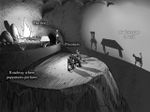
    Ideal Forms were not limited to those that could yield tangible expressions (like tables) in our sensory world. The World of Ideal Forms was populated, also, with immutable principles and attributes like Justice and Beauty and Intelligence and Depression. These principles acted upon the world of experience and were expressed in our things, and our institutions. The State, properly organized, was the highest expression of Justice in the world of experiences. Thomas Aquinas, proved the existence of the soul and the afterlife with the argument from Justice. In short, since we see an incomplete expression of Justice in our daily lives, and since Justice is real and acts upon God's creation, then scores must be settled and ledgers must be balanced somewhere other than in the world we experience. Aha! Therefore, there is an afterlife. Aha!, again. The afterlife must be populated by souls so that Divine Justice can be visited upon something that outlasted decayed flesh. British humor captured this nicely with an Anglo-Saxon St. Peter. "English souls up this way. The French, down there, please."


Pythagoras was the other culprit

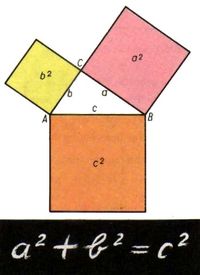
    Pythagoras (c. 569 BCE - c. 475 BCE), initially, had the markings of a budding scientist. He was keen to observe and experiment, at least so far as the physics of sound and music was concerned. His greatest achievement was discovering properties of mathematics and using them to represent Pythagoras diagram phenomenon in the world. A lot of his applications were in geometry. Why geometry? Because geometry was integral to civilized life: construction, land surveying, measuring of objects and commodities, and so on. Then he fell off his goat, damaged his brain, and took a scientific turn for the worse. The hell with wasting time observing, experimenting, and recording data. All of the secrets of the universe would yield, he preached, to the study of the mathematics that underly all of nature. Experience only gets in the way and wastes time. Get into the numbers, the ratios in particular, and all will be revealed to you. To make matters worse, knowledge was to be kept secret among the few, and not promulgated to the masses. The path to knowledge (enlightenment, if you will) was this: create a philosophers' club, require secret passwords and handshakes, support yourself from student tuitions, and delude yourselves into thinking that truth is yours for the thinking.
    Pretty stupid, huh? Well, not so stupid that most of western civilization, for 2,000 years and more, bought into the ideas that thinking and logic obviated any need for observation and experiment. It was also adopted by the church and still influences theology, doctrines of faith, and papal encyclicals. It's also part of the philosophical foundation for PTT. The real scientists-in-the-making like Thales (c. 624 BCE - c. 547 BCE), Democritus (c. 460 BCE - c. 370 BCE), Anaximander (c. 610 BCE - c. 546 BCE), and Anaximenes of Miletus (c. 585 BCE - c. 525 BCE) lost the game. The final score:

        Real Men From Let's Just Think About It            -     8

        Wusses From Let's Observe And Experiment     -     1


Abelard, and Galileo to the rescue

    So, now PTT is up at bat with two strikes against it. This would be warning enough for most good scientists. The problem is that it's impossible to see the forest for the trees if you believe you are using the correct form of good science. Also, it's hard to detect a problem when it appears that PTT does have a great deal of utility and value. It is my personal view that most psychometricians have not the foggiest notion of the consequences of having Plato and Pythagoras as their research associates. They need to fire P&P and hire a new research team, Peter Abelard (1079 CE - 1142 CE), and Galileo Galilei (1564 CE - 1642 CE). Abelard will handle the philosophical foundations, and Galileo will address the scientificAbelardHeloise foundations. First, a warning - no, two warnings. If you don't manage Abelard carefully, and keep him focused on the problem, he's going to monopolize your time and tell you about all his calamities. Like the time he was neutered by the uncle of his teenage student and lover, Héloise, at the behest of her disapproving father. Galileo can be a self-serving SOB. He's as likely to take your inventions and pawn them off as his own. Don't get me started on the telescope thing. If you keep him in line, and watch him like a hawk, he will take you to the stars.

    Abelard, following his mutilation, and not having anything better to do, returned to a monastic life. He was the greatest logician of his time; he was an outstanding teacher; and he made contributions to philosophy, theology, and ethics that influenced the entire Western world. His presence in France led directly to the founding of the University of Paris. With credentials like that, it's an easy conclusion to draw that he was considered, eventually, a heretic by the Church. Of particular note for this discussion is that he completely debunked Plato's reality of Ideal Forms and replaced it with something modern man and science could sink their teeth into. Abstractions (ideas, thoughts, concepts) do not exist. They have no separate reality. There is only one reality, and that is what we experience. It is the real pain from stubbing my real toe on the real piano leg, and letting out a real vocalization that is laced with loud expletives. From experiences of reality we create abstractions that help us name things, classify them, think about them, and relate them. They help us think and generate more abstractions that help us understand. His philosophical contribution to science was this: An idea has no separate existence of it's own apart from the human mind's ability to conceive it, communicate it, and use it to advance thought, language and knowledge. The implication for science is profound. Knowledge proceeds from both experiencing reality AND thinking about it. The scholastics are really going to be pissed.

    Galileo picked up mathematics where Pythagoras wimped out. For Galileo, mathematics was the Galileo2 language of nature, a point on which Pythagoras would agree. Galileo went further to say that mathematics should find and express relationships in that which we observe in the real world. It was ridiculous for science to meditate on numbers, and propose ratios that described all of nature, without testing to see if nature will go along. It would be even more efficient to bypass the whole dream sequence concoction, and find the ratios and relationships in nature itself. To add insult to injury, Galileo abolished all notions of absolutes in nature. He is the first discoverer of relativity. In short, mass, position, and velocity could never be determined without an arbitrary reference. There is no absolute standard for measuring nature. Aristotle, a virtual canonized doctor of the Church, is discarded in one fell swoop. Oh boy! Do you know what this means? This means that the sole arbiter of knowledge about nature and man is science. Wait till the arbiters of knowledge-through-thinking-alone get a hold of this.


PTT is saved by P. W. Bridgeman, or is it?

    In the excellent TV series on the WWII invasion of Europe by the Allied Forces, "Band of Brothers", an episode or two are devoted to the Battle of the Bulge. In particular, it was about the Battle of Bastogne and the 101st Paratroop Infantry Division of the U.S. Army, "The Screaming Eagles". The 101st was completely surrounded by the German Army, cut off from resupply and reinforcements, exposed in the worst winter in fifty years, out-equipped, and out-gunned by the enemy. The siege of Bastogne was first broken by the tanks of General George S. Patton's Third Army. In the popular mind, Patton was instrumental in rescuing the 101st Division. To this day, no member of the 101st ever acknowledged they needed to be rescued.

    The mathematical statisticians, psychometricians, and practitioners behind the development of PTT have something in common with "The Battered Bastards of Bastogne". Like "The Screaming Eagles", they don't think they need to be rescued, either. It's my personal view, that almost all would acknowledge the important advances in philosophy and science made by Abelard and Galileo. They would not, however, see the problems with PTT that are founded in Plato and Pythagoras, and exposed by Abelard and Galileo. Are they dense, stupid, incorrigible, phony, or deficient in someway? No, not really. Why? Because they have an all purpose trump card, or at least they think they do, that will get them out jail, to the head of the line, past the bouncer at Paris Hilton's club, and in a worst case scenario, a do over. Their magic wand? It's found in modern physics. In particular they are the ideas of P. W. Bridgeman in his 1927 book, "The Logic of Modern Physics".

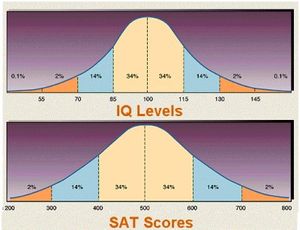
    The relevant ideas from Bridgeman are the hypothetical construct and operationalism. They are Einstein bell curve important concepts that should be adopted by psychological science. But they can't fix the problems created by Plato and Pythagoras. I will get into this and other issues for PTT in Part 2 of this article on Monday July 20, 2009. Here's something to ponder in the meantime. The Normal Curve (the Bell Curve) is not derived from nature, does not reflect anything in nature, and does not represent anything in nature. The Norman Curve is an invention of Euler and Gauss and is a purely mathematical construction. It has nothing to do with reality as far as PTT goes. Please take the time to comment on this article, and I hope you will be back for Part 2 on July 20, 2009.
    IF YOU ARE LEARY ABOUT USING YOUR REAL NAME AND EMAIL WHEN YOU COMMENT, USE A PSEUDONYM AND A PROPERLY FORMED EMAIL ADDRESS LIKE, me@my.com. WHO'S TO KNOW?

Happy Father's Day.

Posted by Norman Costa at 12:05 AM | Permalink

Comments

I'll use my real name! Really good article, Norm...

Posted by: Elatia Harris | Jun 22, 2009 1:08:39 AM

I'm sorry but this is an extremely poorly written article. There are many problems with it, but the one that jumps out is your assertion that the normal curve does not reflect or represent anything in nature. It might help if you've talked to any scientists at all before making this claim, since the normal curve is ubiquitous in nature, and serves as a good approximation of many different distributions e.g. the heights of a population. You might also want to look up the Central Limit Theorem.

Posted by: Anu | Jun 22, 2009 10:05:10 AM

I'm still not sure how this undermines PTT. You respond to your first Achilles heal by discussing relativism, which is more or less the same assumption as "fundamental reality can never be known." A good psychological test will continually be updated to reflect the best knowledge we have. Your examples of SAT score and IQ reflect this: they are adjusted over time and for age groups to attempt to not be a snapshot, but a relative measure of intelligence.

Yes, it is true that PTT relies on assumptions that aren't necessarily true, but this is also the case for virtually all scientific theories. Newton certainly didn't have the ability to test his laws under frictionless conditions, yet was able to derive the proper law of force. In order for science to progress, sometimes we have to make assumptions.

I think the question to ask is not "Are these tests the best absolutely?" Of course they are not, but this part of your overall critique! The better question to ask is, "Do these tests give us a better understanding?" I think the answer is yes. Especially in the realm of Psychology: we don't yet have a way of downloading brain signals that can be read without human interference, either the reader of the signals or the sender of the signals. For now we are like 17th century Newton, hoping that enough or our assumptions are enough correct to enhance knowledge.

Posted by: Zach | Jun 22, 2009 10:46:08 AM

...pile of dodo...

Should that be "doo-doo"? Or is it a Freudian slip? Forms being worthy of philosophical extinction. ;-)

Posted by: Bruce | Jun 22, 2009 11:26:26 AM

Since you asked for a comment...

Congratulations on trashing the most important and seminal minds in the history of western philosophy in favor of a relatively obscure medieval scholastic. However you should not blame Pythagoras for you low SAT score. Perhaps you should simply accept your inability to fathom abstract mathematical concepts unrelated to natural phenomena.

The quip about Pythagora falling off a goat and suffering brain damage was neither witty nor true - a crass ad hominem of the worst sort.

Abelard "completely debunked Plato's reality of Ideal Forms and replaced it with something modern man and science could sink their teeth into. Abstractions (ideas, thoughts, concepts) do not exist."

"The Normal Curve (the Bell Curve) is not derived from nature, does not reflect anything in nature, and does not represent anything in nature. The Norman Curve is an invention of Euler and Gauss and is a purely mathematical construction."

Honey, ALL of mathematics is purely mathematical invention/construction. You may wander the forests and deserts and plains of the earth for a lifetime and, while you may see "leaves" and "lizards" and "locusts", you will never see a "2+2=4".

This does not mean mathematics and other abstractions do not exist. Nor does it mean mathematics or other abstract concepts are not useful. On the contrary, they are indispensable to our modern social existence.

To say that psychologists misuse mathematics is one thing. (Doubting the veracity or efficacy of much the "science" of pychology is not in itself lamentable.) However blaming Pythagoras (or Plato or Socrates or Aristotle) for this misuse is just plain dumb.

I could go on but you get my drift even if I haven't "proved" anything. So you don't owe me a meal. The closest thing we have to things that can be proved are mathematical theorems and if these merit only your disapprobation then nothing, it seems, is available to be served up to you as proof.

Posted by: Richard | Jun 22, 2009 11:46:20 AM

Huh? I have no idea where you think you're going with this. You're wrong about the Normal curve, as noted. And you're misguided about the philosophy, too. Of course there are underlying traits. We may not know what they are, or the best way to approximately measure them, and they may change over time more than acknowledged, but unless you're denying the existence of physical reality, they're there.

Incidentally, you may find this book useful:

http://www.amazon.com/o/ASIN/0521388848/amazon-tag-20

The Taming of Chance, by Ian Hacking

Posted by: Harlan | Jun 22, 2009 12:24:05 PM


Elatia Harris: If no one else claims it, you get the dinner.

Bruce: I don't know how I missed that one. Thanks. Did anyone catch the "Norman Curve"?

Everyone else: PLEASE, keep those cards and letters coming in, especially the criticism. I fully expected to get my nose bloodied on this one. You are informing me as to what I must address in Part 2.

PTT is a technique, a system of high value and utility. Should we understand it's philosophical and scientific foundations and limitations? Could it be better if we eliminated the limitations and found a more robust theoretical foundation?

Here's an interesting play of CTT vs IRT in a recent appellate case before Judge Sotomayor, in the matter of a selection test for middle management in a Fire Department. No minority Fire Department personnel 'passed' the test. Minority plaintiffs sued, successfully, to bar use of the test results. During oral argument Judge Sotomayor had an interesting exchange with the respondent attorney for the Fire Department. Judge Sotomayor was arguing from the perspective of IRT, while the Fire Department's attorney was arguing from a CTT perspective. I don't know if they were conscious of that distinction at the time.

Posted by: Norman Costa | Jun 22, 2009 12:38:42 PM


Harlan: I checked out Hacking's book, and his others, on Amazon. He is definitely worthy of study before I pen Part 2. Thanks.

Posted by: Norman Costa | Jun 22, 2009 1:04:04 PM

Ya, I caught the "Norman" mistake and even quoted it but didn't deem it worthy of specific mention. Was thinking that perhaps you weren't too leery of following in the footsteps of Timothy Leary when you wrote the piece tho...

;-)

Posted by: Richard | Jun 22, 2009 2:03:00 PM

Personally, I think it is a worthy point to consider. Often we base our entire knowledge base on assumptions taken for granted by scientific giants. Rarely do I hear of someone taking the time to consider the flaws and dangers in doing this. I appreciate the thoughts on the topic and am looking forward to reading part 2 in addressing the above concerns. I thought it was enjoyable to read in its directness and humor.

Posted by: Angel | Jun 22, 2009 9:36:44 PM

Knowledge was first practiced in Greece, then the books dusted for two thousand years, and then Galileo to the rescue.

Wonderful story. And story it is.

Sorry for being mean, but I couldn't just help.

Posted by: Manas Shaikh | Jun 22, 2009 9:39:28 PM


Manas Shaikh,

No apology needed. If you inspire thought and discussion, then it's a good thing. Keep in mind that my analysis is focused on the antecedents of PTT and psychological science, not all science and knowledge. Also, a little overstatement to make a point is an acceptable rhetorical device.

In my undergraduate work in the 1960s, my college library had psychology texts that asserted memory was a property of the soul, and was not accessible to scientific research. Aristotle was referenced a great deal. So many of my contemporaries cannot fathom the preeminence of Scholasticism in some departments in institutions of higher learning. It's still around in one form or another.

Western (European) civilization was in the doldrums from the latter part of the first millennium till the 1200s CE, compared to the advances in all aspects of culture, learning, technology and the sciences in the Islamic world. The West owes so much to Islamic civilization for both preserving and developing knowledge, science, philosophy, etc.

In the 1400s, dissection was starting to be accepted, in the west, for proper anatomical study. When studies showed that nerves led to the brain and not to the heart, there was a crisis among the academic physicians. They were saying, literally, since they knew from Aristotle that the heart was the seat of emotions, and not the brain, they were obliged to dismiss what they were seeing.

What other science, today, starts with the premise of Ideal Forms from Plato? Did you know that we couldn't get the American Psychological Association to take a public stand with science in the Dover School District intelligent design controversy? Nobel Laureate Richard Feynman noted that psychology as a science seems to have the mastered the form of science, but we are not producing any laws of nature. My point is that there is good reason for that.

Posted by: Norman Costa | Jun 22, 2009 10:32:19 PM

Thnaks Norman,

I don't know a lot of names in the field of psychology. But I will mention a physicist who worked on psychology. Ibn al-Haitham, is said to have introduced experimentation into psychology. He probably was not the only person in his culture thinking about psychology.

However, it is not only Islamic contributions that are ignored. Indian, Chinese and Persian elements that contributed to the Islamic science and (mainly through that path) to the modern sciences in the West.

However, I do not know enough about history of psychology to be able to mention names, but I am quite sure there have been many who wondered about mind.

Posted by: Manas Shaikh | Jun 22, 2009 11:05:11 PM

Dr. Costa, in your rush to condemn a flawed, but nonetheless useful, system of knowledge without proposing a better one, you are clearly ignoring (or ignorant of) the purposes of psychological science. There are 4 purposes to psychological research: description, prediction, explanation, and control. Too, it is useful to bear in mind that there are at least two levels of analysis that are commonly utilized. Psychologists may consider the behavior of individuals (usually those who do that are clinicians), or we may consider the behavior of groups of people.

When considering the behavior of individuals, one may have the luxury of enough time to write out a lengthy treatise describing the individual in depth. We call those treatises case studies. Psychological scientists who use other research designs are fond of pointing out the lack of validity and reliability inherent in case studies. That being what it may, case studies are useful when attempting to describe behavior. They sometimes assist in the prediction of behavior. However, because the sample is one individual, the prediction is pretty iffy and attempting explanations is hazardous at best, regardless of the faith the researcher puts in his or her study.

On the other hand, you may not have that kind of time on your hands. Alternatively, that kind of in depth look at one person’s psyche may not be what you have in mind. Instead, you may want to compare that individual to other people, thereby using both an individual and group level of analysis. Perhaps you want to predict the behavior of a particular individual by comparing that person to the behavior of similar others. Now here is the conundrum. How do I compare the person in front of me, Namron, to other people? Suppose I want to know if Namron is as smart or as anxious or as self-confident as other people. How do I discover this? Well, back in the bad old days before classical test theory, I would have read an infinite number of case studies, wondering if the authors meant the same thing I did by anxious, and trying to winnow some bran from the chaff. It would have taken a long time. It would have been frustrating and ultimately shed very little light on the question.

What test theories, and tests themselves, allow us to do is give Namron a test or 3, and compare her scores to those of a large sample of people who have taken those tests previously. We can then determine that Namron scores very high indeed on measures of intelligence, is more anxious than normal, and about as self confident as the next gal. Now, before anyone jumps down my throat, let me clearly state that comparing Namron’s scores on a measure of intelligence to those of 1,000 other people is likely to be a poor predictor of her performance on the job I am considering hiring her to do. (Intelligence scores predict school performance and little else.) In addition, Namron’s intelligence scores may or may not have anything to do with how intelligent Namron in fact is. Philosophical debates about ideal forms aside, one important reason for this is the fact that the definition of intelligence is hotly debated, and frankly, I wonder if the concept has any real utility. Which is THE weak spot in psychological testing that Dr. Costa neglects to touch upon. That is, psychological tests allow the reification concepts, making real things that may or may not have any use to anyone other than the graduate student who got a degree for constructing the test as part of his or her dissertation project. Still and all, when you are faced with 500 applicants for 10 openings, it sure is nice to be able to weed some of them out quickly.

Now, psychology isn’t just about hiring the right person for a job or even about shrinking heads (as so many people seem to think). Sometimes we want to know how prejudiced people are, whether the children of alcoholics have the same psychological issues as children of abusive parents, or if the new instructional techniques are better than the old ones. Given our current level of technology, the best way to find any of those answers is to ask people questions. So, if we want to know how people in general think, as opposed to simply describing the thoughts of the 50 people we could talk to before our grant money ran out, then we need to ask questions in a way that will allow our results to generalize. We need to use tests, not interviews, and certainly not case studies. If we really want our results to generalize, if we want to have some validity and reliability, maybe even get published, we need to use a theory of test construction. For most purposes, Classical Test Theory is quite sufficient. However, not for all of them.

Why would we use Item Response Theory? Well, if we want to construct an achievement test, we want to know how closely the answers to each question (each item) are related to the overall score. That will allow us to determine the quality of each question. For example, if most questions are answered correctly by 75% of the students and Question 12 is answered correctly by 5% of the pupils, you know it is different than the other questions. You can choose to keep it because you think some questions that separate the excellent students from the average students belong on the test. Or you may choose to exclude it, because you believe it to be too difficult. The test theory won’t solve that puzzle for you, but it will give you the knowledge you need to make an informed decision.

As we have seen, psychological testing theories are useful if we want to describe behavior. They are even more useful if we want to predict behavior. Where we get into trouble sometimes is thinking that they can explain the causes of behavior or help us control behavior. (Those of you, who think the desire to control behavior is deplorable, go try to teach spelling to a room full of 7 year olds and then talk to me.) The trouble there, however, is as much with using correlational designs to explore experimental problems, as it is with any theory of how to construct tests and measures. Too, we must be mindful that psychological tests are only so helpful when we are using an individual level of analysis. At that level, we are often better off using case studies. However (again) if we want to use a group level of analysis, they are invaluable. Finally, it must be granted that psychological testing allows many concepts to be reified, some of which are not strictly necessary for the understanding or well being of the human species. That said, I still must conclude that throwing the baby out with the bathwater does not change the fact that the kid needed the bath!

Posted by: Rhea | Jun 22, 2009 11:44:53 PM


Manas Shaikh,

I just read the opening summary about Ibn al-Haitham on the link you provided. I am in awe of his intellectual and scientific achievements. This intensity of drive for scientific method and scientific knowledge was NOT matched by the Church-dominated West at that time. The Church was the arbiter of all truth, with little distinction made between matters of the Divine and the mortal.

As far as I understand it, Islam did not appear to usurp the role of arbiter of truth for scientific matters.

A great book on the subject is "The Mind of the Middle Ages: An Historical Survey" by Frederick B. Artz.

Posted by: Norman Costa | Jun 23, 2009 12:05:39 AM


Rhea,

Thanks for taking the time to provide a reasonably comprehensive review of the purposes of psychological testing. I think it will help to bring those who are not in this field up to speed in some fashion.

The rationale for psychological testing and its great utility and value are not being called into question. What I am arguing with, and will complete in Part 2, is the philosophical and scientific foundations of current PTT, which I find lacking.

Let's say we have a not-so-good theory, and a pretty good theory. The two theories are not compatible with each other. It is still possible to yield identical predictions from two incompatible theories. For example, the not-so-good theory is an earth centric view of the universe. The pretty good theory is a heliocentric theory of the universe. Both theories do an excellent job of predicting sunrise and sunset, position of the stars, and the creation of a reliable calendar. The Mayan calendar still does a better job than either the Gregorian or Julian calendars. However, if we want to send astronauts to the moon and return them safely to earth, only the heliocentric theory will do.

If we understand the limitations of PTT (as distinct from the practice of testing), and get rid of them, then we make possible the equivalent of sending humans to the moon, and returning them safely to earth. Otherwise, we are pretty much earth bound, though useful and gainfully employed by ETS.

Posted by: Norman Costa | Jun 23, 2009 12:26:53 AM


Anu,

I am a scientist, and I do talk to myself. On occasion I've been known to talk to other scientists, as well.

Regarding the Normal Curve (Normal Probability Density Function), there is a fine and subtle point to consider in understanding how it relates to Psychological Test Theory (PTT). Before we discuss what this is, we have to establish a few things:

1. On the level of common sense observation and utility, the Normal Curve APPEARS to be in line with many distributions that are observed in nature. In your words, “...the normal curve is ubiquitous in nature, and serves as a good approximation of many different distributions e.g. the heights of a population.”

2. The Normal Curve is one of a number of distributions used by PTT. There are distributions for both continuous variables and discrete variables. Each distribution curve APPEARS to approximate distributions found in nature.

3. All of these distributions, though they APPEAR to mimic nature, are purely mathematical constructions, and are not derived from systematic observation. To the mathematician, this is a big “SO WHAT!” Richard's comment was spot on: “Honey [Honey???], ALL of mathematics is purely mathematical invention/construction. You may wander the forests and deserts and plains of the earth for a lifetime and, while you may see "leaves" and "lizards" and "locusts", you will never see a "2+2=4"”. To the psychometrician, this is a big “WHO CARES!” Rhea said it very nicely: “As we have seen, psychological testing theories are useful if we want to describe behavior. They are even more useful if we want to predict behavior.”

The fine and subtle point is this: The best, but least practical, means of studying measured psychological phenomena begins with a study of the distribution of the measures and determining the properties of the distribution. We use various known mathematical distributions, not because they APPEAR to look like distributions in nature. Rather, we use them because the inventors of the distributions have already defined their properties, though not empirically. Why spend time determining, empirically, the properties of the distribution under study? Let's use a close-enough mathematical distribution whose properties are defined down to a gnat's eyebrow. From the point of view of practicality and utility, “SO WHAT!”, and “WHO CARES!” still apply. From the point of view of theoretical foundations, it makes all the difference in the world. We cannot discuss the good or bad of PTT without agreeing on the assumptions.

Posted by: Norman Costa | Jun 24, 2009 9:29:17 AM


Richard,

Doth thou not see big tongue in even bigger cheek?

Posted by: Norman Costa | Jun 24, 2009 9:36:50 AM


Harlan,

You write, "Of course there are underlying traits." Other than PTT, what modern science begins by quoting Plato?

Posted by: Norman Costa | Jun 24, 2009 9:51:38 AM


Zach,

We agree on the value and utility of the modern practice of psychological testing. The assumptions from which we derive such benefits, however, can also limit progress, and hide problems. In Part 2, I will discuss how we may be misleading ourselves and thinking that some of the observed value and utility is more apparent than real.

I repeat from my response to Rhea, that conflicting theories can lead to identical predictions. Excellent calendars can be derived from both an earth-centric view of the heavens, and a sun-centric view of the heavens. The earth-centric theory, though, will never get us to the moon.

I hope you will return on Monday July 20, 2009 to read, comment, and even criticize.

Posted by: Norman Costa | Jun 24, 2009 2:59:12 PM

Gee, Norm, if Achilles could have healed, he wouldn't have died.

Posted by: Don | Jun 24, 2009 6:21:27 PM

Norman,

In your reply to Anu, you wrote, "The best, but least practical, means of studying measured psychological phenomena begins with a study of the distribution of the measures and determining the properties of the distribution. We use various known mathematical distributions, not because they APPEAR to look like distributions in nature. Rather, we use them because the inventors of the distributions have already defined their properties, though not empirically." Unfortunately, you are not entirely correct here. While some psychological tests, for example, the Wechsler IQ tests, were built to fit a so-called normal curve, with distributions based on the mathematical logic you deride, rather than on the observed facts you tout, others were not. The Minnesota Multiphasic Personality Inventory (MMPI), for example, was derived EMPIRICALLY. (That is one of several reasons it has so little face validity.) Thus, the MMPI cut-off points that are supposed to discriminate normal quantities of a particular personality trait from abnormal quantities of the same trait are based on the impractical real world data you are so confident psychology eschews. They are not arbitrarily set to conform to “normal” curves, as is the SAT. Having said that let me be clear that although the traits seem to discriminate between people with and without mental illnesses, they may or may not be ideally named. What I mean by that is that the traits may or may not be real, just because the answers to the questions work. But then, that gets into the whole argument about what is real and what is not. I’ll leave such maunderings to philosophers like you. Me, I only need to know if I can get to the moon.

Posted by: Rhea | Jun 25, 2009 8:18:50 PM

I love the way U write and like U said, monopolise my time... Excellent! Tks and write more stuff please.

Posted by: Phoenix | Jul 20, 2009 5:06:25 AM

While I am not on the planet to win a dinner from this contest, nor on one where the writer gets "honeyed", it was a very enjoyable discussion for me to be reading. Plus I loved the illustrations. All lively.

Thanks so much, Reven

Posted by: Reven Tell | Jun 4, 2010 5:12:19 AM

Post a comment


Subscribe to this blog's feed  

PayAnywhere with iphone credit card swiper

Android Tablet

Bluetooth Headset

2013 New Style Dresses

Compare Car Rental Prices

DHgate.com Wholesale

3QD on Facebook

3QD on Kindle

3QD by Daily Email

Receive all blogposts at the same time every day.

Enter your Email:


Preview 3QD Email

3QD on Twitter

Miscellany

Lijit Search

AddThis Social Bookmark Button

Add to Google

Recent Comments

Pierre on REFLECTIONS ON WOOLWICH

chris on Race Is Not Biology

Dave Ranning on REFLECTIONS ON WOOLWICH

Sumiran on Friday Poem

prasad on Race Is Not Biology

omar on REFLECTIONS ON WOOLWICH

G on REFLECTIONS ON WOOLWICH

Erich on REFLECTIONS ON WOOLWICH

omar on Race Is Not Biology

Raza Husain on Race Is Not Biology

Raza Husain on Race Is Not Biology

Josef Stern on REFLECTIONS ON WOOLWICH

Colette on POETRY IN TRANSLATION: CORDOBA

Dana on A young Houston couple is planning to give away $4 billion—but only to projects that prove they are worth it. Can they redefine the world of philanthropy?

omar on REFLECTIONS ON WOOLWICH

Dredd on REFLECTIONS ON WOOLWICH

omar on Race Is Not Biology

prasad on Race Is Not Biology

JF on REFLECTIONS ON WOOLWICH

Sundar on REFLECTIONS ON WOOLWICH

omar on REFLECTIONS ON WOOLWICH

musafir on Loneliness, isolation and desperate yearning

carlos on The Gut-Wrenching Science Behind the World’s Hottest Peppers

Dredd on A young Houston couple is planning to give away $4 billion—but only to projects that prove they are worth it. Can they redefine the world of philanthropy?

Dredd on Why Rational People Buy Into Conspiracy Theories

Acclaim For 3QD


"I couldn't tear myself away from 3 Quarks Daily, to the point of neglecting my work. Congratulations on this superb site."—Steven Pinker, Johnstone Professor of Psychology, Harvard University.

"I have placed 3 Quarks Daily at the head of my list of web bookmarks."—Richard Dawkins, Charles Simonyi Professor of the Public Understanding of Science at Oxford University.

"Just wanted you to know I’m one of many who reads and enjoys 3 Quarks....almost daily."—David Byrne, musician, former lead-singer of the Talking Heads, artist, intellectual.

Read more here.

The 3QD Prizes

Subscribe to this blog's feed