
June 06, 2009
Homeopathy kills
Phil Plait in Bad Astronomy:
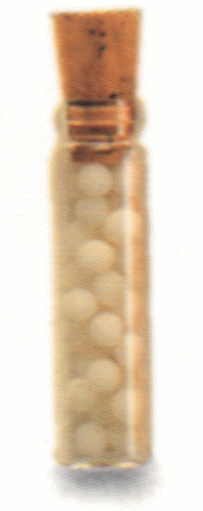
Homeopathy is the antiscientific belief that infinitely diluted medicine in water can cure various ailments. It’s perhaps the most ridiculous of all "alternative" medicines, since it clearly cannot work, does not work, and has been tested repeatedly and shown to be useless.
And for those who ask, "what’s the harm?", you may direct your question to Thomas Sam and his wife Manju Sam, whose nine-month-old daughter died because of their homeopathic beliefs.
The infant girl, Gloria Thomas, died of complications due to eczema. Eczema. This is an easily-treatable skin condition (the treatments don’t cure eczema but do manage it), but that treatment was withheld from the baby girl by her parents, who rejected the advice of doctors and instead used homeopathic treatments. The baby’s condition got worse, with her skin covered in rashes and open cracks. These cracks let in germs which her tiny body had difficulty fighting off. She became undernourished as she used all her nutrients to fight infections instead of for growth and the other normal body functions of an infant. She was constantly sick and in pain, but her parents stuck with homeopathy. When the baby girl developed an eye infection, her parents finally took her to a hospital, but it was far too late: little Gloria Thomas succumbed to septicemia from the infection.
More here.
Posted by S. Abbas Raza at 04:07 AM | Permalink


Comments
i'm missing the shades of gray here... questions:
/ does some homeopathy use less than infinitely diluted amounts?
/ does some homeopathy work despite its excessive molar dilution?
personal account: as a teenager i once had severe cold and a touch of bronchitis. a family homeopathic doctor prescribed a medicine which didn't quite work: it caused phlegm to be secreted from my eye ducts. gross, but true. we called him and he conceded that he'd made a mistake. all's well etcetera.
the uptake for me is not that homeopathy can harm through its inaction and inefficacy, but rather that homeopathic prescriptions can and do have physiological effects -- and these can either harm or cure, just like 'chemicals' other than sugar and water.
Posted by: Aditya Dev Sood | Jun 6, 2009 6:26:19 AM
I was astonished, my first season in Berlin (a few months after the fall of the Wall, in fact) to discover that something between 20% and 30% of the shelf space of the average Apotheke (pharmacy) is dedicated to Homeopathic (or Homeopathy-related "folk cure") "medicines". The image I'd been fed of Germans (as monolithically machine-efficient, Spock-logical and science-saturated) was false. German culture has an enduring mytho-poetic/metaphysical side.
I shared a house in the suburbs here, once, with a couple who hosted weekly meetings of a "Geomantik" group the purpose of which was to heal the planet through spooky, pseudo-Tibetan chants. They sometimes did field work, encircling "sick" trees in the Tiergarten and chanting the poor plants back to vibrational balance (tm). They were homeopaths, too, this kooky couple (very sweet people)... and chronically ill. I've never heard so much *year-round* sniffling and sneezing and Kafkan coughing in my life.
Posted by: Steven Augustine | Jun 6, 2009 8:07:15 AM
"Kafkan coughing"
You should hurry up and trademark that too Steven!
Posted by: Jesse | Jun 6, 2009 8:36:25 AM
Aditya,
Either your symptoms were a complete coincidence and had nothing to do with the homeopathic drug, or it was not a homeopathic drug. If a homeopathic drug were to have any effect at all, it would overturn everything we know about the universe and the scientific laws which govern it.
Posted by: Abbas Raza | Jun 6, 2009 9:17:12 AM
abbas,
seems to me that that happens all the time! in the infinitude of our ignorance, one can drown galaxies, an old professor of mine used to say.
and this is without entering into the question of what healing consists in, exactly...
(it's not often that i wax humble, and when i do it's not at my own expense... so enjoy!)
Posted by: Aditya Dev Sood | Jun 6, 2009 11:28:03 AM
Jesse:
A great name for a band...?
Posted by: Steven Augustine | Jun 6, 2009 11:38:31 AM
And, Abbas, there is that strangely unscientific but well-recognized phenomenon called "The placebo effect."
Posted by: Lambness | Jun 6, 2009 12:39:31 PM
I'm not so sure the placebo effect is "unscientific." It has certainly been observed and measured at length by scientists. Perhaps there is no universally-accepted (by scientists) mechanism to explain it, but that is true of gravitation too, is it not?
Posted by: giotto | Jun 6, 2009 2:39:27 PM
Lambness,
That's part of the "hard problem" of consciousness. It dwells beyond "everything we know about the universe and the scientific laws which govern it."
bostonreview
wrongdiagnosis
"Starfield JAMA article: Barbara Starfield's JAMA article (Volume 284, No. 4, 2000), gives very large estimates of death due to medical treatment. A total of 225,000 deaths are attributed to various iatrogenic causes. This figure puts them at the 3rd highest cause of death, only after heart disease and cancer. With roughly 2.4 million US deaths in 1999, these estimates would put iatrogenic causes at approximately 9.3% of deaths.
However, not all of these deaths are necessarily from "mistakes" with 106,000 deaths due to "nonerror adverse events of medications". In other words, people had adverse reactions to a medication but it was not an error because they had no previous indication of a risk factor. Another 80,000 deaths are attributed to nosocomial infections, which are also not necessarily due to a particular "error" since there is always a risk of infection in hospitals. Her report also cites 12,000 deaths from unnecessary surgery, 7,000 deaths from medication errors in hospitals, and 20,000 deaths in hospitals from causes other than medication errors."
Not ALL alternative medicine is "ridiculous," and it serves no one to suggest that all alternatives to conventional treatments are the same as quack remedies like homeopathy.
mbmi
umassmed
If someone dies as a result of homeopathic treatment, there's an effort to reveal its non-scientific basis. When patients die from Macrodantin toxicity or spend the rest of their lives tethered to an oxygen leash, after their lungs have turned into interstitial fibrosis, it's tough luck and the drug is not taken off the market. Hell, some people might die from eating peanut butter. Should we ban peanuts? Avoid prescribing them?
The "scientific basis" of pharma's effects in psychiatry is far from salutary, unless one sees brain damage and other physiological disabilities as benefits of scientific-medicine-based treatment.
Posted by: Louise Gordon | Jun 6, 2009 3:08:19 PM
Every single "argument" in support of Homeopathy can also be used to support Faith Healing, Healing Crystals, Village Shamans, Voodoo mojos, Christian Science, Lourdes, Orgone Boxes, rubber duckies and Laughter Therapy... and any other course of creative para-medicinal treatment that stands a statistical chance of appearing to occasionally show favourable results.
Toxically wicked hyper-capitalist pharmacology doesn't invalidate scientifically verifiable treatments/results... it merely invalidates *hyper-capitalist pharmacology* while doing nothing to validate utter nonsense such as Homeopathy: you guys really need better (adult-sized, non-rubber) arrows for your rhetorical quivers.
Meanwhile, I'll add this thread to the mounting evidence for my theory that all debates on 3QD break down to Believers vs Non-Believers (laugh)... or is that *all debates*, period?
Posted by: Steven Augustine | Jun 6, 2009 4:11:12 PM
Steven,
I did not say that iatrogenic damage validated quack remedies like homeopathy. I said that not ALL alternatives to conventional treatments are ridiculous. I suggested that there's plenty of BAD science in conventional medicine.
Reading you starts to give me a sick headache. I may have to go see cardiologist Herb Benson for some relaxation response.
Meantime, here's some "Laughter Is the Best Medicine" for you and Abbas:
HaHaHaHa
Posted by: Louise Gordon | Jun 6, 2009 5:03:04 PM
"Reading you starts to give me a sick headache."
Louise, I suspect a surplus of the *Vataj dosha* at the level of your head chakra.
Posted by: Steven Augustine | Jun 6, 2009 5:26:54 PM
I believe there are a number of diseases (obviously, not eczema) for which placebos might be effective. As one of the links says, "It is undisputed that with the help of homeopathy, not insignificant placebo effects can be achieved.".
This is not how we like our medicine to work, but I'm all for it if the evidence suggests better outcomes.
Posted by: Sagredo | Jun 6, 2009 5:29:45 PM
Just an aside:
drugtrials
Posted by: Louise Gordon | Jun 6, 2009 6:13:15 PM
The double-blind randomized controlled trial, the gold standard of scientific testing, is what is depended upon to establish that treatments actually statistically “work,” and yet, one of the chief complaints about the trials that demonstrate some efficacy of homeopathic treatments is that they demonstrate publishing bias and methodological problems. It would seem that all randomized trials would be subject to the exact same two problems, meaning that they perhaps do not deserve the “fool-proof” status that they are often awarded (see Milgrom, 2006, p. 213). Scientific inquiry begins, like most things, with assumptions. For example, who decides what qualifies as “statistically significant?” Additionally, there are many variables which the artificial laboratory environment cannot measure or control, for example, how friendly the researchers were, and how the level of friendliness affected the outcome. It simply is not possible to be completely objective, even in science. That doesn’t mean that some outcomes aren’t totally supportable. It means that not all of them are, regardless of what we “believe.”
I say this because of Steven’s comment about debates boiling down to “believers versus non-believers.” Once again, the discussion is framed in an either/or paradigm, when it might be more true to say that, given the myriad problems and variables with observation as a whole, it’s really a question of “believers versus believers.” Why must it even be viewed as debate? Must someone “win?” That qualifies, to me, as a bias in and of itself. What science inevitably demonstrates, to me, is that our assumptions, beliefs, and “facts” about things are invariably modified and even overturned by future examination.
For myself, I’m not a big fan of homeopathy, because I haven’t experienced a great deal of success with it. Likewise, I’m not a big fan of “statistically significant” pharmaceuticals such as anti-depressants either, for the very same reason. I don’t conclude from this that either one of them should be thrown wholesale into the trash. I mean, I’m really happy to live in an age of antibiotics, and really sad to live in an age of cold, institutionalized “care.” I don’t find any particular benefit to the artificial “all or nothing” paradigm. It is not an either/or equation. Isn’t that a legitimate possible truth? As for beliefs, I think an open mind works out to be the best approach, any way you cut it—scientifically, philosophically and historically.
Posted by: Lambness | Jun 6, 2009 6:31:09 PM
Believers vs Non-Believers (laugh)... or is that *all debates*, period?
That is why my go to guy (I'm assuming male identity, as I don't think the current version of the Bronze Age Fiction was clear on this) is the Talking Snake. I just jump on Mohammed's Flying Horse. and give him a visit.
No need to think, the Talking Snake takes care of that.
The Talking Snake has been strangely absent from #quarks, so I though it was my religious duty to carry on the truth.
Posted by: Dave Ranning | Jun 6, 2009 7:56:29 PM
I agree that there is no scientific reason for homoepathy to work, but I do think it helps in two ways: one, it enhances the placebo effect; and two, it is usually a harmless thing to take for illnesses like common cold which cure themselves but the patient needs the satisfaction of taking something.
Placebo effect is real . I often wonder why medical research does not concentrate on harnessing this effect towards treatment. Homoepathy does precisely that. A homeopath does not give any one medicine for headache. He selects from some 50-odd ones after asking whether the headache is cutting, piercing, boring, pressing; whether it is more in morning, afternoon or evening; whether it gets better or worse indoors vs. outdoors and dozens of such questions. When the patient finally gets a few sweet pills after such exhaustive consultation, her body and mind are fully primed to maximise the placebo effect.
Yes, I do agree that homeopathy must be quickly abandoned if the patient is getting serious. Most people, including homeopathic practitioners, do this when illness gets out of hand.
Posted by: Subodh | Jun 6, 2009 11:26:34 PM
It's difficult to understand a conviction that would stand up to 4 months of living with a baby in constant pain. I'm not a big fan of "alternative treatments" OR taking whatever the doctor prescribes w/o question, but after 4 months of that I'd be willing to try just about anything.
Posted by: Vicki Baker | Jun 7, 2009 12:12:48 AM
i had some sense that this conversation was going to tailspin into territory no one can inhabit without getting a headache.
what the original piece as well as many rationalist defenses of its polemic reveal to me is an ideology of scientism: there are clouded and deluded minds out there who oppose progress and modernity, we must use the truth to set them free. the body is a machine and it can be biomedically calibrated. how terribly quaint -- is that a corbusier table you have in the corner, next to the eames chair?
the fullness of life and the sickness of the body in any real and inhabitable social universe cannot admit of such absolutism.
i'm out of my depth as a historian of science or a biomedical anthropologist, but i now know through direct observation that most allopathic medicine is founded on traditional systems of healing -- albeit informed by a new round of inferences as to why the natives might be using the particular forest product in question.
several other commentators above have defended homeopathy using placebo effect theory. i think that's too limited.
i'd be happy saying that we simply don't yet know why these german and indian natives have taken to homeopathy and what social interactional and / or physico-physiological effects it has, or why patients and practitioners find it to be efficacious in treatment and healing. nevertheless, there is abundant social evidence that it helps people, especially with chronic ailments that are not alleviated through allopathic approaches.
Posted by: Aditya Dev Sood | Jun 7, 2009 12:52:16 AM
Damn it. My entire comment just disappeared.
bio-medicine
">http://www4.nau.edu/insidenau/bumps/2009/01_14_09/seeds.htm">
nau
I'll have to try to reconstruct it later. I didn't know the jury was still out on homeopathy. Aditya, I believed the polemic. I think that practitioners like Herb Benson at MGH and Andrew Weil, University of Arizona, and the people at the stress reduction center, UMassWorcester, are exploring the mind's (or brain's) effects on the rest of the body, but they wouldn't call it placebo effect.
Also interesting:
ellenlanger
Posted by: Louise Gordon | Jun 7, 2009 2:24:13 AM
Aditya,
Taking a stab at medical anthropology:
Satanism and Witchcraft: A study in Medieval Superstition
by Jules Michelet and A. R. Allison
"For a thousand years, the people had one healer and one only -- the Sorceress. Emperors and kings and popes, and the richest barons, had sundry Doctors of Salerno, or Moorish and Jewish physicians; but the main body of every State, the whole world we may say, consulted no one but the Saga, the Wise Woman. If her cure failed, they abused her and called her a Witch. But more generally, through a combination of respect and terror, she was spoken of as the Good Lady, or Beautiful Lady (Bella Donna), the same name as that given to fairies.
Her fate resembles that which still often befalls her favourite herb, the belladonna, and other beneficent poisons she made use of, and which were antidotes of the great scourges of the Middle Ages.
The authors go on to say that in 1527, Paraclesus credited sorceresses with all he knew. But that the Bella Donna's thanks for the healing and good she effected was being tortured and burned at the stake."
Posted by: Louise Gordon | Jun 7, 2009 3:20:43 AM
Lambness
The double-blind randomized controlled trial... Additionally, there are many variables which the artificial laboratory environment cannot measure or control, for example, how friendly the researchers were, and how the level of friendliness affected the outcome.
You obviously do not understand what "double-blind" means. If the doctor doesn't know if she's administering the real treatment or the sham one, then her "friendliness" doesn't matter.
Subodh
one, it enhances the placebo effect
No, it doesn't. That is, I can say I'm giving you homeopathic medicine and instead give you plain water or a sugar pill, and it will have the same effect. Homeopathic "medicines" do not work.
Posted by: billy | Jun 7, 2009 7:31:12 AM
Okay, billy. Sigh. I guess there's no point in further discussing it.
Posted by: Lambness | Jun 7, 2009 1:23:05 PM
Lambness,
Oops. I discovered that Andrew Weil approves of homeopathy. I admit I may have called it a quack remedy too hastily.
I think a lot of alternative medicine is in the preventive range, i.e., nutrition, exercise and so on. But I noticed a long list of maladies on Herb Benson's MGH site that are being treated or at least palliated through "relaxation response" medicine.
I wonder where Felix Larocca is. And Miss Volare. I'd be interested in Felix's opinions on this topic.
Posted by: Louise Gordon | Jun 7, 2009 1:46:38 PM
Andrew Weil is nice guy (he really helped a friend with hepatitis while both were living in Columbia), and I have always enjoyed his Psychonaut travels and ethnobotany explorations, his mushroom studies, etc., but like Terrance Mckenna, some of it is brilliant, some absolute horse shit.
Posted by: Dave Ranning | Jun 7, 2009 5:23:23 PM
Scientific results become clear through observation, yet the very act of observing changes the results. Does this "explain" the placebo effect? I do agree that this question shall never be settled in an all-or-nothing, winner takes all way. Being committed to science in a mystical way, I realize i will always have data/results/effects that lie outside the theorized or expected range. I am sure there are completely valid reasons for these results, but with the limited ability of my instruments/understanding, I cannot account for them. So the most efficient path is to ignore any information that does not fit the pre-conceived paradigm. This gives belief the floor. All the ideas "outside" the established parameters become ground for seriously whack craziness (from Chopra to chakras), and it's not science anymore. But we kid ourselves with double-blind studies, verification, etc., which are still limited by inherent bias.
So since I have had a considerable length of time finding that a specific homeopathic remedy is efficacious for the discomfort of teething in babies, I can speak to the usefulness of this treatment modality. Not only with my own children's pain and drooling and irritability, but throughout a 5 year span of use during the time I was providing daycare to numerous children. Every single one of them showed relief and sometimes complete cessation of symptoms. Perhaps the placebo was working on me? And no, it's not a valid "study," and it's completely anecdotal, but it sure made my life better!
Let's be thankful that teething isn't deadly, but I still don't "believe" in homeopathy, or that all illness can be explained by mechanics/chemicals, either. I can understand a parent wanting to keep trying to find something, anything, that works. And the lengths they go to for that hope. When antidepressant therapy has a paradoxical effect on the patient and causes suicide, does that mean they are "unscientific" drugs?
"Skepticism is the chastity of the intellect."
--Santayana
Posted by: MissVolare | Jun 7, 2009 8:33:58 PM
MissVolare, you're back! I'm very happy to see you...
Posted by: Elatia Harris | Jun 7, 2009 9:36:11 PM
MissVoltare---
Well, I can play in the shallow end of the pool also!
Deepak can possibly enlighten me, for a mere three thousand?
Posted by: Dave Ranning | Jun 7, 2009 9:45:58 PM
"Scientific results become clear through observation, yet the very act of observing changes the results..."
Oh no, *please*, not that faux-Hiesenberg stuff... next thing you know, somebody'll bring up some cocktail-party-chatter-grade "String Theory" gunk (or even *Chaos Theory*... shudder)...
Posted by: Steven Augustine | Jun 8, 2009 4:55:08 AM
Steven--I am with you there on "string theory" and i don't attend cocktail parties! Having read Sean's blog for many years and studied Eddington, Einstein and Feynman, I will agree that there is always more I do not know very well, but I know enough to try and remain rigorous. For me, that includes keeping an open mind.
"A man should look for what is, and not what he thinks should be."
-A. Einstein
And thank you Elatia--that is sweet!
Posted by: MissVolare | Jun 8, 2009 4:12:18 PM
I suspect that much of medicine relies on the placebo effect for the simple reason that the body will cure itself of most conditions given time and rest. Placebos have the great advantage of no harmful side effects.
Posted by: J. Hawkins | Jun 8, 2009 4:38:07 PM
Miss V:
Just teasing! (It's only the word "fractals" that *really* sets my teeth on edge... laugh)
Agreed on "open-mindedness", but I also believe that, in order to cut down on the waiting line at the patent office, there should be a limit after which, if a positive case hasn't been made after umpteen trials, the unverifiable charm of anecdotal evidence (plus all considerations of how *neat* a theory would be if only it were proven to be true)... are not enough to keep the mind propped open to an already unlikely proposition.
Homeopathy has had over two centuries to produce better-than-iffy results and it has failed to. Shouldn't we be on the look-out, instead, for "alternative" medicines that actually work? The Truth is out there... but maybe it's too boring to capture the public's fancy... ?
Posted by: Steven Augustine | Jun 8, 2009 6:01:47 PM
damn erratum:
"is not enough"
Posted by: Steven Augustine | Jun 8, 2009 6:03:23 PM
http://www.bloomberg.com/apps/news?pid=20601087&sid=ax2SviPKBoIE
Hmm...I guess all those double-blind studies didn't catch the harmful effects of Percocet for more than a decade that it had been on the market after getting approved. Or maybe the pharma company marketing the drug and/or revolving door policy at FDA played some part? So much for modern "medicine".
Posted by: Kaffir | Jun 30, 2009 8:32:04 PM
"I suspect that much of medicine relies on the placebo effect"
Except that homeopathic vets claim that their remedies work on animals. If they are right, then you are wrong. Animals are not subject to placebo effects.
Posted by: F Sawalha | Feb 18, 2013 1:13:42 AM
Post a comment