
by Jeff Strabone

Gordon Silverstein, my professor at Dartmouth in the 1990's, recently called Justice Souter 'the only true conservative' on the Court in the New Republic for May 1, 2009. Souter, Silverstein reminds us, has been conservative in his judicial temperament. It's the precedents that he conservatively upheld that happened to be liberal:
Judicial conservatives generally have great respect for the law, and for legal decisions that have been made. This is the essence of what is called stare decisis—let the decision stand. Upholding precedent staunches the forces of change—and typically, that generates conservative results. But when the precedent you are upholding is precedent set by the Warren Court, holding back the forces of change means enforcing liberal decisions against radical demands for change from movement conservatives.
That was not the kind of conservatism that Bush had intended.
My most distinct memory of watching Souter's confirmation hearings on C-SPAN in 1990 is that the guy was a real enigma, so much so that Senator Paul Simon encouraged him to get out more, get some experience, see more of the country. From the transcript of the Senate Judiciary Committee's hearings for September 14, 1990:
Senator SIMON. Finally, just a suggestion that I am going to pass along to you. Growth is one of the things that I talked about in my opening remarks. I think it is very important for Senators, I think it is very important for Justices on the Court, to be exposed to things in our society that maybe we have not been exposed to.
Even now, news sources claim he has only travelled outside the U.S. once, and that was to attend Oxford as a Rhodes scholar.

Broadly speaking, there are two basic types of people who flat-out refuse to travel: at one end, uncurious know-nothings, and at the other, the quiet, contemplative sort who would prefer to stay home and read according to a model of learning more monastic than modern. Luckily for the country, Souter was the latter sort of stay-at-home: a learned man not given to show but prepared to stand up for what matters most. Here he is offering a vigorous, practical defense of the humanities at a symposium sponsored by the American Academy of Arts and Sciences on March 10, 2009. I sometimes wonder, particularly when I see pictures of his New Hampshire home, if Souter has fashioned his life after Henry David Thoreau.

The question now that he has announced his retirement from the Court is how to replace him. The arguments we hear most frequently in the press and online revolve around the idea of diversity, particularly with regard to gender. I, too, would like to see more women on the Court. (How about five?) An out lesbian justice would be particularly timely. Would the presence of a gay or lesbian colleague next to them on the bench moderate the gay-unfriendly decisions of any of the four hardcore conservatives on the Court?
Other types of diversity, including diversity of experience, have also been advocated. In an op-ed article in the New York Times for May 6, 2009, Ann Aldrich, Alex Frondorf, and Richard J. Hawkins made the case for appointing a federal district judge, i.e. a trial judge, against the sea of appellate judges typically named. Remarkably, Hendrick Hertzberg of the New Yorker thinks non-lawyer Al Gore should be appointed to the Court. Gore would then join William Howard Taft as the only Supreme Court justices also elected president, but then who would save the earth from destruction?
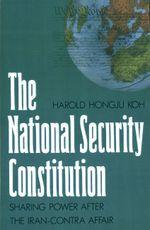
These are all good arguments, but I think the Court needs someone whose qualifications distinctly suit this judicially critical moment when the chickens of Bush fils are coming home to roost. Harold Hongju Koh, dean of the Yale Law School and President Obama's current nominee for Legal Adviser of the State Department, is such a person. Koh's book The National Security Constitution: Sharing Power after the Iran-Contra Affair (1990), which I first read back in Professor Silverstein's class at Dartmouth, demonstrates why. It makes the case for a new/old national-security framework for the three branches of government, a framework that makes less likely the 'Congressional acquiescence' and 'judicial tolerance' that have allowed presidents since the war in Vietnam to ignore the Constitution and the balance of powers when it comes to foreign affairs.
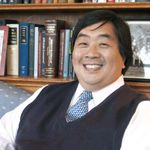
Koh argues in the book, and everywhere, that
the power to conduct American foreign policy is not exclusively presidential, but rather, a power shared by the president, the Congress, and the courts. The constitutional system of checks and balances is not suspended simply because foreign affairs are at issue. To the contrary, in foreign as well as domestic affairs, our Constitution requires that we be governed by separated institutions sharing policy powers.
That may sound utterly uncontroversial to some, but it is not how things are done in the United States. Many do not believe that the judicial branch has any role in national security or foreign affairs, yet the history of the republic is full of such cases. The argument against the courts' role is one that is often made by judges themselves: that the courts are not competent to act and should therefore defer to the president. It is a view found on the Supreme Court to this day, as we see in Justice Clarence Thomas's dissent in Hamdi v. Rumsfeld, 542 U.S. 507 (2004):
The Executive Branch, acting pursuant to the powers vested in the President by the Constitution and with explicit congressional approval, has determined that Yaser Hamdi is an enemy combatant and should be detained. This detention falls squarely within the Federal Government's war powers, and we lack the expertise and capacity to second-guess that decision.
Thomas goes on to speak of the Court's 'institutional inability', its lack of 'expertise', and the curious quality of national security and foreign affairs cases to be, quoting another case, 'simply not amenable to judicial determination because “[t]hey are delicate, complex, and involve large elements of prophecy”'. Two years later, in Hamdan v. Rumsfeld, 548 U.S. 557 (2006), Thomas, quoting the same decision (Chicago & Southern Air Lines, Inc. v. Waterman S. S. Corp., 333 U. S. 103), wrote that such matters are '”of a kind for which the Judiciary has neither aptitude, facilities nor responsibility and which has long been held to belong in the domain of political power not subject to judicial intrusion or inquiry”'. This is not just the opinion of right-wing extremist jurists but a widely shared view across the political spectrum. What would re-activate the judicial branch's competence in national security more immediately than the addition of Koh's expertise in precisely this area?
In the years since his groundbreaking book, Koh has remained a critic of Dick Cheney's 'unified executive' theory [sic] in scores of articles for law reviews and the popular press. While some in the legal community were losing their heads, Koh's op-ed piece in the New York Times for November 23, 2001 reminded us of the right way forward:
If any judicial system in the world can handle a case like this fairly, efficiently and openly, it is ours. If four or 400 Americans had died at the World Trade Center and the perpetrators had been caught, no one would suggest that we try the murderers anywhere but in American courts. No country with a well functioning judicial system should hide its justice behind military commissions or allow adjudication of the killing of nearly 4,000 residents by an external tribunal. Why not show the world that American courts can give universal justice?
As a former Assistant Secretary of State for Democracy, Human Rights, and Labor in the Clinton Administration, Koh reported to the UN Committee Against Torture. In 2005 in the pages of the Columbia Journal of Transnational Law ('A World Without Torture', vol. 43, p. 641-661), he systematically dismantled the now-famous torture-enabling memo of August 1, 2002 by Jay Bybee. As a legal scholar, he has brought all of his expertise and skill to bear precisely on the constitutional, moral, and legal questions which concern us most as a nation in articles like 'The Case Against Military Commissions' in the American Journal of International Law (2002) and 'Can the President be Torturer in Chief' in the Indiana Law Journal (2006).
If Koh is appointed, there will not be any questions, as there were at Souter's hearing, as to whether the nominee is worldly enough to serve. His parents experienced the oppression of Japanese colonialism in Korea, followed by dictatorship in the north and south. A legal scholar and a sociologist, they fled to the U.S., where together they were the first Asian-American faculty at Yale, according to his Wikipedia entry.
It would be easy and true to argue that Koh's background as a Korean-American would add diversity to the Court. While that would be no small thing, Koh would bring an even more valuable kind of diversity: that of his peculiar qualifications and his family's experience. Although never a judge, he is no stranger to the Court: he clerked for Justice Harry Blackmun and has argued cases there. According to his faculty profile at Yale, he has also worked in Reagan's Office of Legal Counsel and Clinton's State Department. He has testified before Congress on the Convention on the Elimination of All Forms of Discrimination Against Women, human rights in Turkey, global trafficking in persons, U.S. policy toward Haiti, and many other topics beyond the ken of most justices. He even represented Ken Wiwa, son of the Nigerian activist Ken Saro-Wiwa, against Royal Dutch Petroleum.
No one has made the case for the judiciary's role in national security more cogently than Koh, which is why we need him on the Court right now. In returning to his book The National Security Constitution after more than a decade and a half since I first read it, I was struck not just by its prescience and its wealth of historical example. What struck me most keenly this time was that, all the way back in 1990, he was already taking on Dick Cheney. Although Cheney is barely mentioned by name in the book, the argument's adversary is clearly the minority report section of the 1987 Report of the Congressional Committees Investigating the Iran-Contra Affair (S. Rep. No. 216, H.R. Rep. No. 433, 100th Cong., 1st Sess.). Tucked away in the back of the main report, on pages 431 to 633, and signed by Dick Cheney and seven other far-right Republicans, the minority report is a foreshadowing of the executive-branch power-grabs of the early 2000's. Future Justice Koh's majority opinions in the post-Bush cases sure to come before the Court would be the ultimate response. And if one of those cases is—I can dream, can't I?—an unsuccessful appeal of Dick Cheney's conviction for war crimes, so much the better.