
May 04, 2009
Prick Up Your Ears, Times Readers: Do You Know What Your New York Times Is Doing?
Michael Blim
The minutes of the night tick down as I write this column. Soon I will have my morning reward. My column will come out on 3QD, and I will hear the thud of the Boston Globe against the front door.
My column will come out, but with the Boston Globe?
Ask The New York Times Company, its owner. For the past month, they have been threatening to close the Globe unless its workers give back $20 million in wages and benefits by May 1. For the past two days, the Times company has extended the deadline by one day. As I write, the Times company has put several hours back on the clock at the same time it is waving its official plant closing notice as required by the state in the faces of its employees.
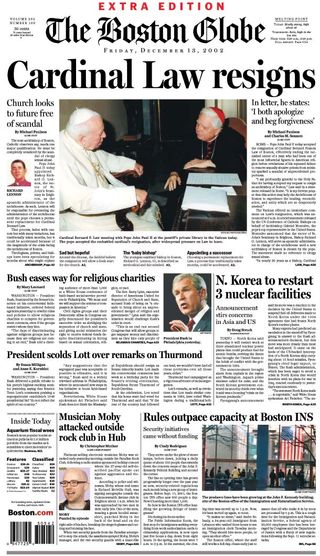
The Globe, once the Sulzberger flagship for its New England media armada, and a cash cow to boot, is now losing a million dollars a week. It is the last paper of record in Boston, and has garnered dozens of national awards, including seven Pulitzer prizes since 1995. The 2007 prize was won by reporter Charlie Savage’s exposure of President Bush’s abuse of so-called signing statements, pithy bits of prose attached to his approval of laws that skewed or set aside whole provisions of legislation he could not summon the courage to veto. The 2003 prize was won the Globe’s spotlight team for their uncovering of the sex abuse scandal in the local and national Catholic churches.
These were hardly prizes awarded for art criticism, however valuable those forms of recognition may be. They were what newspapers do that no other institution or platform in America can yet do, which is to generate facts about and attention to serious, yet undiscovered problems in everyday life.
In Massachusetts, run so long via a Democratic Party daisy chain, the Globe is in effect the opposition party, even though it is a liberal institution –far more liberal institution than its owner’s paper, the New York Times.
Like so many major dailies across the country, it is hemorrhaging circulation and ad revenues. Its website, www.Boston.com, is the sixth busiest newspaper-related site in the United States, even though it is the 14th in circulation size nationally.
Despite its eminence and importance as the most authoritative journalistic voice in New England, the Globe’s editorial staff and workers are being frog-marched forward to concessions or oblivion by the Times. The Gray Lady herself has sunk to concession bargaining a great newspaper like some percale sheet producer would whoop a benighted southern-town labor force. This is not collective bargaining, but simply the blackmail that low-down employers in America use every day to discipline and dispossess their labor forces.
Prick up your ears, Times readers. For those of you for whom the Gray Lady is a messenger of enlightenment and truth, register its hypocrisy. As Globe copy editor Julie Dalton on April 4 put it: “People feel like the Times is willing to throw us overboard."
Not willing, I would say, after a month of squeezing its employers for concessions on top of concessions made just 2 years ago in collective bargaining contracts. Quite ready.
Beginning soon, perhaps as early as later this week, if you read the Times, you will likely find you’re paying fifty cents a copy more.
In Boston, people fear that they will not be able to purchase the Globe at any price.
Consider not buying the Times for a couple of days. If you start getting the bends, read it on line if you must. Try reading another paper -- you may enjoy the change. But let the Times Company know that you know what they are doing in Boston, and that concession bargaining Globe workers, especially given its pretensions to being something other than a union-busting percale sheet producer, doesn’t sit well with you.
Meanwhile, I’m going down to make coffee with the hope that my Globe delivery agent hits the door this time rather than the flowerbed.
Posted by Michael Blim at 06:39 AM | Permalink


Comments
I'm with you Michael -- this is a terrible thing. And it may not be "by the by" that, of the two, the NYT is the paper that has recently been declining more in quality and increasing in right-leaning bias -- not to mention foul labor practices. The Globe may have stopped selling ads, but not uncovering and reporting news. The Times is still selling (some) ads, but where WAS it during the Bush years? It may be all a matter of which mastodon dies the hardest -- Detroit transposed to Newspaper World -- but there is much to be sad about here, when the biggest mastodons survive a few more years by cannibalism.
Posted by: Elatia Harris | May 4, 2009 10:15:42 AM
I grew up with the NYTimes [back in the day]. Whenever, wherever I travelled one of my first concerns was always "where can I buy the Times?" I had it delivered for decades.
Now every time I'm tempted to resubscribe, there's another blunder: AIPAK stooge Abe Rosenthal, Judith Miller, Kristol, the failure to report [any number of issues] until after the election. I remember when the [first?] ombudsman proudly proclaimed "We no longer claim to be the paper of record." And now this. Well, fuck the Times.
Posted by: elbrucce | May 4, 2009 11:21:02 AM
As a native New Englander, I would hate to see the Globe go. But what exactly is the New York Times supposed to do with an organization that is hemorraging cash every day?
The old newspaper and magazine models are irrevocably broken. Something has to be done to fix it. If they can't earn enough money to pay for existing writers' contracts, what are they supposed to do?
Posted by: Michael Benoit | May 4, 2009 12:18:06 PM
I live in NYC and have only read the Boston Globe very occasionally so I don't want to comment on that as much as I do on how stupid the NYT is with its money. They built a very expensive new headquarters for no apparent reason other than that real estate was at its height, and they bought about.com, which anyone who actually gets the internet could have told them is (and always was) a nonentity used only by clueless middle-aged people who just don't get the internet. And now they are sending out cease and desist letters to small-time bloggers who direct traffic towards the NYT site. They have a very peculiar and at times schizophrenic approach towards the internet, and I think it hurts them far more than the Boston Globe. And in the meantime they have apparently decided to focus their self-help efforts on stirring up the sort of pointless controversy (with articles about things such as how hard it is survive on $500,000 year in NYC) that smaller and less-professional websites are far more nimble and effective at.
Posted by: Anonymousreader | May 4, 2009 12:41:41 PM
Okay - what is your solution?
If the Globe is, in fact, losing $1M a week, do you think that the owners have some sort of moral responsibility to spend $52M a year to keep the paper afloat?
Posted by: tde | May 4, 2009 1:54:54 PM
"The Gray Lady herself has sunk to concession bargaining a great newspaper like some percale sheet producer would whoop a benighted southern-town labor force."
If it's losing $1m per week, just how great a newspaper is it? If no-one wants to buy it, why should its staff create it?
Posted by: Sagredo | May 4, 2009 3:06:16 PM
--Abe Rosenthal, Judith Miller, Kristol
The Times, while always a mouthpiece for capitalism and the status quo, went over the top with embarrassing itself with Judith Miller during the Iraq invasion and occupation.
They became stenographers for the Pentagon, and a "Manufacturer of Consent".
Posted by: Dave Ranning | May 4, 2009 4:22:16 PM
Hello and thanks for the comments.
There is no ready-made solution for what ails the Globe. But threatening to close down the paper and put everyone out of work is no solution at all. As the Globe market sinks due to recession and a general decline in the business prospects of newspapers, there will be more losses, and the Times will have to return with new threats for new concessions. These moves would hardly save the Times' bacon, but they will finish the Globe as is and destroy its value to the Times company.
The Times needs the Globe employees to find a new way. They are the capital it has left in the Globe. Working with them to build a new kind of news experience, perhaps a combination of an expanded give-away metro daily and web-based subscriptions for the high-quality Globe, could put the Globe on a solid footing.
In this world where everything must have a "business plan," how is it that the Times draws a pass and takes its ignorance out on its workers instead? Is it possible that no one at the Times has figured out the break-even point for a web-based newspaper and/or a morning commuter handout produced to create demand for the web paper?
It's a modest proposal, Mr. Sulzberger. What about it?
If the Times has thought of more than threatening the Globe workers with unemployment and of squeezing them for concessions without offering anything but more of the same down the road in return, one expects it would not have escaped the notice of the Globe staff and its unions.
I expect we would know about it too.
So you ask me what my solution is.
First, let the Times stop beating its employees over the head and come to its senses about how to run a business originating, compiling and writing news. Then, if the Times hasn't poisoned the labor-management well ad eternum, let it try with its workers to make something new and viable.
Michael Blim
Posted by: Michael Blim | May 4, 2009 5:46:04 PM
In this world where everything must have a "business plan,"
Not everything, surely; just, you know, businesses?
Posted by: Sagredo | May 5, 2009 1:17:06 AM
While my sympathies are with the workers at the globe, I think that reporting will go on without them. I am rather tired of hearing how important x or y newspaper is....most pieces amount to sycophantic beat-sweeteners or retreads of the same talking points heard over and over.
Posted by: Fill | May 5, 2009 6:45:31 PM
Without reference to this particular paper, I think the best way for news"papers" to survive will ultimately be from through funding via some kind of tax or levy, similar to the TV licence fee that supports the BBC and similar TV broadcasting bodies in Holland and other countries.
The idea is that privately owned news companies would deliver news material free to computers, iphones and electronic book readers and compete for funding from the central public fund, based on their relative download and popularity ratings, or some other agreed criteria.
This would provide finance for quality journalistic work and free the news companies from total reliance on advertisers (big problem with free printed newspapers). Of course, the objections would be against government control and extra taxation, but I think that the licensing authority could be made fairly independent, in most countries, and have its income secured from inteference by politicians. The whole notion of totally free internet news is a bit of an illusion anyway, because real jounalism costs money, and it would be better to release it from total reliance on soap adverts.
The other alternative would be an expansion of the cyber copywrite wars, with spy software creeping into everyone's devices and reporting every downloaded or copied newspage or song that has not paid been paid for by subscription. That would threaten civil liberties far more than public funding of news organizations.
Posted by: aguy109 | May 6, 2009 4:13:17 AM
Post a comment