Last summer, when I was remodeling this house, I had six air-conditioners installed, one for each room, most of them split units, their umbilical tubing buried within the masonry. When we moved in, at the end of September, they seemed excessive, perhaps even a bit of a waste. This month, they seem barely adequate, and my family's warnings prescient — don't skimp on the aircon or you'll regret it in the summer, when you most need it. The units loom over each room, promising Singaporean efficacy, but delivering Patna levels of cooling.
In the center of the two-storied house is a kind of small atrium, or large shaft, which stretches from plinth to roof. My neighbor has one just like it — it is mandated by local zoning. The idea was, in those pre-aircon-days of the Raj and early Indian post-coloniality, that air would circulate through the house, gathering heat from the groins and armpits of its wilting inhabitants, before entering the atrium and rising up as hot air must, but also following Bernoulli's principle, that fluids will accelerate as they pass through a narrower channel. The logic of air-conditioning, sadly, runs so directly counter to this ecological understanding of architecture, as a coordination of air flows from outside the building, in through its interiors, all the way out its top.
In my grandfather's house, the air-conditioners were enormous wet monsters, set into courtyard windows at just about child height and, it now seems, equally familiar to me from both ends of their operation. On the front they dripped and dribbled condensation off white and gold grills, sometimes even creating sheets of ice in the night, which might slide off and splatter the floor in the morning. In the back, their grey-black fins bore dents and scratches like war wounds, as water ran round to cool the entire roaring assembly before running off into planterboxes of cacti and bonsai, artfully placed below. The window's chhajja, a horizontal projection of concrete that protects it from rain, might have had a chick protecting the back of the unit from sun and there might have been other plants crowding all round the courtyard windows. These were old techniques of courtyard living, the cultivation of layers of vegetation and other kinds of screening around all fenestration, now re-adapted to helping those groaning air-conditioner units along.
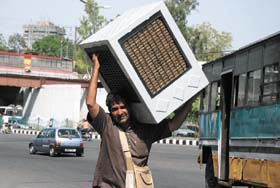
Soon after my parents moved into their West End home, they built a large and dark cabinet, which stretched floor to ceiling along one of their living room walls. It was a multimedia marvel, housing books, records, recessed lamps, as well as a record changer and cassette deck connected to an amplifier and then to speakers perched up at the top. But equally wondrous, in one of its bays, a roll-top screen slid up and over to reveal a hidden 'cooler.' After school, my kid brother and I would have trudged back home under a glaring afternoon sun, our bookbags making large stains of sweat on our backs. We'd shrug off our shirts and steady ourselves before the cabinet's 24-inch fan to enjoy the continuous blast of moist-wet coolness that hummed steadily out. Only once we were sated of this air shower, would we agree to turn to lunch and the other diversions of doing nothing at home.
I think I only came to realize that coolers were an esoteric technology while visiting relatives in the States, who had no reference for whatever it was that I was talking about. In Phoenix they were then called
Desert Coolers, and I now believe them to be one of the few manifestations of the
alternative technology movement that actually found a market — and a worldwide following — in the 1970s. In India their evaporative cooling fins were traded in for chicken-wire mesh screens that held in place a padding of
khus-khus shavings, dry-wooly masses that have the most indescribably
positive fragrance — clean, cool, fresh, inviting. A modified aquarium pump might push water up to the top the cage, from where it would be allowed to drip on to the
khus-khus, while the fan pulled air through the entire screen sandwich. Voila, fragrant evaporative cooling from a cooler.
At the homes of friends and relatives a subtle hierarchy of cooling could be observed: service areas, like stairwells and interior hallways might be air-cooled, while spaces for public reception and polite sociality were air-
conditioned. This subtle gradation as to the status of the two technologies seems based on their relative complexity, cost, and energy consumption. The more wasteful and difficult to manage the technology, therefore, the more it is prized, and the more likely that its use will be reserved for elites who really deserve it. The caste of air-cooler duct-installers, consequently, has lower status than air-conditioning duct-installers, and one must be wary of conflating the two. All this seems a great shame, for if there is an opportunity for a credibly green approach to cooling Delhi's homes, if not offices, it must begin with the bastardized, improvised,
jugaadbaaz air-cooler.
These days, my free time at home is taken up with imagining ways of converting the double-storied atrium at the center of my home into a kind of building-wide cooler. I am imagining a thirty foot tower of khus-khus, through which I would allow water to drip over two-and-a-half stories. An enormous fan — or maybe centrifuge — at the roof would push air down and through the khus tower. We would all be living in, essentially, a habitable cooler.
To understand the joy of cooling, one must first reconcile oneself to the heat of this difficult city. Despite air-conditioned cars, air-conditioned malls, and air-conditioned metros, one's exposed forearms, forehead, cheeks will glow red for the sun. The body will sweat and streak and stain your shirts, and turn the hair on the nape of your neck into a micro evaporative cooler. Without thinking, you will run your hands through your hair, wipe the sweat from your brow, and shake the collars of your shirt to allow air in, for that brief whoosh of cool that your entire torso will exult in. There can be no joy in cooling without surrender to the heat, without a knowing intimacy with its inevitable, permeating embrace.
Cultural, architectural responses to Delhi's heat have traditionally achieved their nobility by creating artificial oases of vegetation, waterworks, wind tunnels and screens. Human ingenuity has been applied to create spaces hospitable for human habitation and enjoyment or
vilas. The madarsa of
Hauz-e-Khas, now just Hauz Khas, for instance, is a double-storied colonnaded structure on edge of a huge, now urban, water-tank. For centuries, westerly winds have picked up moisture and lost heat to that pond, before striking the screen
jali-s of the madarsa, the better to ensure that its students remain occupied with their theological and juridical studies. My cousin Ayesha lives in a courtyard house not a block away from the madarsa, and oriented in precisely the same way to this special tank of water. But like me, she now air-conditions each room separately, although I'm sure she would also prefer another, better approach.
In Old Delhi's
Red Fort, one can make out the vestiges of
waterworks that ran through its bilaterally symmetrical gardens and into the colonnaded marble floors of the Diwan-e-Khas, or special reception area. The marble floors of the pavilion dip down into shallow pools with edges that seem perfectly designed not only for seating but also for cavorting with those already dunked into the pool. And from what we can tell of courtesans hanging out at the palace, as depicted in Mughal miniature paintings, such technologies to beat-the-heat were well integrated into the social functions of the Mughal pleasure palace. Why wouldn't one want to socialize at private pool parties in the summer? And in this city, in this part of the world, how could one possibly feel at ease without taking off one's shoes, washing one's feet, and wiping one face and head with a towel, effectively conducting a full
vajoo, ritual cleansing, every time one stepped into a courtyard?
The Thar Desert, on whose Eastern, extending, desertifying edge Delhi is perched, is far from those moist riverine deltas of Africa, where
humankind acquired its distinctive characteristics, including our aqualine nose, our relatively hairless body, and the curious fact that it is slightly more difficult to drown a human baby, because its windpipe reflexively closes when immersed in water. Well before the Great Mughals, we evidently knew the pleasure of bounding in and around moist wet architectures on the edge of flowing water, cavorting upon and around a variety of wooden furnitures and vegetal furnishings. This mostly hairless ape can imagine no better vision of an Edenic garden than those Mangroves-e-Bahisht.
From that originary apiary home, we have wandered far, into natural deserts as well as those devised of our own self-incarceration. Yet, we long to recreate those densities of flora and moist-cool habitation, though in our contemporary image. Architecture serves as both boundary and link back to our pre-cultural past, and we need it to be moist and cool when it is hot and dry outside, and warm and dry within when it is cold and wet outside.
What I am missing, in these split-unit-invisible-ducting-cost-centers of my home, I think, is the
synesthetic experience of the respite that a home is supposed to bring. The room is cool now, but how? I am not
feeling the wonder,
appreciating the ingenuity,
respecting the total-architecture that is the inventive cooling solution. What is required, it seems to me, is the social-architectural analog to a fireplace, which burns its logs in full view of the room, heating all of it through convection, but radiating heat to your warming hands, buttocks and thighs as you sidle up to its mantle, ostensibly to look at the photographs and cards on display. The fireplace is intrinsic not only to the room, but also to the architecture of the building, its chimney iconic of the home from outside.
Along the same lines, we need a cooling solution that allows a party guest, in the middle of May, to walk over to a cabinet or shelving unit to admire the book collection, while exposing his chest and armpits to the full blast of cool moist air for a few minutes, before he heads off to the bar. The solution must be as integral to the architecture of the building as it is to the room, and it should involve the strategic location of moisture, greenery and forced ventilation through it. This, at any rate, is what a contemporary cultural-architectural response to Delhi's heat would have to look like — a marriage of ingenuity with responsibility, informed of a thousand years of eloquent space-making within the city.