May 25, 2009
Atheistic Materialism in Ancient India
By Namit Arora
Various societies at different times have dazzled with their bursts of creative and intellectual energy. Historians have a penchant for dubbing them Golden Ages. Examples include the Athens of Herodotus, the Baghdad of Haroun al-Rashid, and the India of the Buddha. But though India has long been famous for its "ancient wisdom", the few historical sources that survive shed woefully inadequate light on the Buddha's society. By contrast, far better portraits of classical Greece and Abbasid Baghdad are available to us.
Still, evidence at hand suggests that around 600-500 BCE, in parts of the Indo-Gangetic plain of north India, people were asking some very bold and original questions: What is the nature of thought and perception? What is the source of consciousness? Are virtue and vice absolute or mere social conventions? Old traditions were under attack, new trades and lifestyles were emerging, and urban life was in a churn, reducing the power of uptight Brahmins.
Philosophical schools flourished in a marketplace of ideas, and included chronic fatalists, radical materialists, self-mortifying ascetics, die-hard skeptics, cautious pragmatists, saintly mystics, and the ubiquitous miracle mongers. "Rivalries and debates were rife. Audiences gathered around the new philosophers in the kutuhala-shalas—literally, the place for creating curiosity—the parks and groves on the outskirts of the towns.... The presence of multiple, competing ideologies was a feature of urban living."[1] It was also an age of nascent democratic republics, which, like Athens later, did not ultimately survive the march of monarchy and empire.[2]
Ever since the colonial encounter, the West has associated India strongly with its spiritual tradition—often out of sympathy, respect, and the best of intentions, but sometimes dismissively as "the land of religions, the country of uncritical faiths and unquestioned practices."[3] But such assessments are problematic. As Amartya Sen has argued, the history of India is incomplete without its tradition of scepticism. To see India "as overwhelmingly religious, or deeply anti-scientific, or exclusively hierarchical, or fundamentally unsceptical involves significant oversimplification of India's past and present." The West, Sen claims, focused unduly on India's spiritual heritage, on "the differences—real or imagined—between India and the West," partly because it was naturally drawn to what was unique and different in India.[3]
The nature of these slanted emphases has tended to undermine an adequately pluralist understanding of Indian intellectual traditions. While India has ... a vast religious literature [with] grand speculation on transcendental issues ... there is also a huge—and often pioneering—literature, stretching over two and a half millennia, on mathematics, logic, epistemology, astronomy, physiology, linguistics, phonetics, economics, political science and psychology, among other subjects concerned with the here and now.
Sen marshals a good deal of evidence in support of his view of India's long tradition of heterodoxy, openness, and reasoned discourse. While India might offer "examples of every conceivable type of attempt at the solution to the religious problem," Sen submits that they "coexist with deeply sceptical arguments ... (sometimes within the religious texts themselves)." Among his examples is the 'song of creation' of the Rig Veda, "the first extensive composition in any Indo-European language" (Wendy Doniger) and the radical doubts expressed therein.
Who really knows? Who will here proclaim it? Whence was it produced? Whence is this creation? The gods came afterwards, with the creation of this universe. Who then knows whence it has arisen? Whence this creation has arisen—perhaps it has formed itself, or perhaps it did not—the one who looks down on it, in the highest heaven, only he knows—or perhaps he does not know.
The historian Romila Thapar has observed that "until recently, it was generally thought that Indian philosophy had more or less bypassed materialism." But scholars now widely recognize that in ancient "spiritual India", atheistic materialism was a major force to reckon with. Predating even the Buddhists, the Carvaka is one of the earliest materialistic schools of Indian philosophy (named after one Carvaka, a great teacher of the school, with Brhaspati as its likely founder). Its other name, Lokayata, variously meant "the system which has its base in the common, profane world," "the art of sophistry," and also "the philosophy that denies that there is any world other than this one."
The Carvakas offered an epistemological justification for their materialism that echoes British empiricist and skeptic David Hume, as well as logical positivists. The Carvakas admitted "sense perception alone as a means of valid knowledge", and challenged inferential knowledge "on the ground that all inference requires a universal major premise (e.g., "All that possesses smoke possesses fire") but there is no way to reach certainty about such a premise". The premise "may be vitiated by some unknown "condition,"" and we can't know that such a vitiating condition does not exist. "Since inference is not a means of valid knowledge, all supersensible things" like "destiny," "soul," or "afterlife," do not exist. To say that such entities exist "is regarded as absurd, for no unverifiable assertion of existence is meaningful".[5]
The Carvaka denied the authority of all scriptures. "First, knowledge based on verbal testimony is inferential and therefore vitiated by the flaws of inference". The scriptures, they claimed, are "characterized by three faults: falsity, self-contradiction, and tautology". Based on such a theory of knowledge, "the Carvaka defended a complete reductive materialism according to which the four elements of earth, water, fire, and air are the only original components of being and all other forms are products of their composition". Consciousness arises from the material structure of the body and characterizes the body itself—rather than a soul—and perishes with the body.[5] Ajita Keshakambalin, a prominent Carvaka and contemporary of the Buddha, proclaimed that humans literally go from earth to earth, ashes to ashes, dust to dust:
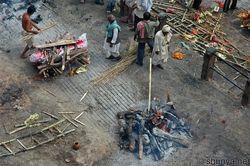
Man is formed of the four elements. When he dies, earth returns to the aggregate of earth, water to water, fire to fire, and air to air, while his senses vanish into space. Four men with the bier take up the corpse: they gossip as far as the burning-ground, where his bones turn the color of a dove's wing and his sacrifices end in ashes. They are fools who preach almsgiving, and those who maintain the existence [of immaterial categories] speak vain and lying nonsense. When the body dies both fool and wise alike are cut off and perish. They do not survive after death.[4]
According to the Carvaka, the soul is only the body qualified by intelligence. It has no existence apart from the body, only this world exists, there is no beyond—the Vedas are a cheat; they serve to make men submissive through fear and rituals. Nature is indifferent to good and evil, and history does not bear witness to Divine Providence. Pleasure and pain are the central facts of life. Virtue and vice are not absolute but mere social conventions. The Carvaka advised:
While life is yours, live joyously;
None can escape Death's searching eye:
When once this frame of ours they burn,
How shall it e'er again return?
The Carvakas mocked religious ceremonies, calling them inventions of the Brahmins to ensure their own livelihood. The authors of the Vedas were "buffoons, knaves, and demons." Those who make ritual offerings of food to the dead, why do they not feed the hungry around them? Like the other two heterodox schools, Jainism and Buddhism, they criticized the caste system and stood opposed to the ritual sacrifice of animals. When the Brahmins defended the latter by claiming that the sacrificed beast goes straight to Swarga Loka (an interim heaven before rebirth), the Carvakas asked why the Brahmans did not kill their aged parents to hasten their arrival in Swarga Loka. "If he who departs from the body goes to another world," they asked, "how is it that he comes not back again, restless for love of his kindred?"
Carvaka thought also appears in the Ramayana. In the epic, Rama is not the god that he later became, but an epic-hero, who, as Sen notes, has "many good qualities and some weaknesses, including a tendency to harbor suspicions about his wife Sita's faithfulness." In the epic, a pundit named Javali "not only does not treat Rama as God, he calls his actions 'foolish' ('especially for', as Javali puts it, 'an intelligent and wise man')". Echoing Carvaka doctrine, Javali even asserts that "there is no after-world, nor any religious practice for attaining that ... the injunctions about the worship of gods, sacrifice, gifts and penance have been laid down in the [scriptures] by clever people, just to rule over [other] people."
In their ethics, the Carvakas upheld a kind of hedonism: the only goal people ought to pursue is maximizing sensual pleasure in life while avoiding pain—the kind that proceeds from over-indulgence and instant gratification. As is common with confrontational schools of thought, they were accused of "immoral practices" and depicted as "hedonists advocating a policy of total opportunism; they are often described as addressing princes, whom they urged to act exclusively in their own self-interest, thus providing the intellectual climate in which a text such as Kautilya's Arthashastra ("Handbook of Profit") could be written."[5]
Carvaka doctrine had disappeared by the 15th century, but its erstwhile importance is confirmed by the lengthy attempts to refute it found in both Buddhist and orthodox Hindu philosophical texts (some written as late as the 14th century), which also constitute the main sources for our knowledge of the doctrine.[6] Perhaps the Buddhists felt threatened by the Carvaka emphasis on pleasure, rather than suffering.
Just as the Stoics of ancient Greece and Rome resemble the Buddhists in their emphasis on mental tranquility through self-awareness and reining in of the ego and selfish desire, the Epicureans are reminiscent of the Carvakas, who too disavowed irresponsible sensualism and upheld ethical ideals similar to the Epicureans. Epicurus' words below could well have been spoken by a Carvaka:
When we say that pleasure is the goal, we mean ... being neither pained in the body nor troubled in the soul ... it is not possible to live pleasurably without living sensibly and nobly and justly. A just man is least troubled but an unjust man is loaded with troubles ... the pleasant life is produced not by a string of drinking-bouts and revelries, nor by the enjoyment of boys and women, nor by fish and other items on an expensive menu, but by sober reasoning.
____________________________________________
Notes:
[1] The Penguin History of Early India, 2002, by Romila Thapar, p. 164.
[2] Democracy in Ancient India by Steve Muhlberger, 1988.
[3] The Argumentative Indian: Writings on Indian Culture, History and Identity, by Amartya Sen, Penguin, 2005.
[4] Digha Nikaya, 1.55, tr. AL Basham, The Wonder That Was India, p. 296.
[5] Carvaka, Encyclopedia Britannica, 2008.
[6] Such as Mādhava's Sarva-darśana-samgraha (“Compendium of All Philosophies,” 14th century CE). Haribhadra in his Sadharśanasamuccaya (“Compendium of the Six Philosophies,” 5th century CE) attributes to the Carvakas the view that this world extends only to the limits of possible sense experience. Source: Encyclopedia Britannica 2004.
Photos (in order of appearance; © shunya.net):
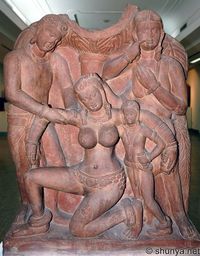
—Vasantasena, Bacchanalian relief with intoxicated courtesan, Kushan, 2nd century CE, Mathura, UP; National Museum, Delhi.
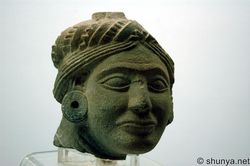
—Turbaned Male Head Maurya, 3rd century BCE, Sarnath, UP; National Museum, Delhi.
—Musician, 5th-6th century CE, Nalanda University, Nalanda, Bihar.
—Sunset in Kausani, 2005, Uttaranchal, India.
—Funeral pyres on the banks of the Ganga, 2006, Varanasi, India.
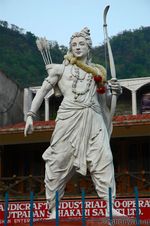
—A statue of Rama on a traffic island in Rishikesh, 2005, UP, India.
__________________________
More writing by Namit Arora?
__________________________
Posted by Namit Arora at 12:01 AM | Permalink


Comments
Fascinating stuff, Namit. Thanks.
Posted by: Abbas Raza | May 25, 2009 7:27:50 AM
Yes, fascinating it is indeed, to visit ancient cultures and there philosophical discourse. The limitation of our leaders in our economic, political, philosophical and religious world appears so more obvious. Thats while we don't learn about this in school
cheers mica
Posted by: Mica Hubertus Mick | May 25, 2009 7:54:06 AM
Carvaka, is wrong. Indian society is a wealth of spritual diversity. The pratice of Casting is for spritual rebirthing processies. In other words you'll reap what you sow. In this manner they kept out the influence of the lower conscience from the higher, perhaps because it is easier to courrupt good than it is to reform evil. They leave the judgment of which is which to a divine authority. Outsiders usually end up being cast in to the lower realms because of thier base instincts, Cavaka apparently was objectional to this reasoning.I can dumb it down by comparing it to a school system, do good, you progress,do wrong ,you digress. I belive, and I may be wrong.who's to say , but I trust my instints on this one.
Posted by: quasar63 | May 25, 2009 10:20:15 AM
Viva Carvakas! Alas, their likes are few and far between in India and elsewhere.
Thanks Namit, for this post. It should be an eye opener for those who wish to see India in general and Hinduism in particular, only through a miasma of vague spiritual and mysterian thoughts.
Thanks also for explaining that like the Epicureans, the Carvaka sages were intelligent and responsible in their world views and not licentious hedonists. Their focus on reason and material well being was distorted to imply amoral pleasure seeking by the spiritualists in order to discredit them. Carvakas upheld reason above emotional and feel-good speculations about the world. All round well being of the human condition was favored over unnecessary suffering for the sake of imaginary purity (a swipe at the ascetics). The original Carvaka, the eponymous sage and founder of this school of thought, is said to have used a bit of irreverent humor to make his point when he advised folks "to incur debt if necessary, to eat butter." But the main thrust of the Carvaka point of view was what you quote from Javali, "there is no after-world, nor any religious practice for attaining that ... the injunctions about the worship of gods, sacrifice, gifts and penance have been laid down in the [scriptures] by clever people, just to rule over [other] people." In other words, don't waste your time and money after elusive promises. What the Carvakas did possess and value above all else, were well honed B.S. detectors. Too bad that millennia of evolution has not sharpened this tool in the human gene pool.
Another interesting item in the Wiki entry about the Carvaka school of thought:
Ain-i-Akbari, written by Abul Fazl, the famous historian of Akbar's court, mentions a symposium of philosophers of all faiths held in 1578 at Akbar's insistence. Some Cārvāka thinkers are said to have participated in this symposium.[14]
Under the heading "Nastika," Abul Fazl has referred to the good work, judicious administration, and welfare schemes that were emphasized by the Cārvāka lawmakers.
This too points to a sensibility that was far from hedonistic or escapist. Rather than rest on the promises of happiness in a future "unseen" world, the practioners wished for a better life and happiness for all in the "here and now." They were social progressives looking for practical solutions to end human misery.
Also worth mentioning is the fact that the Carvakas were not persecuted by the religiously inclined Indians, the vast majority at any given time. I have not come across any mention of an atheist in ancient India being burnt at the stake or put to death in any other manner for their "disbelief." Their minority view was not just tolerated but accorded equal time in religious debates. After all, both Carvaka and Javali are regarded as venerable wise men in the pantheon of Hindu sages. If only modern India's religious extremists and superstitious obscurantists could learn a lesson from the past.
Posted by: Ruchira | May 25, 2009 3:38:08 PM
The most recent theory regarding the Veda is that it was the composition originating from the Sindhu Saraswati civilisation, which is considered indigenous to India. Hence, Wendy Doniger et al are followers of the earlier theory of the Aryan invasion of India put forward by European and British scholars. A.L. Basham the British scholar in his book written in the 1950s The Wonder That Was India upheld the Aryan invasion theory.
Posted by: vijaya | May 25, 2009 6:32:27 PM
Namit, this is your post and you are free to handle your readers' comments as you see fit.
But I still forbid you to start the discussion that Vijaya would like you to embark upon. Not here, not now. Please!!!
Posted by: Ruchira | May 25, 2009 7:05:15 PM
And then Caravaka philosophy became part of Hindu School.
Posted by: Ajay | May 25, 2009 9:06:23 PM
Were Caravacas more atheist than Yoga and Sankhya folks.
I have a feeling that rather than getting upset with these philosophies which challenged the convention, people of the time encouraged the debates.
Posted by: Ajay | May 25, 2009 9:13:25 PM
Ruchira,
Many thanks. I'll follow your advice on the Aryan debate, especially since Vijaya's note seems to me a non sequitur here. I'll tackle that one as a dedicated article on 3QD in due course.
Ajay,
Your note provoked some new thoughts, and what I say here relates to Ruchira's comment too. It's true that atheism was also embraced by at least two of the six orthodox schools of ancient Hinduism, including Samkhya, Mimamsa (and to a lesser extent Yoga). In this context, the terms Astika and Nastika are erroneously identified with "theism" and "atheism", respectively. Classically, the two words meant "orthodox" and "heterodox", according to whether a school accepted the authority of the Vedas or not. One could be Astika and still reject god. It is somewhat incoherent to speak of a basis for punishing or ostracizing an atheist in the Indian system; social penalties were instead tied to whether one believed in the authority of the Vedas or not—theism or atheism was irrelevant.
This is why the raging Western debate between theists and atheists elicits a yawn in the Indian mind -- religious power in Indian society did not pivot on that question (as for Western monotheists), but on a different idea of orthodoxy based on rituals and customs to which God was irrelevant. To the counterpart of Dawkins in the Indian system, rejecting God is almost besides the point -- far more central to him would be rejecting the rituals and social customs inspired by the Vedas.
Coming back to your question, it seems to me that the unique and defining feature of the Carvaka is not atheism but philosophical materialism. The Samkhya folks, for instance, were atheistic dualists (self and nature) who still believed in transmigration of a "human essence" from body to body, the possibility of liberation (moksha), and techniques for achieving that. To the Carvaka, there was no "beyond". So I think it is also not accurate to say that "Carvaka philosophy became part of Hindu school." It stood outside the Hindu fold, like Jainism and Buddhism, until it disappeared.
Ruchira, the Carvakas were cool in so many ways but regarding their ethics, I'm more ambivalent. The few sources we have on their ethical injunctions, and on their actual behavior, paint a mixed picture. I fully expect their acts to have exhibited a similar range that atheistic materialists (whose ranks include you and me) exhibit today: from ignoble to noble. History has taught me that neither atheism, nor materialism, decisively excel at inspiring people to be empathetic toward their fellows.
Posted by: Namit | May 26, 2009 1:27:34 AM
Like the Epicureans, Carvaka thinking is pretty advanced, bold and appealing. Judging from the bibliography, however, it seems that the author has not delved too much into original sources.
Posted by: Anwar Patel | May 26, 2009 3:05:49 AM
hello all,
i am gopal form india.
maharishi [ saint ] charavak was a great human who tried his best to enlighten humanity.
it is true no god/allah created man,but man is evoled by nature,and that nature is eternal and the adi shakti energy.
the 5 elements and the soul r just part of nature.
so he was not wrong but he was correct.
Posted by: gopal narayan | May 26, 2009 6:33:36 AM
I fully expect their acts to have exhibited a similar range that atheistic materialists (whose ranks include you and me) exhibit today: from ignoble to noble. History has taught me that neither atheism, nor materialism, decisively excel at inspiring people to be empathetic toward their fellows.
Didn't say that they did. My point is that materialists and atheists with well developed social consciences illustrate that it is perfectly possible to be ethical AND empathetic without believing in god, after-life or purifying rituals. I can't cite much from ancient history but recent history and my own encounters in life have convinced me of that. The spiritualists and the religious never had and never will have exclusive claims to empathy or doing the right thing by others. The Carvakas prove that it was just as true centuries ago as it is today.
Posted by: Ruchira | May 26, 2009 9:37:04 AM
The following points in your article are subjects of dispute:
1. Whether Ajita Keshakambalin was a Charvaka. (The evidence we have suggests that he was not a Charvaka but a mere skeptic. Charvakas accept the law of causality as evidenced by the fact that they accept svabhava vada but Ajita very clearly rejects svabhava vada and also the law of causality.)
2. Whether Charvakas only recognized perception as the means of right knowledge. (There is evidence that they accepted inference as a means of right knowledge but inference could not be used for accepting knowledge about subjects related to transcendental matters according to the 7th century Charvaka Purandara who has been quoted by S.N. Dasgupta in his 'History of Indian Philosophy'.) The claim that Charvakas would only accept perception as a means of right knowledge seems again to be a trick of their opponents to discredit them.
3. It is important to note that all the writings about Charvakas and Charvakism is by their orthodox philosophical who hated or at least disliked their views. Even the great Vachaspati Mishra calls them 'more beastly than the beasts' and in Mahabharata we have the scene of Charvaka being burnt to ashes by other brahmins after he criticized Yudhishtira. (We know that Charvaka texts written by Charvakas existed at one time because there is a reference to a Charvaka text by a certain Bhaguri in Patanjali's commentary on the Ashtadhyayi.)
4. It is a canard that Charvakas were hedonists and opportunists--a canard spread by their opponents. The view on ethics as evident from the views of Charvaka elucidated by him just prior to being burnt to ashes by other brahmins after he had criticized Yudhishtira reveal an ethics which has nothing to do with hedonism.
5. While i appreciate your efforts i feel you have not done sufficient research before doing your writeup.
6. For anyone interested in the subjected, i would recommend the following book:
http://www.amazon.com/Carvaka-Lokayata-Anthology-Materials-Studies/dp/8185636117
Posted by: Rashmun | May 26, 2009 10:01:41 AM
Namit,
I greatly enjoyed reading your article. I was first introduced to the Carvaka philosophy from Sen's marvelous book, and was impressed that such a clear case for materialism and against supernaturalism had been made in ancient India. It's sad that the only historical references to this philosophy that have not been destroyed are the ones written by those who sought to discredit them.
Thanks for a thought provoking post. I liked the comparison to Epicurean thought, and I wish that both philosophies were more well known. I look forward to learning more about them. The book mentioned above by Rashmun looks like a good place to start.
To vijaya - please take a look at Sen's book 'The Argumentative Indian'. In his essay 'India: large and small', he clearly demonstrates that the whole idea of the Saraswati civilization (i.e. the assumption of Vedic origin to the Indus valley civilization) is false - it's a doctoring of history that was blatantly created in order to meet the political agenda of the hindutva movement.
Posted by: Aatish | May 26, 2009 7:47:14 PM
Ruchira, what sane person would disagree with that?
Thanks Aatish. That's also a great short response to Vijaya.
Rashmun,
Thanks for your note and the useful reference (several sources, and excerpts from other sources by scholars, are also on Google Books now). I'll check it out and report any notable revelations I have.
About your point #1, if you are right, I'll blame it on both Romila Thapar and AL Basham. As for #2, I read your article where you make your case—based on one scholar's view of a Carvaka source from the 7th century CE—that the Carvakas accepted inference for worldly matters but not for transcendental matters. You conclude that "the Charvakas were obliged to argue in favour of the primacy of sense-perception [because] the defenders of the orthodoxy found it necessary to deny reason to make room for faith..." In other words, socio-political motives compelled the Carvakas to emphasize sense perception over inference in their epistemology. This is interesting and plausible but is it adequately supported by other sources and scholars? How, for instance, does one confirm that this is not one particular Carvaka's belief but the party line? In fairness to you, you did say these points were "subjects of dispute".
It is not contentious to attribute to the Carvaka a materialistic ontology, empirical epistemology, and hedonistic ethics—you seem to reject the very idea of hedonism in Carvaka ethics, which is patently absurd. There is good and bad hedonism, and like Epicurus, many Carvaka sages (as Ruchira notes) seem to have cautioned against irresponsible hedonism, and advocated an open and secular pursuit of joy, pleasure, and making the best of our lives in this world. I also did suggest in my essay but probably should have written more plainly that the Carvakas were frequently and unfairly maligned by their hostile opponents, much as Epicurus was by the otherwise venerable Cicero.
But shouldn't we be cautious with Carvaka ethics—since, as you say, "no Charvaka book written by a Charvaka exists today"—and avoid too close and certain an association with Epicurean ethics (as Anwar seems to want)? If only to honor a Carvaka sage's standard of empirical evidence. Epicurus' own works do not survive, but we know much more about Epicurus' ethics from other Epicureans like Lucretius, who wrote sympathetically about their teacher's beliefs. Perhaps I am being unduly cautious/ambivalent here, but in my article I tried to also record the adversarial accusations against Carvaka ethics, before closing with its suggestive resemblance to Epicurean ethics.
Posted by: Namit | May 26, 2009 10:21:29 PM
Namit, thanks. A marvelous post taking me back to Sen, and even Basham, with whom I had a schoolgirl relationship -- as a reader, mind. Even with a large number of South Asian readers, both in the West and in South Asia, we can forget here that the Western philosophical tradition doesn't have a patent on atheism -- or lots of other ideas we claim as our own, mainly if not exclusively. I appreciate that we have a blogger who can contrast and compare.
Posted by: Elatia Harris | May 26, 2009 10:55:16 PM
This is a response to Aatish who has quoted the "Argumentative Indian". It is Sen's view that the Saraswati civilization is false. It is now proving to be fact that the Aryan theory was false. None other than Romila Thapar is now debunking this theory. She held it supreme for a very long period of time in her life. The Aryan theory was a doctoring of history that was balatantly created by the British in order to meet their political objective of dividing the northerners and the southerners! There is not an iota of evidence anywhere to prove the Aryan theory whereas the ancient scriptures which repeatedly speak of the Saraswathi river and a civilization that lived on its banks, sounds much more credible. In fact there are communities and castes in India even till date that call themselves as "Saraswath" or the ones who lived on the banks of the Saraswathi.
Posted by: Niranjan Prabhu | May 26, 2009 11:33:01 PM
How do you pronounce Carvaka? I think it should be spelled Charvaka. I have been reading about them for some time. But never come across their name spelled as Carvaka.
Posted by: Jit | May 27, 2009 12:56:59 AM
It should be recognized that even some eminent modern scholars have a peculiar dislike for the Charvaka philosophy. This is inferred by the sometime peculiar arguments they offer when they describe the Charvaka philosophy. Here is something from an earlier post:
Although a very knowledgeable scholar, S.Radhakrishnan because of his distinct bias in favour of the extreme idealism of the Vedanta (more specifically Advaita Vedanta) cannot be taken to be the last word on Indian philosophy. I give two examples:
1. Radhakrishnan and Charvakas:
In his book 'Indian Philosophy' vol. 1, pg 278, Radhakrishnan writes thus about the Charvaka philosophy:
"The substance of this doctrine is summed up by a character in the allegorical play of Prabodhacandrodaya."
One may reply to Radhakrishnan that this is as good as saying that the substance of the Socratic view or the essence of the Socratic character is to be found in the plays of Aristophanes. For what we really have in the Prabodhacandrodaya is only a caricature of the Materialist, and by no way a subtle one. This play, it is well known, "was written by Krisna Misra of Mithila to expose, ridicule, and contradict the ideas of the Budhists, Jainas, Charvakas, Kapalikas and other sects which had taken hold of the public mind in his days", writes the translator of this play (Taylor, pg 4 of his introduction to the play).
No scholar would suggest the possibility of recovering the substance of Budhism or Jainism from such a play. With the Charvaka philosophy, though, the matter is different. Scholars like Radhakrishnan are not interested in distinguishing between its substance and its caricature.
2. Radhakrishnan and Mimansa:
Radhakrishnan in his book Indian Philosophy vol. 2, pg 427, writes:
'The lacuna of the Purva Mimansa was so unsatisfactory that the later writers slowly smuggled in God.'
In support of these words, Radhakrishnan gives the examples of the works on Mimansa by Vedanta Desika, and Apadeva. Of these two, the former (Vedanta Desika) produced a strange work called Sesvara-Mimansa or "Mimansa with God"--the title says it all. What Radhakrishnan does not say unfortunately is that Vedanta Desika's real philosophical affilation was not to the Mimansa but to the Ramanuja school of Vedanta (Visistadvaita). Further, it is arguable as to whether Vedanta Desika was trying to smuggle in Mimansa ideas into the framework of his own theism rather than trying to smuggle in God into the Mimansa philosophy as Radhakrishnan suggests.
As regards Apadeva: Apadeva advances the strange thesis that during the time of the universal dissolution (pralaya) , the Vedas continued to remain in the memory of God; but this thesis could only be in complete disregard of the earlier and authentic Mimansa standpoint wherein the conception of pralaya, like that of sristi or creation, was only a figment of the theist's imagination. Thus, the later tendencies in some scholars--on which Radhakrishnan lays undue stress--of attempting to reconcile the Mimansa with theism only results in upsetting the fundamentals of Mimansa philosophy.
Posted by: Rashmun | May 27, 2009 2:26:00 AM
From an earlier post:
--------------
1. Hedonism:
This stems basically from Madhava's (this is not Madhavacharya of Dvaita fame, but an Advaita Vedantist) claim in his Sarva Darsana Samgrah where he attributes the following verse to the Charvakas:
'While life remains, let a man live happily; let him feed on ghee even though he runs in debt'
This, it is submitted, is a vilification of the Charvakas. Garbe writes (Encyclopaedia of Religion and Ethics viii. 138):
'It is natural to conjecture that the Lokayata system was based by its founder upon deeper principles, and developed upon more serious philosophical lines than the information which has come to us from their opponents allows us to understand'
[A clarification is in order here: No Lokayata text exists today, even though we know that some existed in the past since there are references to them in several works; it is conjectured that when the attacks of the Charvakas became more and more acute on the religious nonsense existing in their time, they were systematically persecuted and their works destroyed. Whatever we know about them is through references to them and their thoughts in the works of their philosophical opponents.]
Belvalkar and Ranade, writing in their 'History of Indian Philosophy' ii.459 write about the Lokayata:
...'its great seductive charm and extensive vogue cannot be readily explained on the usual assumption regarding the purely negative and destructive character of its tenets.'
But we have before us more direct evidences of Lokayata ethics. I refer to the well known episode of the killing of Charvaka, which occurs in the Santiparva of the Mahabharata. After the great Kuruksetra war, when the Pandava brothers were returning truimphantly, thousands of brahmins gathered at the city gate to bestow blessing on Yudhisthira. Among them was Charvaka. He moved forward and without the consent of the rest of the brahmins, he addressed the king thus:
'This assembly of the Brahmins is cursing you for you have killed your kins. What have you gained by destroying your own people and murdering your elders? You should die.'
This outburst of Charvaka, abrupt as it was, stunned the assembled brahmins. Yudhisthira felt mortally wounded and wanted to die. But then the other brahmins regained their senses and told the kind that this Charvaka was only a demon in disguise. And then they burnt him, the dissenting Charvaka to ashes.
Charvaka being a demon in disguise was of course a typical way in which people were made to be scared of the materialistic philosophy. But the point is that in this Mahabharata passage, the philosopher said nothing that could even remotely suggest any ethics of blind selfish pleasure. For the dark deeds of which Yudhishthira was accused were that of killing the kins and murdering the elders. In the Kuruksetra war, this had hapenned. Kins had to be killed. The old moral values of tribal society were being trampled upon and destroyed.Charvaka's protest against this was outspoken and courageous. But he was burnt to ashes and the moral standards revised and restated to suite the new situation.
We find this done in the Gita. On the eve of the Kuruksetra war, Arjuna felt depressed. He would not kill his kins and destroy the elders. He would not fight. So Krishna had to elevate his mind to the lofty metaphysical height where death did not matter. But before doing so he had to dwell on the matter of fact mundane considerations. Hence, Krishna argued (Gita ii.37):
'You will attain heaven if you are killed in this battle, and if you win it, you will enjoy this earth.'
This was quite outspoken. There was the prospect of pleasure in either alternative--pleasure on earth if you could kill your kins and pleasure in heaven if you are yourself killed; and this was probably the earliest expression of a real ethics of pleasure in the history of Indian philosophical thought. But the ethics of the Charvakas, at least judged on the Mahabharata evidence, was an open protest against this. Could it, therefore, be that those who were accusing the Charvakas of a gross philosophy of pleasure were themselves subscribing to it, though surreptiously?
Posted by: Rashmun | May 27, 2009 2:32:52 AM
Adi Sankaracharya's views on the Charvakas (Lokayatikas) makes for interesting reading.
(In his commentary on the Brahma Sutra, Adi Sankara mentions the Charvaka (or Lokayata) views thrice, and invariably as the doctrine of there being no Self over and above the body. )
Observes Sankara (on Brahma Sutra i.1.1):
"Unlearned people and the Lokayatikas are of the opinion that the mere body endowed with the quality of intelligence is the Self.
For this very reason, viz. that intelligence is observed only where a body is observed while it is never seen without a body, the Materialists (Lokayatikas) consider intelligence to be a mere attribute of the body.
Here now some materialists (Lokayatikas) who see the Self in the body only, are of opinion that a Self separate from the body does not exist; assume that consciousness (caitanya), although not observed in earth and other external elements--either single or combined--may yet appear in them when transformed into the shape of a body, so that consciousness springs from them; and thus maintain that knowledge is analogous to intoxicating quality [which arises when when certain materials are mixed in fixed proportions], and that man is only a body qualified with consciousness.
There is, thus, according to them no Self separate from the body and capable of going to the heavenly world or obtaining release, through which consciousness is in the body; but the body alone is what is consciousness, is the Self.
For this assertion they allege the reason stated in the stura, 'On account of its existence where a body is.' For wherever something exists if some other thing exists, and does not exist if that other thing does not exist, we determine the former thing to be a mere quality of the latter; light and heat, e.g. we determine to be qualities of fire. And as life, movement, consciousness, remembrance and so on--which by the upholders of an independent Self are considered qualities of the Self--are observed only within the bodies, and not outside bodies and as an abode of these qualities, different from the body, cannot be proved, it follows that they must be qualities of the body only. The Self, therefore, is not different from the body."
Posted by: Rashmun | May 27, 2009 8:34:21 AM
//To the counterpart of Dawkins in the Indian system, rejecting God is almost besides the point -- far more central to him would be rejecting the rituals and social customs inspired by the Vedas.//
Now that is an interesting observation. Advaitic social reformers have tried that. Narayana Guru in South India is one such example. Vivekananda another. I am all for this. But the real question is with massive financial onslaught from Western fundamentalist evangelists on Indian culture, which threaten to destroy it with all its diversity where do we stand?
Posted by: aravindan neelakandan | May 27, 2009 9:18:58 AM
Ever since the European enlightenment, scientific materialism has been the dominant philosophy of the modern age. Thinking people find it easy to accept and internalize. Bertrand Russell and the logical positivists have developed this philosophy to its peak.
The problem with materialism is the idea that whatever the five senses and the mind perceive, must be the truth. Not only that, that what is not perceived by these faculties, does not exist.
We also need to look at the perceiving apparatus.
If all communicating human beings were blinded for a few generations, colors, rainbows, clouds and the oceans would not be perceived properly - if at all. If some scientists then invented a seeing instrument, then these things would be perceived according to the capacity of the seeing instrument. As the instruments were improved by the scientists, more and more contours, shapes and sizes would come into perception.
There was a time when we did not know that electricity and magnetism existed. We did not know that x-rays, ultra-violet and infra-red rays, sounds below the hearing threshold etc existed. A Carvaka in those times would be justified in saying that these things did not exist, they were pure speculation to fool the people.
From a neuro-scientific point of view, we could say that any experience is only a matter of neural firings in the brain. Thus we could experience and see things which did not really exist. I believe Francis Crick takes this position in The Astonishing Hypothesis. In that case, nothing exists but patterns in the brain. Then who can verify whether the brain exists? Further, whether you and I exist? This will lead to Descartes!
Immanuel Kant is one thinker who has written about these matters very well. The best development of his thoughts come from P.D.Ouspensky - in his books Tertium Organum and A New Model of the Universe.
Ancient Indians have also contemplated and debated from these alternative models of knowledge. The Idealist schools focused on the instruments of knowledge, based on the reason that precise instruments were needed for proper perception, and poor instruments lead to faulty knowledge. Therefore it was necessary to know and refine the instruments of knowledge. This gave rise to the idea "Know Thy Self".
Posted by: Naras | May 27, 2009 11:46:57 AM
Naras,
There are many "problems" with materialism depending on how it is defined and who is assessing. Materialistic ontology can range from mechanical to physicalistic, reductive to emergent, or commit not much more than a rejection of supernatural categories. How and what kind of knowledge one gains about one's notion of reality is another variable (epistemology conditions, and is conditioned in turn by ontology). Two ways we encountered in the Carvaka context are sense perception and inference. So yes, the perceiving apparatus and the mind are pivotal to all knowledge. Even knowing thyself is inescapably shaped by them.
Jit,
You are right. A more accurate rendition would be charvakas. However, in such matters I prefer to follow what is fashionable. If you Google carvaka, you'll get 36K results, charvaka produces 27K. Textbooks tend to write Cārvāka. I believe it is pronounced char-vaka, as in char-lie + cuerna-vaca.
Elatia: Thanks!
Posted by: Namit | May 27, 2009 11:50:54 PM
"Even knowing oneself is inescapably shaped by them."
We can't know how inescapable this is. Initial conditions would be so. But as the skill in self-observation improves, internal errors could be more quickly detected. Just a hypothesis, since most of us have not even started on this.
There's plenty of yoga and meditation literature by practitioners that provide detailed maps of stages in self-observation.
In a small booklet called Alternative States of Consciousness, Daniel Goleman has rigorously described a 7-stage process of Buddhist meditation with 4 "rational" and 3 "super-rational" stages in a Self-observer's journey.
The first 4 stages as I remember are:
1. Initial (on an object of contemplation)
2. Access (to the object)
3. Merger (with the object)
4. Bliss.
The next 3 stages are:
5. Infinite space(or emptiness)
6. Infinite consciousness.
7. Neither perception nor non-perception.
I find the study believable and fascinating.
Posted by: Naras | May 28, 2009 2:56:21 AM
namit, pleased to see such topics addressed on 3QD. your point above, in comments, about materialism without atheism is well taken. it has come to mind, i must say, just about every time atheism has been addressed on this blog.
light pedantic supplements, not corrections, below:
_ nastika: one who denies the eternality (=transcendental existence) of the vedas.
astitva, eternal being, to be distinguished from transient facticity. famously: na sato vidyate bhavo na bhavo vidyate satah.
_ i'd prefer to retain or recuperate carvaka, lokayata and other materialists within a hindu fold -- especially because they're not around to argue otherwise, which may not be the case for buddhists and jains.
alternatively, precisely because the above is so specious and tricky, perhaps we should pass over in silence the question of how the category hindu might apply to carvakas?
Posted by: Aditya Dev Sood | May 28, 2009 3:05:40 PM
Seems like those on the Wall Street are staunch followers of Carvakas and have taken their following words to heart:
"While life remains let a man live happily, let him feed on ghee even though he runs in debt, [..]"
Posted by: Kaffir | Jun 3, 2009 10:46:59 PM
The word Charvak (Charu + Vak) itself means, "sweet talk". Talk of sensual materialistic pleasure is indeed very sweet. However, materialistic pleasure dependent upon senses does not give lasting happiness. Debating only gives satisfaction to person's intellectual ego. Men beat men by debating. Cults overcome cults by debating. Some cults overcome others by warring and terrorising! But God cannot be known either by debating, warring or by terrorising but by chanting his divine names. Tukaram's words of assurance are, "Mukhi Naam Haati Moksha, Aisi Saksha Bahutanchi". Dnyaneshwar after writing the Dnyaneshwari, also wrote the Haripath in which he says, "Hari Mukhe Mhana". So to a person constantly chanting the sweet name of God, there is no need for any debate, or any argument as all(for nothing remains to be proven or to be proved) his questions have already been answered. Such persons usually do not argue. In their silence, lie all answers. It is the sweet,Self- Engrossed silence of Bhakti, that speaks louder than arguments of Charvakins or Advaitins or Vishishtadvaitins or Dvaitins or Shaivites!
Posted by: Anant Vasudevan | Nov 22, 2009 6:10:49 AM
I would like to comment on Rashmun's words written in May 27, 2009. Almost two years passed since he wrote it so I don't know whether he would read it again. Rashmun's statement that the Carvakas were ridiculed by Hindus as one having a gross philosophy of pleasure is missing the point that the Buddhists also accused the Carvakas of the same fault. And as the Carvakas criticized rituals of the Hindus most bitterly, the Hindus are expected to retort bitterly but since Carvakas did not criticize the Buddhists in this manner, why should Buddhists make such a claim about the Carvakas if it would be without any real basis? I doubt that philosophers like Samkara would even think of distorting of the views of his philosophical opponents for that would only make his argument brittle and anyone from the opponent school can challenge and throw it down. Finally Rashmun, bitter criticism was not the monopoly of the Hindus/Brahmanical people alone. In Patanjali's Mahabhashya, there is a passage which raises a question should we call any verse (shloka) as a valid means of knowledge, "kim shlokaa api pramaanam?" and gives an example of a verse, "yadudumbaravarnaanaam ghatiinaam mandalam mahat piitam na gamayet svargam kim tam yajnagatam nayet" which means "If this cluster of fig-coloured pitchers (full of wine or soma juice) when drunk not lead us to heaven, how is it then that the same when done in the sacrificial ritual would allow us to do so". Patanjali's answer to this is "pramattagiita esa tatrabhavatah"(this is not authoritative saying but nonsense of (oblique) His Highness The Great Carvaka).
To Ruchira's comment that spiritualists alone cannot lay their claim on empathy, I would like to state that while Modern Western atheists and materialists who have a lot of empathy has descended from their Christian forefathers in the West and therefore their idea of empathy and compassion and mercy cannot be completely ignorant of the Christian idea of empathy and compassion and mercy, the fact that Carvakas were materialists and atheists does not automatically prove that they would exhibit empathy and compassion. It is possible that they did not believe in it. Since the Hindu and Buddhist philosophical works are the best sources about Carvaka philosophy, we cannot do anything but conjecture on what was the Carvaka view on compassion and empathy.
Posted by: Anonymous | Mar 17, 2011 7:01:29 AM
Namit, well written, good one.
I enjoyed reading it and the quality of comments in your blogs are commendable. Reasoned debate is so hard to find, more so in comments section!
Very little is written about Charvaka school of thought in mainstream media. Even the word nastika is mostly used as atheist, not as heterodox. I doubt many of todays Jains or Buddhist would consider themselves as nastikas :)
The greatest tragedy in mankind's entire history may be the hijacking of morality by religion.
—Arthur C. Clarke
Posted by: Sridhar | Apr 14, 2011 8:30:49 AM
Post a comment