
Edward B. Rackley
Even the most subtle and complex artists can’t escape the crudity of synopsis. Grazing the critical literature surrounding Herzog’s films and career, two stock phrases repeat incessantly: ‘man vs. nature’ and ‘Heart of Darkness parable’. These signposts may guide the uninitiated, but as always the map is never the terrain.
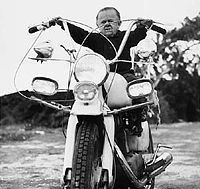
Generically speaking, Herzog explores the complexity of man/nature relations in dozens of films and documentaries; his antipathy towards romanticism and Cinema Verité is well known. To reject both fantasy and empiricism as story telling vehicles, where does that leave a director? Because it blurs fact and fiction, Herzog’s method of documentary cinema is rogue. To contrast his approach with Cinema Verité, in interviews he cites the Heideggerian concept of ‘ecstatic truth’ (remember ‘unconcealment’, fellow philosophers?). The work of the author lies in finding friction between the facts, enough to create light or 'illumination' according to Herzog.
‘The truth of accountants’
In 1999 Herzog released a twelve-point manifesto called ‘Lessons of Darkness’, borrowing the title of his silent recording of devastated oil fields in Kuwait following the first Iraq war. Much of the manifesto is tongue in cheek, Point Three captures Herzog’s balancing act between fact and insight, where fact is a “rock beneath which greater truths hide.” Facts are superficial truths, the “truth of accountants,” the snapshots of tourists. To film facts and reject fabrication is to confuse fact for truth; such orthodoxies “plow only stones.” Illumination, the goal of successful cinema, happens because “facts sometimes have a strange and bizarre power that makes their inherent truth seem unbelievable.”
Man the measure of madness
It is easy to caricature Herzog as a misanthrope: dwarfs taking over the asylum in 'Even Dwarfs Started Small'; the swaggering, leering colonial adventurer in 'Aguirre: Wrath of God', the voyeuristic cruelty of 'Kaspar Hauser'. Yet misanthropy followed Herzog closely, less in his choice of themes than in the form of his frequent lead actor and artistic collaborator, Klaus Kinski. Kinski starred in Nosferatu, Aguirre, Fitzcarraldo, Woyzeck, Cobra Verde and, the classic record of supreme artistic hubris as madness, My Best Fiend. YouTube holds a trove of Kinski's spiteful outbursts; I like this one the best (from MBF).
Aguirre and the more recent Grizzly Man constitute the spectrum of Herzog's misanthropic subjects, each with their own antagonistic relationship to nature and the world of men. Aguirre, the story of a mutinous Spanish conquistador seeking gold and domination in the Peruvian rainforest, sets the stage for nature's harsh rebuke. It is this film more than all others that feeds the popular perception of Herzog films as 'Heart of Darkness parables'. I see it instead as one among many shades of misanthropy and anthropocentrism, the full spectrum of which is contained in Herzog's career. Aguirre is arguably Kinski's finest performance, with Fitzcarraldo a close second.
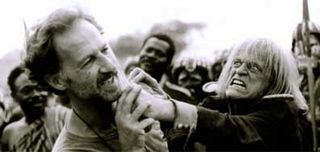
Grizzly Man presents an altogether different, more nuanced and contemporary mode of misanthropy and anthropocentrism, that of the environmental defender/activist. Nature is under siege by a calamitous and greedy humanity; its flora and fauna at risk of extinction as human civilization encroaches and metastizes. Alaskan Grizzly Bears provide Timothy Treadwell with an object of communion, a purpose for his existence, thus far elusive in human society. Nature and its beasts are not 'red in tooth and claw'; they are there for our solace and succor. Inter-species communion is obtainable with Treadwell's enlightened approach. But Treadwell is eaten alive on camera–not Herzog's but his own, an attempted record of his efforts to befriend a remote Grizzly. 'Let us be grateful the universe does not know our smile', Herzog writes in his manifesto. No hippy romantic, he.
Soundtrack as dramatic element
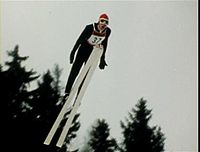
Herzog has an uncanny ability to match the climaxes and nadirs of his soundtracks with the film's visual footage and narrative. Popol Vuh, named after the Mayan genesis myth, created soundtracks for many Herzog films of the 70s and 80s. In a previous post for 3QD, I confessed my first love among Herzog films. 'The Great Ecstasy of the Woodcarver Steiner' follows a record-setting ski jumper who makes his living carving wood figurines. Popol Vuh provides its powerful soundtrack, full of building crescendos and periods of faint, throbbing notes.
Watching 'Kaspar Hauser' the other night, I was surprised to see a cameo of Florian Fricke from Popol Vuh. He plays a blind pianist living where Kaspar the adult foundling is taken in by a good Samaritan. Fricke sits slumped at an old piano, banging out these chords from the Steiner soundtrack. Herzog lets the camera linger on Fricke's face as the last note fades — a gesture of kinship and respect between two visionaries. [The song itself appears on the Aguirre soundtrack album.]
A Heideggerian in Hollywood
In a recent interview with an awestruck Henry Rollins in annoying gee-whiz mode, Herzog was not expansive but did confirm that he’s living in Los Angeles and liking it. “LA is the city with the most substance in the US, period.” Henry tried to wrap his head around that one and couldn't. He leaned forward: “And all the plastic surgery? What about that?”
Herzog smiled, unfazed: “Hollywood is where the dreams of the world are organized and manufactured … including stupidity.”