
| ABOUT US | ARCHIVES | LINKS | RSS FEED | MONDAYS | |

3quarksdaily

An Eclectic Digest of Science, Art and Literature

« The Literature of the Piano | Main | A Tribute to European Trains Twenty or Thirty Years Old »

April 20, 2009

The Next Great Discontinuity

Part Two: The Data Deluge
(Link to Part One)

By Daniel Rourke

Speed is the elegance of thought, which mocks stupidity, heavy and slow. Intelligence thinks and says the unexpected; it moves with the fly, with its flight. A fool is defined by predictability...

But if life is brief, luckily, thought travels as fast as the speed of light. In earlier times philosophers used the metaphor of light to express the clarity of thought; I would like to use it to express not only brilliance and purity but also speed. In this sense we are inventing right now a new Age of Enlightenment...

A lot of... incomprehension... comes simply from this speed. I am fairly glad to be living in the information age, since in it speed becomes once again a fundamental category of intelligence.

Michel Serres, Conversations on Science, Culture and Time

Human beings are often described as the great imitators:
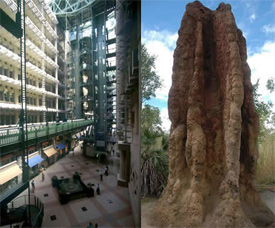
Termite mound vs skyscraperWe perceive the ant and the termite as part of nature. Their nests and mounds grow out of the Earth. Their actions are indicative of a hidden pattern being woven by natural forces from which we are separated. The termite mound is natural, and we, the eternal outsiders, sitting in our cottages, our apartments and our skyscrapers, are somehow not. Through religion, poetry, or the swift skill of the craftsman smearing pigment onto canvas, humans aim to encapsulate that quality of existence that defies simple description. The best art, or so it is said, brings us closer to attaining a higher truth about the world that remains elusive from language, that perhaps the termite itself embodies as part of its nature. Termite mounds are beautiful, but were built without a concept of beauty. Termite mounds are mathematically precise, yet crawling through their intricate catacombs cannot be found one termite in comprehension of even the simplest mathematical constituent. In short, humans imitate and termites merely are.

This extraordinary idea is partly responsible for what I referred to in Part One of this article as The Fallacy of Misplaced Concreteness. It leads us to consider not only the human organism as distinct from its surroundings, but it also forces us to separate human nature from its material artefacts. We understand the termite mound as integral to termite nature, but are quick to distinguish the axe, the wheel, the book, the skyscraper and the computer network from the human nature that bore them.

When we act, through art, religion or with the rational structures of science, to interface with the world our imitative (mimetic) capacity has both subjective and objective consequence. Our revelations, our ideas, stories and models have life only insofar as they have a material to become invested through. The religion of the dance, the stone circle and the summer solstice is mimetically different to the religion of the sermon and the scripture because the way it interfaces with the world is different.

Likewise, it is only with the consistency of written and printed language that the technical arts could become science, and through which our ‘modern’ era could be built. Dances and stone circles relayed mythic thinking structures, singular, imminent and ethereal in their explanatory capacities. The truth revealed by the stone circle was present at the interface between participant, ceremony and summer solstice: a synchronic truth of absolute presence in the moment. Anyone reading this will find truth and meaning through grapholectic interface. Our thinking is linear, reductive and bound to the page. It is reliant on a diachronic temporality that the pen, the page and the book hold in stasis for us. Imitation alters the material world, which in turn affects the texture of further imitation. If we remove the process from its material interface we lose our objectivity. In doing so we isolate the single termite from its mound and, after much careful study, announce that we have reduced termite nature to its simplest constituent.

The reason for the tantalizing involutions here is obviously that intelligence is relentlessly reflexive, so that even the external tools that it uses to implement its workings become ‘internalized’, that is, part of its own reflexive process...

To say writing is artificial is not to condemn it but to praise it. Like other artificial creations and indeed more than any other, it is utterly invaluable and indeed essential for the realisation of fuller, interior, human potentials. Technologies are not mere exterior aids but also interior transformations of consciousness, and never more than when they affect the word.

Walter J. Ong, Orality and Literacy

Anyone reading this article cannot fail but be aware of the changing interface between eye and text that has taken place over the past two decades or so. New Media – everything from the internet database to the Blackberry – has fundamentally changed the way we connect with each other, but it has also altered the way we connect with information itself. The linear, diachronic substance of the page and the book have given way to a dynamic textuality blurring the divide between authorship and readership, expert testament and the simple accumulation of experience.

The main difference between traditional text-based systems and newer, data-driven ones is quite simple: it is the interface. Eyes and fingers manipulate the book, turning over pages in a linear sequence in order to access the information stored in its printed figures. For New Media, for the digital archive and the computer storage network, the same information is stored sequentially in databases which are themselves hidden to the eye. To access them one must commit a search or otherwise run an algorithm that mediates the stored data for us. The most important distinction should be made at the level of the interface, because, although the database as a form has changed little over the past 50 years of computing, the Human Control Interfaces (HCI) we access and manipulate that data through are always passing from one iteration to another. Stone circles interfacing the seasons stayed the same, perhaps being used in similar rituals over the course of a thousand years of human cultural accumulation. Books, interfacing text, language and thought, stay the same in themselves from one print edition to the next, but as a format, books have changed very little in the few hundred years since the printing press. The computer HCI is most different from the book in that change is integral to it structure. To touch a database through a computer terminal, through a Blackberry or iPhone, is to play with data at incredible speed:

Sixty years ago, digital computers made information readable. Twenty years ago, the Internet made it reachable. Ten years ago, the first search engine crawlers made it a single database. Now Google and like-minded companies are sifting through the most measured age in history, treating this massive corpus as a laboratory of the human condition...

Kilobytes were stored on floppy disks. Megabytes were stored on hard disks. Terabytes were stored in disk arrays. Petabytes are stored in the cloud. As we moved along that progression, we went from the folder analogy to the file cabinet analogy to the library analogy to — well, at petabytes we ran out of organizational analogies.

At the petabyte scale, information is not a matter of simple three- and four-dimensional taxonomy and order but of dimensionally agnostic statistics...

This is a world where massive amounts of data and applied mathematics replace every other tool that might be brought to bear. Out with every theory of human behavior, from linguistics to sociology. Forget taxonomy, ontology, and psychology. Who knows why people do what they do? The point is they do it, and we can track and measure it with unprecedented fidelity. With enough data, the numbers speak for themselves.

Wired Magazine, The End of Theory, June 2008

And as the amount of data has expanded exponentially, so have the interfaces we use to access that data and the models we build to understand that data. On the day that Senator John McCain announced his Vice Presidential Candidate the best place to go for an accurate profile of Sarah Palin was not the traditional media: it was Wikipedia. In an age of instant, global news, no newspaper could keep up with the knowledge of the cloud. The Wikipedia interface allowed knowledge about Sarah Palin from all levels of society to be filtered quickly and efficiently in real-time. Wikipedia acted as if it was encyclopaedia, as newspaper as discussion group and expert all at the same time and it did so completely democratically and at the absence of a traditional management pyramid. The interface itself became the thinking mechanism of the day, as if the notes every reader scribbled in the margins had been instantly cross-checked and added to the content.

In only a handful of years the human has gone from merely dipping into the database to becoming an active component in a human-cloud of data. The interface has begun to reflect back upon us, turning each of us into a node in a vast database bigger than any previous material object. Gone are the days when clusters of galaxies had to a catalogued by an expert and entered into a linear taxonomy. Now, the same job is done by the crowd and the interface, allowing a million galaxies to be catalogued by amateurs in the same time it would have taken a team of experts to classify a tiny percentage of the same amount.

This method of data mining is called ‘crowdsourcing’ and it represents one of the dominant ways in which raw data will be turned into information (and then knowledge) over the coming decades. Here the cloud serves as more than a metaphor for the group-driven interface, becoming a telling analogy for the trans-grapholectic culture we now find ourselves in. To grasp the topological shift in our thought patterns it pays to move beyond the interface and look at a few of the linear, grapholectic models that have undergone change as a consequence of the information age. One of these models is evolution, a biological theory the significance of which we are still in the process of discerning:
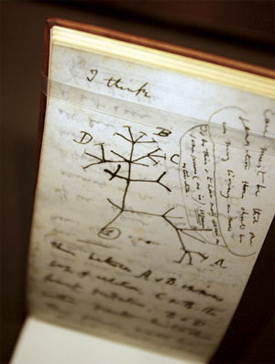
Darwin's tree of life

If anyone now thinks that biology is sorted, they are going to be proved wrong too. The more that genomics, bioinformatics and many other newer disciplines reveal about life, the more obvious it becomes that our present understanding is not up to the job. We now gaze on a biological world of mind-boggling complexity that exposes the shortcomings of familiar, tidy concepts such as species, gene and organism.

A particularly pertinent example [was recently provided in New Scientist] - the uprooting of the tree of life which Darwin used as an organising principle and which has been a central tenet of biology ever since. Most biologists now accept that the tree is not a fact of nature - it is something we impose on nature in an attempt to make the task of understanding it more tractable. Other important bits of biology - notably development, ageing and sex - are similarly turning out to be much more involved than we ever imagined. As evolutionary biologist Michael Rose at the University of California, Irvine, told us: "The complexity of biology is comparable to quantum mechanics."

New Scientist, Editorial, January 2009

As our technologies became capable of gathering more data than we were capable of comprehending, a new topology of thought, reminiscent of the computer network, began to emerge. For the mindset of the page and the book science could afford to be linear and diachronic. In the era of The Data Deluge science has become more cloud-like, as theories for everything from genetics to neuroscience, particle physics to cosmology have shed their linear constraints. Instead of seeing life as a branching tree, biologists are now speaking of webs of life, where lineages can intersect and interact, where entire species are ecological systems in themselves. As well as seeing the mind as an emergent property of the material brain, neuroscience and philosophy have started to consider the mind as manifest in our extended, material environment. Science has exploded, and picking up the pieces will do no good.

Through the topology of the network we have begun to perceive what Michel Serres calls ‘The World Object’, an ecology of interconnections and interactions that transcends and subsumes the causal links propounded by grapholectic culture. At the limits of science a new methodology is emerging at the level of the interface, where masses of data are mined and modelled by systems and/or crowds which themselves require no individual understanding to function efficiently. Where once we studied events and ideas in isolation we now devise ever more complex, multi-dimensional ways for those events and ideas to interconnect; for data sources to swap inputs and output; for outsiders to become insiders. Our interfaces are in constant motion, on trajectories that curve around to meet themselves, diverge and cross-pollinate. Thought has finally been freed from temporal constraint, allowing us to see the physical world, life, language and culture as multi-dimensional, fractal patterns, winding the great yarn of (human) reality:

The advantage that results from it is a new organisation of knowledge; the whole landscape is changed. In philosophy, in which elements are even more distanced from one another, this method at first appears strange, for it brings together the most disparate things.

People quickly crit[cize] me for this... But these critics and I no longer have the same landscape in view, the same overview of proximities and distances. With each profound transformation of knowledge come these upheavals in perception.

Michel Serres, Conversations on Science, Culture and Time

Posted by Daniel Rourke at 12:08 AM | Permalink

TrackBack

TrackBack URL for this entry: http://www.typepad.com/services/trackback/6a00d8341c562c53ef0115702e3adc970b

Listed below are links to weblogs that reference The Next Great Discontinuity:

Comments

This could be an artifact of my own ignorance, but I had a really hard time extracting a coherent argument from these two essays. I was puzzled after reading the first, but wanted to wait until the second before making any comments. So here goes. As far as I can tell, the main ideas rest on this claim:

---At one point humans did not have writing, later they did, and now they are availing themselves of new kinds of informational organization (networks being the paradigm).

That claim seems unproblematically true to me. But the further ideas that rest on this claim *are* problematic, and the essays do nothing to substantiate them. For example, as I understand Rourke he claims that, corresponding to the three phases of human information technology (ritualistic, grapholectic, networked), there are three distinct kinds of *thought* (ephemeral, enduring, distributed). Supporting this claim would seem to require a massive synthesis of evidence from history, anthropology, philosophy, cognitive science, linguistics, cartography, etc., but there's no such synthesis here. Maybe Ong and Serres have done this work (I don't know; I've never read them), but if so they haven't been summarized here in a way that makes sense of the argument. And even well-known problems from individual sciences don't get any discussion---where, for example, is any engagement with linguists' work on the Sapir-Whorf hypothesis? Or cognitive scientists' work on embodiment? Or philosophers' work on the extended mind?

I think there's a similar difficulty with Rourke's claim about the fallacy of misplaced concreteness, if it is supposed to entail a kind of relativism about truth. Again, I might simply misunderstand, but it looks like Rourke has three main claims to make about truth:

---1. Our idea that science progresses toward truth, overturning falsehoods along the way, is intelligible only on a grapholectic way of thinking.
---2. Truth is relative to (at least) mode of thought; ephemeral, grapholectic, and distributed thought each admit of a different kind of truth.
---3. Our instinctual denial of (2) is an instance of the fallacy of misplaced concreteness: we think that truth *simpliciter*
is a property of thought *simpliciter*.

If these are indeed Rourke's claims, we might expect some engagement with the long history of philosophical work on relativism. We might expect examples of apparently True thoughts that are really only Grapholectically-True, or apparently false thoughts that are really Ephemerally-True. And we might expect discussion of *why* those examples ought to be understood in that way, rather than simply thinking that some of our old preliterate beliefs were actually just false. But none of this shows up in the essay, as far as I can tell.

What does show up is often bewildering. For example, I thought I understood the fallacy of misplaced concreteness (what Dewey called the "philosophical fallacy"). As applied to truth, above, I get the idea. But what is the deal with these termite mounds and human tools? I can see why it might be fallacious to consider the former natural and the latter artificial, but why is this fallacy one of misplaced concreteness? I'd have thought it was simply a failure to understand what an organism's nature is, not (as the FMC would have it) a mistake of treating abstractions as concrete.

Finally, the general point of the essay sounds suspiciously unfalsifiable. Indeed, given what he's written here, Rourke can probably write off any of my criticism as being couched in grapholectic terms; to ask for further *reasons* that support one's *claims* sounds steeped in grapholecticism, right? But can't Rourke make this response to *any* kind of criticism? If so, then his argument can't be challenged. Admittedly, the falsifiability criterion is considered kind of stodgy, even within grapholectic circles, but I'm still for it.

Short version: as I understand the essay, the trend in information technology looks right, but the philosophical morals drawn from it are overblown and unsubstantiated.

Posted by: Adam | Apr 21, 2009 4:43:13 PM

Daniel, thanks once again -- I really admired and enjoyed these two essays.

Adam, it couldn't hurt to get to know Serres and Ong. You would like a short essay meant to provoke thought to be compendiously referenced out to include thinking with which you are familiar, but are untroubled at your lack of familiarity with the thinkers it does reference. This places a real limit on the reach of your observations, but you take pains to demonstrate humility, so you probably knew that as you wrote. I am disappointed, too, to see in your remarks two tendencies -- summing up slightingly points the writer has made before you criticize them, suggesting that he has built into his words a means of disposing of any and all criticism -- that I associate with teen-aged debating society rule-books. It is very difficult to suppose that your critique is the result of care and thought, or to find it worth the words.

Posted by: Elatia Harris | Apr 21, 2009 8:03:11 PM

But wait, Elatia, am I humble, or am I a cavalier straw-manning teenage-style debater?

In all seriousness, I tried my best not to erect straw men, and to paraphrase Daniel's argument in the terms I'm familiar with (I haven't got any others, after all). So I take responsibility for any mischaracterizing, and am happy to be corrected where I did so. Part of my trouble is undoubtedly that I haven't read Serres or Ong. You say I'm "untroubled" by this, and in one sense that's true; one can only read so many books in a lifetime. But in another sense I am troubled---I don't want to be one of those people (I'm sure we've all met a few) who dismisses an entire area of inquiry as nonsense without being at all familiar with its basic ideas and theoretical commitments. That's why I've got the disclaimers about ignorance, misreading, etc.

But the theses Rourke is advancing (as I understand them) are spacious, and I do claim at least some familiarity with some of the disciplines they touch---linguistics, cognitive science, history, philosophy. It would indeed be too much to expect a dissertation from a blog post, but I do think it's surprising that well-known work in these disciplines isn't mentioned.

Maybe even that is unfair; after all, Daniel does refer to some scholarly work, and he surely isn't at fault for my not having read it. But here's where I think it's fair to ask a blog post to *explain* that work for the lay reader, even if briefly, at least when that blog is for a lay audience and not for other scholars in one's field. Certainly Ong and Serres (and others) have here been quoted, and their terms mentioned, but I don't see any clear exposition of their ideas. This is in contrast to, e.g., the discussion of 'crowdsourcing', which was lucid and helpful.

As far as "suggesting that he [Daniel] has built into his words a means of disposing of any and all criticism," well, guilty as charged. But I hope this is no mere teenage debate fallacy; I took myself to be giving an *argument* for the unfalsifiability of the project. Maybe unfalsifiability isn't a defect of a hypothesis; fair enough. But then we're disagreeing about the merits of falsifiability, not the legitimacy of calling something unfalsifiable.

Finally, though you find it "very difficult to suppose that your critique is the result of care and thought," I must respectfully insist that, hey, yes, I do believe I did take some care while writing, and even considered it kind of thoughtful.

Posted by: Adam | Apr 22, 2009 2:50:49 AM

Hello Adam and Elatia.

Firstly, thank you for your comments. The blog format, in this regard at least, does extend some benefit to my words.

Your summary, Adam, is much needed. It reminded me that the thesis and the blog post do no necessarily sit well together. I regard much of the chaos of my essays as intentional, owing to the ability of internet/blog readers to be able to click links, surf at will through external arguments and fill in blanks at their leisure. I do feel like my first essay examined Michel Serres' arguments - offering enough of a glimpse into his work, and working technique, that a newcomer might feel they understood/wanted to understand more. Once again, and as you say in your second comment, these blog posts were not meant as a thesis. In trying to balance enjoyment and depth whilst also being aware of the (often) smaller attention-span of the average internet reader (no offence intended, but the statistics do back this up) my essay did break many cardinal rules of logical structure and bibliographical insight.

My second main point, and one perhaps that answers a few of your queries all at once, revolves around my position on "ephemeral, grapholectic, and distributed" media. At no point do I say that trans-grapholectic media is better than oral or written. This leads too into your point about the termite mounds. I meant to suggest that distinction of any kind is dangerous to the thinking mind, be it the distinction between a mound and a termite, a human and a skyscraper, material or technology, or indeed a human and the world. All these entities are abstractions, constructs of thought and language, which in turn shift in response to the kind of materials that they are manifest in. Matter reflexively invades thinking - the model changes, imperceptibly - the new model, in turn, alters the material. The cycle continues. It is fallacious to consider any of these abstractions as concrete. The skyscraper is 'human'; the termite mound is 'technology'.

The shift I am interested in, as I expressed it in this second essay, is that with trans-grapholectic media the material interface itself is necessarily mutable and in flux. The trans-grapholectic is more compatible with the fluxus of reality all around us. Thought - thinking through it - bends more naturally, and the isolating constraints of dialectic thought, or the linear movement of grapholectic thought appear more readily as the abstractions that they are.

Again I am being spacious in my expression of what is merely an idea (and one founded on the ideas of many others). More gaps open up even as I send my words reeling on linear trajectories inescapably conditioned into the line of the page and the pattern of the sentence. Trans-grapholectic media and the newly distributed, network-like science and philosophy are still changing in response to the textual, oral culture that created them. When I talk about these ideas I am bound by my speech, when I write I am bound by text and the page. Here's hoping that at least by blogging them - by letting readers comment on them, save them as tagged links, quote them, email them, distributing them yet further - I am giving up something of my inane ponderings to experiment, liberation and play.

In these two essays, I admit, I did abuse the philosophical essay. I took it and shoved it deeply down the throat of the blog format. There was some inevitable choking. In one of my earlier 3quarks posts (Writing, (Hyper)text and Image) I attempted to break with the linear conventions of the essay much more, but my attempt received a total of zero comments. These two distinct battles with format and content have taught me something about how, for all its idealism, blog culture is still very much a grapholectic format and I am still very much a grapholectic writer and thinker. I'm still playing around with all these ideas and formats. I hope to really get stuck in over the next few years as part of my PhD. Here's hoping that we can have this conversation again in a couple of years, perhaps with a much sounder grounding to it.

And once again, thanks so much for your comments. They mean a lot.

Posted by: Daniel Rourke | Apr 22, 2009 2:25:52 PM

Not sure if it's off topic, but on the subject of "the isolating constraints of grapholectic thought"...

Umberto Eco wrote a essay I saw online several years ago about the benefits of limited research sources (IE your local library) over the boundless data of various quality found online.

I keep trying to find that essay again and I have been unable to. Does it ring a bell to anyone?

Posted by: Carlos | Apr 22, 2009 3:42:50 PM

Carlos-
I find local libraries the hight of radical democracy, and judge a community by the library they have (and not necessarily in material terms). So I would agree with Eco, and if you ever find the link, please share it.
Thanks
Dave

Posted by: Dave Ranning | Apr 22, 2009 8:38:33 PM

Late-stage capitalists privatize public libraries:


chrislopez

Posted by: Louise Gordon | Apr 22, 2009 10:14:57 PM

I attempted to post that just for you, Dave. Late-stagism is illustrated in the right-hand column, fifth box down. A cute little omnivore.

Posted by: Louise Gordon | Apr 22, 2009 10:26:15 PM

What traditional libraries need is a more networked, discursive interface.

I love the British Library. I spent half of my study time there last year, searching for specific books in the database and picking them up from the collection desks to study at my leisure. Imagine if once I had a book, once I had read, studied and digested its contents, I could go back to the database and enter my own 'metadata' into the system!

Suddenly the library has a crowdsourced, upper-most layer, and searching for material becomes a process of gliding through the network of possibilities that literature represents, rather than linearly trawling through limited text searches.

Crowdsourced databases are multi-dimensional, and self regulating. In a traditional system, when I search for 'Orality and Literacy by Walter J. Ong' I get a listing separated into a few, limited subjects:

- Language and culture.
- Oral tradition.
- Writing.
- Oral-formulaic analysis.

In a trans-grapholectic system, I might be able to add and/or discover a multitude of 'extra' information added by knowledgeable readers. Perhaps I have never heard of Ong's text and I am interested in theorists writing in the early 1980s, or authors who were born in Kansas City, Missouri, or writers on literacy who came from a Roman Catholic background, or books with chapters about 'Plato and Computers', or containing comparisons between the works of A.R.Luria and Julian Jaynes. In a normal library I may spend years studying these specific issues and never come across Ong's book. In a crowdsourced library a search would lead me down the right path much quicker, and allow me to get down the the important business of reading.

There are other, more ethereal realms of information that crowdsourcing the library would uncover. A crowdsourced book would be completely searchable, after a time, so that the library database became like an extended appendix, index and bibliography for every book, all at once, and infinitely interlinked.

I love libraries, and the methods of research that are carried out within their walls, models and databases, but I do believe that the networked library would be a more advanced kind of research tool, incorporating everything that makes books and libraries THE repositories of knowledge, but adding new layers of value and meaning.

Socrates spoke at length about the horrors of writing, about how it would become a crutch to true philosophical thought, about how it would distort debate, memory and logic. Plato wrote down his words, gave them structure. Further writers added footnotes, appendixes, contents and bibliographical bedrock to Socrates' words. Have we not benefited from these 'crutches'? Would not a database, searchable, tagged and crowdsourced version of Socrates' speeches be even more useful?

The library WILL eventually be supplemented by the cloud. And I look forward to it.

Posted by: Daniel Rourke | Apr 23, 2009 3:51:42 AM

In a crowdsourced library a search would lead me down the right path much quicker, and allow me to get down the the important business of reading.

Eco's point, as I recall, was that too many crowdsourced paths make finding a personal path that much more difficult, and prevents you from more quickly getting down to the important business of thinking.

Posted by: Carlos | Apr 23, 2009 8:47:35 AM

Thanks Louise--
A great site!

Posted by: Dave Ranning | Apr 23, 2009 10:35:30 AM

Post a comment


Subscribe to this blog's feed  

3QD PHILOSOPHY PRIZE

3QD ADVERTISING

3QD on Facebook

3QD on Kindle

3QD by Daily Email

Receive all blogposts at the same time every day.

Enter your Email:


Preview 3QD Email

3QD on Twitter

Miscellany

Lijit Search

AddThis Social Bookmark Button

Add to Google

3QD BALL 2010 INFO

Recent Comments

Physeter macrocephalus on What Is Consciousness?

Gardenia on Religion and Democracy in the United States: Danger or Opportunity?

Erich on Stephen Hawking: God was not needed to create the Universe

Fill on What Is Consciousness?

Caroline Wellington on Cool and Calmly Composed: Nico Muhly, Changing the Face of Classical Music

Dave Ranning on Religion and Democracy in the United States: Danger or Opportunity?

Jonathan on What Is Consciousness?

Carlos on A Rational Approach to Irrationality

Carlos on A Rational Approach to Irrationality

Jan on Thursday Poem

Elatia Harris on Taking Aim at Pre-Leukemia Disorders

Dave Ranning on A Rational Approach to Irrationality

Dave Ranning on Stephen Hawking: God was not needed to create the Universe

Fill on What Is Consciousness?

maniza on A Date That Will Live in Oblivion

Carlos on A Rational Approach to Irrationality

Cyrus Hall on geoengineer it

Carlos on A Rational Approach to Irrationality

Carlos on A Rational Approach to Irrationality

Carlos on A Rational Approach to Irrationality

Carlos on Stephen Hawking: God was not needed to create the Universe

Carlos on Stephen Hawking: God was not needed to create the Universe

Carlos on Stephen Hawking: God was not needed to create the Universe

kara on Stephen Hawking: God was not needed to create the Universe

Dave Ranning on Stephen Hawking: God was not needed to create the Universe

Acclaim For 3QD


"I couldn't tear myself away from 3 Quarks Daily, to the point of neglecting my work. Congratulations on this superb site."—Steven Pinker, Johnstone Professor of Psychology, Harvard University.

"I have placed 3 Quarks Daily at the head of my list of web bookmarks."—Richard Dawkins, Charles Simonyi Professor of the Public Understanding of Science at Oxford University.

"Just wanted you to know I’m one of many who reads and enjoys 3 Quarks....almost daily."—David Byrne, musician, former lead-singer of the Talking Heads, artist, intellectual.

Read more here.

The 3QD Prizes

See all winners here.

Logos designed by Vicki Winters

Subscribe to this blog's feed