
By Aditya Dev Sood
I am sitting inside a white cube, watching things familiar but different. I know this music, but there are no lyrics, nothing to anchor the sound flowing round and through me. These soldiers, their rhythms, they seem to be preparing for an event I was once at. Perhaps India's Republic Day, which I remember attending with my kid brother when he was about six, both of us sitting in grass in front of the VIP enclosure with passes that Captain Kumar had arranged for us while he was serving as ADC to the President. Perhaps the Beating of the Retreat, which is held in front of the old Viceroy's Palace, now the Rashtrapati Bhavan, and which ends with a spectacular drum detail, no two drummers in the same uniform or from the same regiment, North and South Block reverberating together, silhouetted by the camel brigade, whose mounted guards point submachine guns into the air as the flares come sailing down to close the ceremony. It is, of course, another country, another time, and these memories have been triggered by a haunting new video work by Shahzia Sikandar entitled Bending the Barrel (no still available).
There is something uncanny about the angle and depth of Sikandar's camera. The marching band is moving past without making much progress, as if depth had been flattened for framing the scene into a Mughal miniature painting. The music emanates from their instruments but the moment is intercut with other scenes — we are there but no longer there. Before there can be boredom there is a new anomie, introduced by Krugeresque text fragments that overlay the image plane, not with slogans, but with the impersonal and passively-voiced militarese that cannot but be recognized as the public pronouncements of the Army's leadership. This is an acute, biting piece, crafted without polemic, so much more powerful for being all quotation, all documentation, all juxtaposition.
The conductor's back is to me, his musicians stare at their sheets of music. They are seated on an elevated bandstand whose steps were coated last night in chuna, lime, to shine back in the sun a brilliant, almost blinding white, outshining the musician's spats and their neelam-washed white tunics. Framed by Sikandar, the musicians at first appear anonymous, ordered, regimented. But now and again she swoops in. At first this causes me to worry that some amateurism had caused a camera shudder. But she is neither zooming nor panning, but shifting frame, capturing in perfect detail a particular Army bandsman staring directly back at the recording lens, a new composition, a new picture within the picture. This is the delirious pleasure of experiencing cinema through the eyes of a miniaturist, who like others of her craft, can see, and can desire to see the whole as well the individual parts of creation with the same detail, the same interest. Sikandar's way of seeing is elucidated by her film-making, and newly educated, I want more of this vertigo.
I have few and fading memories of my father in uniform. He was already resigning his commission by the time I was four, and the period of his gallantry in combat and the near-thing escapes from border skirmishes thankfully happened before I was born and before he even knew my mother. How much of his joke-telling-scotch-drinking-jazz-loving social personality, though, was shaped by his training as a cadet in Khadakvasla? Would it have been much different on the other side of that border? Sikandar's quiet study of the musical culture of the Pakistani Armed Forces is immediate evidence of the common Anglo-Indian idiom that all legatees of the British Indian Army share.
I feel I should know these tunes by name, but they are blending into one another in my mind. Was there a Reveille? A Taps? One of them must surely be The Last Post, with which soldiers from the United States through Britain through Pakistan and India are laid to final rest. I smile wanly at Pakistani troops marching jauntily to Colonel Bogey March, which I remember from Hollywood's Bridge over the River Kwai. Now a soldier sitting impassively in what appears to be a professional recording studio is belting out a folk or tribal tune that I can't completely catch either, now dissolving into soulful and jazzy improv and fadeout: jadon ho gae gori nal pyar, ho gae kisi de nal pyar…
The alternately seated and then marching Army bands, and their fluid medley of Western and Indian musicalities puts me in mind of my own wedding day, now a lifetime ago. The invitation card was based on a painting I'd commissioned from the contemporary Indian miniature painter Mohammed Firozuddin, who traces his families legacy back to the house of Mansur, Jehangir's court painter. Its cover was based on The Marriage Procession of Dara Shikoh, a famous Avadhi painting by Haji Madni, and showed an enormous imperial procession behind the mounted prince, including a troupe of musicians and foot-soldiers carrying their shields above their heads.
In her choice of Pakistani Army Bands as a subject for visual capture and representation, Sikandar triggers deep resonances from within the tradition of Indo-Islamic miniature painting. The corporeal language, rhythm, space-making and compositional effects that she discovers and creates in film appear rooted in courtly spectacles as well as in their painterly representation, in various Mughal and later Company and British Imperial styles. The pagentry of Army bands on both sides of the border, moreover, have their foundation in mansabdari and related feudatary traditions of spectacle, which involved the parade and presentation of armed battalions and material resources potentially available for the command of the Emperor. Though visually beguiling, they are a pre-democratic form of public spectacle, which have been variously accomodated within the modern republics of South Asia.
In a patch of green in front of a public building a marching band has been invited to play for the camera. Perfectly framed and perfectly composed, they are united in music. Although they have finished the music somehow is still sounding, while they shuffle off and sort into the individuals they are actually comprised of, walking away in twos and threes, or standing alone, struggling with a carry-belt or a piece of regalia. In the distance, a motorcade is being prepared, for General Staff, ready, also to depart.
The common threads of our Anglo-American and Indo-Pakistani martial cultures are easy to trace through all of these songs, national, martial and regional, as well as in the patterns of drill that the marching bands will follow and the diverse postures of relaxation and ease that the bodies of these men will fall back into when they break formation. While it is easy and commonplace to fault the Pakistani army for usurping civilian authority, Sikandar's video essay would suggest that this has occurred not on account of their own character, but because of the structure of institutions and society around them. It has been on my mind, since I saw Sikandar's piece and viewed her other exhibits, that Britain and India enjoy civil service bureaucracies with a strong cadre structure, traditions, and values of social and welfare service delivery, while by comparison, at least, Pakistan and America do not.
The emerging embrace of the American and Pakistani militaries and national security apparatuses is the subtext of numerous sketches and studies that are also on exhibit. Reading clockwise around the gallery, they are illuminations from an unwritten manuscript, whose themes and meanings build successively upon one another as the creative afterglow of her cinematic project, while also being informed by the Americana she has recently curated from the collections of the Cooper-Hewitt National Design Museum. As esquisses they give an intimate account of the Artist's process of thought, association, meaning-making, and so will be prized by contemporary collectors, though they might once have served as mere preparatory work for real paintings. Sikandar has, in fact, completed several major new paintings of this kind, folio spreads too large to be lost, larger than the measure of man, at the scale of architecture itself, wherein all the meanings and intentionalities worked out in these drawings are reassembled in grand compositional style.
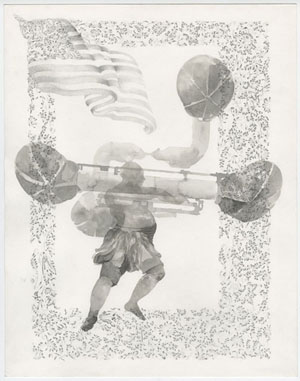
Tone-Deaf Top-Brass is a tart set of obvious double-entendres, that Sikandar also couldn't resist perhaps, though the painting's visual content allows even more deeply critical readings of the relationship between Pakistan and America: amidst a figural garden stands the dynamically arching body of a warrior-monk, his loin-cloth fluttering in the wind of his motion. His arms outstretch such that they might hold an M-16, or is it an AK-47, or is it just a deformed trombone, whose double-sided double-barrelled horns billow into parachutes. This is blowback, for virtual inversions and bilateral near-asymmetries must always describe the joint drills being conducted under a waving American flag.
In a series of calligraphic remixes and medleys, Sikandar explores the imposition of freedom upon Pakistan and the transposition of American values and national narratives upon the region at large. She copies existing copies of that famed original parchment, the American Declaration of Independence, her version being interrupted by further Krugeresque text fragments, now esconced within arabesques and calligraphic flourishes that bleed into the declarative signatures of John Hancock and other Founding Fathers. Beyond the limits of foundational charters, beyond time and the reactionary logic of the state, there is a warning here, and also a terrifying invitation, to the blurring of cultures and national narratives, which will create monstrosities and beauties, the likes of which populate our dreams. The calligraphic line, the flow of ink, funding, influence and power which now interconnect the destinies of Pakistan and America, Sikandar seems to suggest, form an umbilical chord, stomach to stomach, America to West Asia, but who is feeding whom?
Unlike Steve Gaghan's film Syriana (2005), which appears to counsel Americans to stay home and stay out of West Asia lest they endanger their children, their marriages and their personal safety, Sikandar's ambivalent exploration of the engagement of Pakistan and America seems to acknowledge that there is no turning back. Yet these intersections of culture and national interests will not involve any simple relations of power and quiescence, but will continue to create terrible beauty and violence before something else, something new, however bastardized or unholy, is born.
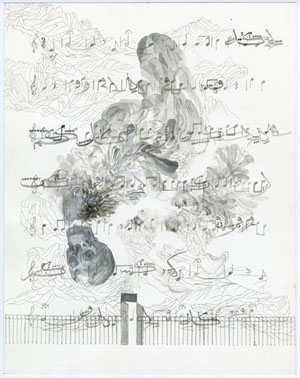
As Sikandar's sketches turn to watercolor and gouache studies, they become increasingly lurid and phantasmagoric, tracing for example the intestines of the general as they curl into a fleshy great horn, the sound emanating therefrom becoming a grotesque fart. Finally, in the apocalyptic Faith, Unity, Discipline, named for Pakistan's national motto, the Artist's warrior-monk is dancing a tandava amidst the flames of a ruined state, whose mountains and clouds are equally inflammed, whipped up by whirring battleship helicopters, as Jinnah's likeness, with Pakistan's flag for backdrop, looks on impassively. If the flavors of these paintings includes fury, horror and disgust, the overarching mood of the series is of pathos — but without compassion, and leading the observer not to shanti, cessation, but rather the indeterminacy of a stalemate. All known ways of living and being and managing Pakistan from within and without have been exhausted, no new ones have emerged, and still we must persist.
All images courtesy Scott Briscoe of Sikkema Jenkins & Co:
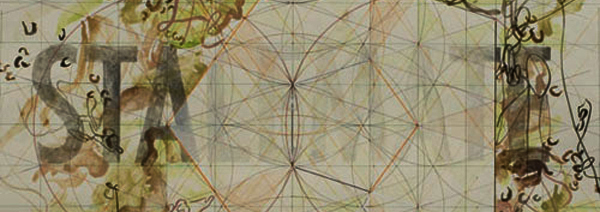
1. Empire Follows Art, 4th of 4 works, detail
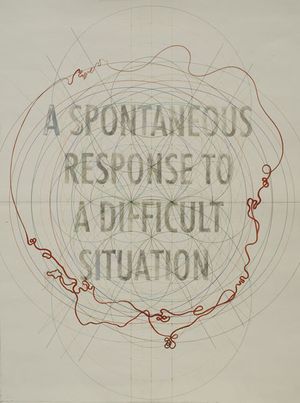
2. Empire Follows Art, 3rd of 4 works
3. Tone Deaf Top Brass
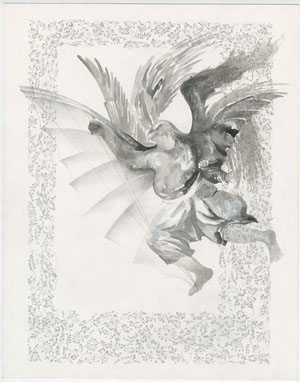
4. Alter Ego, After Goya #2
5. Last Post
Shahzia Sikandar's exhibition Stalemate is on at the Sikkema Jenkins Gallery through May 2, 2009.