
March 02, 2009
The Bitter Taste of Life
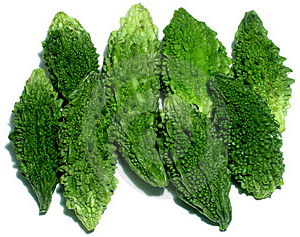
The other evening, Behenji Bua invited us over for dinner, especially to try her new karela dish. It was sublime, setting off taste sensations all round the apperceptive palate. The slightest sweetness, a balanced coping of salt and sour, fullness and complexity, all built around the fundamental bitterness of bitter-gourd, as karela is unfortunately called in English. I’d never liked karela as a child, and adults around me seemed to understand that – it was especially prepared, I recall, for Behenji’s husband, and for other vegetarian connoisseurs in the family, and I don’t think any of us children were even especially encouraged to eat our share of it. It was not a delicacy, but an acquired, perhaps adult taste. Nowadays, I’m sure it is my favorite vegetable, and I’m sure my mindbody and aesthetic sensibility would be poorer for not consuming it at least twice a week.
What is it about bitterness, that allows it to become a part of one’s aesthetic appetite later in life, having been the opposite of pleasure in one’s youth? From when I was a child, I'd always loved raw mango, tamarind, every kind of chat, and even those spicy-salted prunes putatively from Afghanistan. But only recently have I begun to drink Campari-soda by choice, enjoy green vegetables of all kinds, including arugula, kale, colacasia, and seek out those super-hoppy beers that can sting my senses with a burst of pure firstness, as if I were seventeen again, experiencing sushi and wasabi for the first time, learning that warm sake can fumigate the nasal cavity just as wasabi can inflame it. My taste for bitterness is, perhaps, partly founded in the search for novelty, but there is also something else, a transformation of the body's biochemistry in early-middle age, to a new and shifted harmonics of taste.
Over a couple of Christoffels at Bangalore's only Jazz bar a few days ago, I asked my friend Gabriel to help me think about bitterness.
Gabriel seems uniquely qualified to help, being a biological artist, now working on a project to feed silkworms anything but mulberry leaves so as to make their secreta predictably variable. Only catch is, he hates the taste of bitter-gourd: "I don't get why everyone around here is so into it -- it seems to me like just a single sharp note, no complexity -- and I thought I liked bitter things... Like this beer!" The Christoffel sure is hoppy, the only Dutch beer among the Belgian brews they're serving here. But we've spent years learning to taste beer, and he has yet to put in the time to learn to taste bitter-gourd.
It doesn't take Gabriel long to reprise for me the essential link between bitterness and poison. Most natural poisons taste bitter, and he seems to remember that it is somewhat hard to synthesize a poison that doesn't taste bitter. All kinds of green plantlife may naturally select in ways that render them poisonous, and therefore bitter, or else merely bitter, similarly discouraging animals of all kinds including humans from munching on them. But Gabriel is interested to relate the story of newts and snakes somewhere in California, newts having brightly-colored orange underbellies, which they might expose provocatively to attacking snakes, the snakes biting them and dying immediately of the tetrototoxin stored in the newt's flesh. In some areas newt-flesh being immediately toxic to snakes, their encounter having only one outcome, but in certain special hotspots, their interaction going on as long as the snake and mongoose in parts of India, and the outcome no longer being certain. The snake might die, might survive incapacitated, take another bite, the newt's toxicity might spike, its orangeness might fade, the behavior of flipping over to reveal the underbelly might change, and so and so forth.
Gabriel's story somehow reminds me of local newspaper reports of tens of people dying from drinking sugarcane juice because a lizard had somehow gotten caught in the presser. The inherent toxicity of the flesh of this kind of animal has mythopoetic overtones, and the idea of mixing a bitter toxin with sugarcane juice suddenly seems a profound foundational narrative for India. The poor souls who drank that bittersweet mixture may not have chosen that day for death, but they would likely have tasted a well balanced drink with an unimaginable kick. In fact, a kind of beer, for all beer can be defined as the addition of a bittering agent to an otherwise treacly mash of fermenting carbohydrates, usually from malted grain, but also possibly from rice, honey, and why not, sugarcane. As I've recently learned, the characteristic use of the hops leaf in beer dates from the Rhinesgebot law of 1516, which was partly intended to prevent peasants from poisoning themselves by adding to their brews randomly selected local plantlife, which often turned out to be not only bitter, but in fact toxic.
But the more interesting consequence of Gabriel's bio-evolutionistic theory of bitterness is that it reduces my aesthetic apparatus to mere chemoreception. It is demeaning, at first, to have the particularity of one's aesthetic reception reduced to thousands of years of competitive play between plants and varieties of mammals or even primates, but then it quickly feels thrilling and vertiginous. It strikes me that I am right to meditate on bitterness as the transcendent taste, which brings us into difficult contact with the rest of creation, as opposed to sweet, sour, salty, and fatty. The sweetness of an orange has never filled my mind with wonder, the way it might have for Rumi, for there is too easy a fit between its ripe perfection and my own voracious appetite. But the taste of bitterness in leaves and vegetables is the taste of their life forces pushing back against ours.
I am reminded of Peter Greenaway's infamous movie, The Cook, The Thief, His Wife, Her Lover, whose courant intertextuality and pop philosophizing made it the rage among us budding highbrows and turtlenecks on campus two decades ago. Other than the vivid colors, I am haunted by the careful explanation of the chef as to how he prices different foods: more for anything black, which represents death, and which can be mastered by consuming it, like a black olive. I remember being struck by the artfulness of this reasoning, but also sensing that it was a glossy, gauzy veil that disguised a deeper truth. Gabriel's reminder about the bitterness of poison helps me to reconstruct the intended homology: black = death = poison = bitter.
But can bitterness be
securely identified with the color black? I'm not so sure, for
bitterness allows for a wide range of nameless but distinct kinds of
chemoreceptive experiences, tinged with salt, touched by sour. It
strikes me that the visual spectrum breaks discontinuously into
the
perceived categories of color, leaving a rather large swath, indigo to
the outer edges of violet, where while we can know color though we
cannot understand it with as much nuance. So also, bitterness leaves us
infused with the barest taste, knowable only as something
indescribable, barely sensible, unknown. In some Hindu iconography,
shyam, the color of night,
illuminated at its edges by the moon, or else by the refractions of an
already set sun, is identified as the
color of mystic divinity. It is a limit condition of
knowledge, a place of self-awareness, reverberation, and presence. Never darkening to pure flat black, but remaining a blue-black shimmer it may also sometimes lighten, like a
purple cloud, nearly to the color of ash, khak.
"Is bitterness like noise?" offers Gabriel, "Is it like a taste of variousness, unevenness?" While noise is constituted of the same elements that can otherwise make up signal, we know that tastes are perceived at varying locations on the human tongue. So the same things that taste sweet, sour or salty, cannot in some inappropriate admixture taste bitter, unless they actually have a different and new chemical composition. Still, the signal-noise metaphor does make some kind of sense, for it is through an evaluation of their non-bitterness, that foods become recognized as edible. All the things in the world have some kind of taste, even if mostly bland, vaguely gross, metallic, and bitter-bleachhh, and it is only against their horizon that the high notes of starch, carbohydrate, sugar, fat, protein can be made out. When bitterness is appreciated, which is to say experienced aesthetically, it is analogous not to noise, but rather to Noise, the contemporary experimental style of music, which has adherents many parts of the world. My own aesthetic conception of karela, meanwhile, sits inside my brain somewhere near those lobes which store the intensely dissonant Dhrupad stylings of the Dagar Brothers, who are playing now, at full volume, even as I write, pushing all those limits en route to eventually delivering me to harmonization, meaning, cessation, satiety.
There are no tactile analogues to bitterness that immediately come to mind, only visceral ones. If sweetness is a smile, or a kiss, or even an embrace, bitterness is a swift knee to the balls, with all of its lingering afterblow. Gabriel and I agree that there is something salient about the fact bitter is tasted towards the back of the tongue and mouth, and this might mean that it is linked to the gag reflex, and the body's ability to purge itself of a toxic build-up in the stomach. Gabriel also points out that many naturally occuring poisons in nature are alkaloids, as are narcotics like the chemicals in opium and cannabis, along with other non-poisonous chemicals that merely taste bitter. There was, in this sense, a continuity between the sensation and apperception of bitterness and intoxication, and with sheer toxicity. Exploring bitterness as a limit region of the sensorial manifold, then, appears as a threshold point or even a gateway for the expansion of the mindbody's given boundaries, and the search for transcendental sensations through the ingestion of hallucenogenic substances. Interesting to note, given the Ara Bier I've now moved on to, that in beer the bitterness is actually added to the alcohol, unlike vegetal intoxicants, in which the bitterness would already inhere.
It was hard to say anything more profound about the body's reaction to bitter substances at the bar, especially without access to a brain scanner. Instead, I offered Gabriel the parable of Nilakantha. In a primordial era, well before this one, the deva-s and the asura-s were locked in a manichean tug of war, but looped around a churning device, through which the mixed-up soup of the cosmos came to be clarified, and separated. Many valuable treasures were created from this churning, including the immortalizing nectar of the gods, but also created was halahala, the terrible toxin that began immediately to poison all life around it. As the gods and the demons were both threatened by it, they turned to Shiva, who immediately gulped down the poison, but who also managed to hold it within his gullet, preventing it from either metabolising within his yogic body or irrupting back into the world. While the poison remained within his gag, it darkened his throat to a bruised blue color, on account of which he came to be called Nilakantha, Bluethroat. The story nicely associates poison with the threshold of the body which it must not cross, while also suggesting that it is possible, at least for Nilakantha, to differentiate the bitter taste of poison from its harmful physiological effects.
I also shared with him an account of a time three weeks into my first year of college, when suddenly overcome with homesickness one Friday night, I wandered into an illegal progressive party, ending up locked inside a room where they were doing tequila and triple sec shots, of which I remember five, having already downed several beers and multiple cubes of a slimy-wriggly fluorescent-green vodka jello. After we were all busted, the paramedics evidently determined that I didn't need to have my stomach pumped, and a hallmate watched me all night to make sure I didn't drown in my own puke. For months afterward, however, I experienced nausea at the smell of alcohol, principally beer, every time I went out. The mindbody can have certain aversions and associations hardwired into its system, and evidently acquire, as well as forget, new ones through experience. This experience also often comes to my mind when I hear Maqbool Ahmed, of the Sabri Brothers, pronounce, "pina haram hai -- na, pina haram hai -- nahin, pi ke hosh mein ana haram hai..." It is not drinking that is vile / damned, but rather the coming round to those very conditions of life that one had sought to escape.
Upon deep reflection and introspection, I now believe that it is not the knowledge of the certainty of death that condemns us to the human condition, but the Sisyphean certainty of yet another day, trapped in the same social and material circumstances with which we began the night. While the mindbody is a strange loop infinitely turned on itself, this crushing insight is the most bitter of all possible aspects and manifestations of bitterness, which is only vaguely approximated in gustatory or visceral modalities of the concept. Our experience of everyday life affords much sweetness, and some calm, but also periodic knees to the nuts: disappointment, discouragement, uncertainty, confusion and alienation. Even when we cannot control the causes of these experiences and emotions, artificially inducing them can provide some satisfaction, if only because it gives us temporary control and respite from their capriciousness. So far, so Freud, whose basic formulation of repetition and mastery, while clunky and inelegant, would seem to help me understand why I was once accustomed to drugging myself out of the unheimlich quotidian of my painful everyday.
With age, or with time, my mindbody seems to have righted itself since those dark days. It has, one might say, begun following the example of Nilakantha. It prevents halahala from entering into itself, while still remaining open to the extremities of life and the abundance of the sensorial world. I'll be helping it along tonight, with a Campari-soda-slice-of-lime, or maybe a beer, karela done three different ways, gooseberry preserve, chocolate pudding, and after-supper coffee.
Posted by Aditya Dev Sood at 12:00 AM | Permalink


Comments
karela done three different ways
Recipes please, or names of same. Can you get karela in Indian markets here?
Posted by: Carlos | Mar 2, 2009 8:42:12 AM
Marvelous, Aditya -- thanks! Carlos, you can buy karela in produce markets where the Indian diaspora shops -- the photo here does not quite prepare you for the appearance of the thing, however. It has a primordial look. And one must be prepared for the cuisine of the polypeptide rush, too...
Posted by: Elatia Harris | Mar 2, 2009 10:50:48 AM
I love bitter. A devoted karela lover since childhood, I can eat it almost plain - boiled with a bit of salt and mashed with hot green pepper. I will email Carlos my recipe for a spicy Punjabi prep.
Those who may shirk the bitter gourd for its taste will do well to note that it is very beneficial for diabetics in controlling blood sugar.
Posted by: Ruchira | Mar 2, 2009 11:33:44 AM
Wow. Quite a meditation on bitterness, including some synesthetic musings! Good going, Aditya.
By the way, I've never had karela by itself, only cooked as karelay queema!
Posted by: S. Abbas Raza | Mar 2, 2009 12:23:53 PM
Carlos, you can also get bitter melon at Vietnamese markets. It's called khô qua. I've seen it mostly used in soups in Vietnamese cuisine, either sliced in a shrimp broth or stuffed with minced pork in a chicken broth. It's not that hard to grow if you can count on a month or so of really hot weather in summer.
Posted by: Vicki Baker | Mar 2, 2009 12:28:46 PM
Vicki:
That Vietnamese bitter melon soup is delicious - I have had it only with the shrimp broth. Add a few slices of pineapple to combine bitter with tangy.
As I told Carlos, a quick guide to karela buying:
There are two varieties of the vegetable. The Chinese/ Vietnamese variety has larger, smoother gourds which are less bitter and less delicious to my karela loving palate. This one is more easily available both in Asian markets as well as in the produce section of large grocery stores. The Indian variety is crunchier, smaller and more bristly looking - as in the photo that Aditya has posted. Usually, only Indian or Pakistani stores carry it. Also, the Indian bitter gourd is decidedly more bitter and truer to the karela taste that I crave. If you have never tasted the veggie, you may wish to begin with the less bitter Chinese variety. You want bitter melon to be green and hard, not ripe and pulpy.
Posted by: Ruchira | Mar 2, 2009 1:01:41 PM
Thanks, Ruchira, I didn't realize that there was a difference between the Indian and Indo-Chinese varieties. Not sure I'm ready for *more* bitter!
Favorite bitter breakfast: Seville orange marmalade on whole grain toast with lapsang souchong.
Favorite bitter drink: Vodka/bitter lemon
Posted by: Vicki Baker | Mar 2, 2009 1:36:49 PM
"I've never had karela by itself, only cooked as karelay queema!"
You've had it other ways, notably a dry roasted karela with dried chili and dried maldive fish, fresh heirloom tomotoes and lime juice.
Posted by: Robin Varghese | Mar 2, 2009 1:52:40 PM
I've heard the quote; The sweet is never as sweet until you've tasted the sour; seems like you've changed the tide and the counter is fair game! :)
I've never had Kerala before; but will surely give it a try on your behalf.
Just an Idea; but sour may be a rebellious motion, teasing the senses for addictive additives. I do agree, mindbody has to cater with open arms for bitter and may take some getting used to! Tolerance for bitter increases throughout ones years (if your lucky); as long as one is open minded. There's a fine line between Sour Patch Kids and some exotic plant i've never heard of! :P
Enjoy the coffee; I surely enjoyed mine!
Posted by: Abhishek Sood | Mar 2, 2009 2:16:34 PM
Very thought-provoking piece,
Aditya.
I'd like to advance the idea without any substantiation, that a love of bitter tastes is a sign of emotional maturity. It's possible that "acquired taste" just means trying it enough times to get acclimated, but I wonder if the reason children consistently choose sweet over bitter isn't at least partly because they don't yet know that life is bitter. To a person of some maturity, an all-sweet diet doesn't "ring true." Bitter cuisine may be an embrace of life in its fullness, or it may be a ritual attempt to formalize bitter experience in a controlled way. In each case it would seem to be an outgrowth of consciousness and reflection (what did the apple taste like, I wonder, that came from the tree of the knowledge of good and evil?)
Posted by: Chris Schoen | Mar 2, 2009 2:24:19 PM
Aditya:
"But can bitterness be securely identified with the color black?"
So I take it you've never heard that hoary American post-African apercu (insert your own cedilla), "The blacker the berry, the sweeter the juice"...?
Chris:
"To a person of some maturity, an all-sweet diet doesn't 'ring true'."
Not to mention the fact that it's far more likely to kill us! I now eat only 80 or 85%-cocoa chocolate, whereas at 20 (or 30, even) it would have tasted to me like mercury-dipped crabgrass.
Meanwhile, I'm pretty sure that Biblical "apple" would have been a promegranate: bitter as hell as She but into it.
Posted by: Steven Augustine | Mar 2, 2009 5:19:23 PM
or "bit", even
Posted by: Steven Augustine | Mar 2, 2009 5:20:57 PM
Robin, how could I forget?
You are right. That was one of the best things I've ever eaten.
Now get me more Chamandi! :-)
Posted by: S. Abbas Raza | Mar 2, 2009 5:39:58 PM
Steven:
The pomegranate theory sounds plausible - Eden presumably was in a prime growing area in the middle east. But isn't Eve shown holding a very red fruit? That would be the succulent sweet and sour stage. The bitter version is the raw fruit, when the seeds are pale. Then too it is more a mouth puckering acrid than the true blue bitter of "karela." I just planted a pomegranate plant in my backyard last month. Let's see if I will get any of the luscious fruit I so love.
Posted by: Ruchira | Mar 2, 2009 8:07:40 PM
"But isn't Eve shown holding a very red fruit?"
Ruchira, one of the many flaws of the Old Testament is that it is not, alas, illustrated.
Posted by: Chris Schoen | Mar 2, 2009 8:46:26 PM
Until I saw how many places on the Internet you can find excellent pomegranate lore, I had planned to write about the pomegranate for this readership. As I may still do. It's foundational not just to cuisine but to the human experience in many parts of the world. But it's hard finding out how to simply eat one. I guess the first people who did so just...bit. The time-honored (and fastidious) Persian way to eat one in its natural state is to pierce its skin with a knife and suck out the juice and seeds while palpating the fruit. How beautifully meaningful it would be if Eve had had the knife before she ate the fruit. Anyone who hasn't tried it is missing one of the epiphanial tastes on offer.
Posted by: Elatia Harris | Mar 2, 2009 8:52:04 PM
a dry roasted karela with dried chili and dried maldive fish, fresh heirloom tomotoes and lime juice… "one of the best things I've ever eaten."
Mmm. Spill it, Varghese. How do you make it, or what is it called?
Posted by: Carlos | Mar 2, 2009 8:55:19 PM
'sfunny, but although Pomegranates were a common part of my childhood, I lost interest in them for some reason. A year or so ago, after my youngest left for college, I was struck by the realization that I had never introduced my kids to them (BadDad episode 97). In a fit of guilt I arranged to have one waiting for her on her next visit home. Good thing too, because they were her new favorite fruit. I think she had been living on them.
How beautifully meaningful it would be if Eve had had the knife before she ate the fruit.
Hmm. Grr. Nevermind. Whatever.
Posted by: Carlos | Mar 2, 2009 9:06:57 PM
I now eat only 80 or 85%-cocoa chocolate
I'm with you Steven, the rest tastes like poison.
However, humans, along with the rest of the Great Apes (and the Fruit Bat) are the only mammals that can't naturally produce Vitamin C, which wires us to like sweets (to obviously eat fruit high in Vitamin C).
However, before we started selecting and breeding for sweetness, fruit was not nearly so sweet.
This is are evolutionary history.
As far as Bronze Age Fiction and Apples and Talking Snakes, etc that is genera of not much interest to me, although Homer did attract me.
Posted by: Dave Ranning | Mar 2, 2009 9:41:50 PM
well, looks like the 3QD ball this year is going to be a karela-themed potluck! abbas, can we do it in early april when i'm in new york?
chris, thank you for more or less writing the final paragraph of the piece. i'm sure that is what i would have liked to get around to finally saying.
and speaking of potluck, my buddy gabriel and i are working on making a tincture or infusion of karela flavor in local vodka, which i'll be bringing with me as part of our emerging collaboration. any takers?
Posted by: Aditya Dev Sood | Mar 2, 2009 10:06:40 PM
Chris Schoen,
"Ruchira, one of the many flaws of the Old Testament is that it is not, alas, illustrated."
Ah, that was pre-Brick Testament:
thebricktestament
Posted by: Louise Gordon | Mar 2, 2009 10:10:19 PM
Dave, your story about sweets and Vitamin C sounds like another kind of fiction - equal parts EP and the Florida orange marketing council.
There's more Vitamin C in a serving of broccoli or brussels sprouts (both mildly bitter) than in an orange or a pomegranate.
Posted by: Vicki Baker | Mar 2, 2009 10:23:42 PM
Elatia:
The time-honored (and fastidious) Persian way to eat one in its natural state is to pierce its skin with a knife and suck out the juice and seeds while palpating the fruit.
I suppose that means to loosen the seeds from the skin and suck them out for juice. Which is how I eat mine to derive maximum enjoyment. In Indian folklore and music, the pomegranate often alludes to the female breast. Eve again!
By the way, the bitter melon recipe I sent Carlos contains dried mango powder. I forgot that a teaspoon of dried pomegranate seeds should be added too.
Chris: I have not read the original Old Testament. My copy of the Catholic Bible that my grandfather gave me is heavily illustrated and quite beautifully too if I may add. I have also seen Eve in numerous paintings holding a red fruit. As Steven points out, five thousand or whatever years ago, the apple was probably an unlikely fruit in the Mediterranean / Arabian Sea region.
Posted by: Ruchira | Mar 2, 2009 10:47:55 PM
I just found out that there is a National Bitter Melon Council!!!
And that it is more of an art project than a vegetable marketing board!
And we claim all of humanity as part of our Bitter Melon community. From a phylogenetic perspective, bitter compounds in plants evolved as a defense against consumption by animals; in fact, amongst most mammals, Homo sapiens are the only ones to have developed an appreciation of bitterness, e.g. coffee, tea, and chocolate. Therefore, the appreciation of bitterness, the cultivation of a palette for bitterness across cultural-historical and ontogenetic timelines is the very thing that defines us as humans!
http://bittermelon.org/
Posted by: Vicki Baker | Mar 2, 2009 11:16:17 PM
Vicki- That is true, and my preferred way of getting vitamin c, but fruit was our main source, having evolved where cold cabbage family vegetables had not been bred and modified for our general consumption.
Truthfully, I have an aversion for sweets, almost never eat candy, cakes, cookies, and I'm with the crowd who sees the bitter direction as a more developed pallet.
Plants developed chemical warfare to survive (they can't run like us mammals). Being omnivores exploring and modifying every niche we could, we have adapted to this survival strategy well.
Posted by: Dave Ranning | Mar 2, 2009 11:49:08 PM
Ah, lovely, sweet as the bitter fruit!!!
Posted by: Sumana Roy | Mar 3, 2009 2:16:30 AM
I'm this infamous bloggers cousin and here is the even more infamous Bitter Gourd Recipe.
For those straight shooters who don't like the bitter taste, you're in luck because the first step in this recipe is to remove that vile taste. For the rest of you, who prefer living lives of turmoil - just pretend it tastes as bad as it looks.
1.Take 4 bitter gourds, peel them, cut into roundels, sprinkle generously with salt and spread out to dry in the sun for 4 hours.
2. The bitter water will drain away in this time
3. Take the slices and wash the salt off. Pat dry.
4. Add in a pressure cooker, add 1 cup water and cook till the pressure cooker gives off one whistle. (Approx 3 mins) Drain when done
5. In a large frying pan add 4 TBsp of Mustard Oil, a tsp of cumin seeds and a pinch of turmeric. Fry the bittergourd till it turns light pink.
6. Add 2 sliced onons and fry till pink too.
7. Add 2 tsp of fresh sliced ginger, 1 tsp of dried mango power, 1 tsp Coriander powder, 1 tsp Cumin powder, a pinch of dried red chilli powder and a tsp of jaggery (or gur as we call it). Add salt as and how you like it - between 1-3 tsps
8. Fry for a minute and add 2 chopped tomatoes.
9. Fry well till the entire mixture turns into a deep maroon.
Serve steaming hot and enjoy with hot rotis (Indian Bread)
PS: I just dunk this when made in a bowl of yogurt to eat: the hot-cold, and the bland- spicy makes for a great summer dish.
Posted by: Aparna Jain | Mar 3, 2009 11:35:13 PM
For those of us who were fed bits of bitterness in childhood, karela or kakarakai was an external validation of our early experiences, which we were too inchoate to articulate but found a voice for, by eating this strange and bitter gourd. As adults, our early amaroidal memories have become aestheticized in various forms of bitterness we which habitually and sometimes proudly imbibe and then as we age further, as one sees today near all the parks in Jayanagar, we drink a cup of bitter karela juice to ward off the ailments of over-sweetened lives.
Posted by: Annapurna Garimella | Mar 4, 2009 4:11:09 AM
I love cooking karelas. I'll send some recipes in. In Ayurvedic traditions, the karela can assist in regulating blood sugars and are used in diets for people living with diabetes. Karela is known for these properties in India, Sri Lanka and Philippines and I'm sure in other places. I enjoyed the Karela juices in Kerala after some ayurvedic treatment.
I have many more recipes and experiences with the far more pleasant pomegranate and its curative and mythological prowess.
Posted by: Karen | Mar 4, 2009 9:43:15 AM
Ruchira:
"As Steven points out, five thousand or whatever years ago, the apple was probably an unlikely fruit in the Mediterranean / Arabian Sea region."
And isn't the pomegranate, with its intense little seeds like epiphanic rubies (far from convenient to eat, bitterwseet, demanding patience)... a far more lyrical metaphor for carnal knowledge than the easy chomp of some garden variety apple?
Posted by: Steven Augustine | Mar 4, 2009 5:12:42 PM
Can you pls tell me where is this Jazz bar in Bangalore?
Thanks!
Posted by: Jay | Jul 5, 2009 11:11:11 AM
karela is better known of its bitterness but remember its effect is sweetest for blood sugur and heart disease. now a days people accept its utilities and used it regularly.
Posted by: pramod | Mar 2, 2010 1:28:45 AM
A very interesting article…if I may share my thoughts (or rather irritate with my questions).. is this not what life is all about?
The contrast and the extremes? Is it not that what seems desirable that harms? The attractive brightly coloured newts underbelly being lethal for the snake. The bitter gourd and chocolate with higher cocoa solid being less desirable to the palate but harmless to the body if not helpful! Fire flames so alluring and vivid yet extremely destructive! Am I the only one who finds all attractive and appealing things harmful? And I think such is human nature, we are salves of what our senses deem as likeable…sugar is sweet so we like it, drugs make us feel good so we do them, gossiping makes us belittle others and in the process self impose our righteousness , so we do it! But does that mean all that is good? I wonder what if Shiva had not managed to hold it within his gullet, would it mean that we have one less name for Shiva or would it have had other effects? In a similar fashion, how much of the halahala are we willing to hold within our throat instead of spreading it towards our destruction?
Posted by: Ramanika Ved | Mar 5, 2010 12:32:25 AM
For even more bitter beers in Bangalore - try the Flying Dog India Pale Ale or the Rogue Red Ale.
Should satisfy all craving for the excellent bitter stuff
Posted by: Sam | Apr 20, 2010 1:43:40 AM
Post a comment