
This text, which appears on 3QD as the third of a four-part post, was begun as a musing on the theme of series and repetitions in modern and contemporary art inspired by a challenge issued by an art historian colleague of mine. This post addresses the work of Georges Seurat, one of many artists who’ve worked in this manner. For the previous posts (parts I and II, considerations of Wade Guyton’s and Frank Stella’s work), click here and here.
Georges Seurat (1859–1891)
Best known for his bright pointillist paintings, Seurat was also a prolific draughtsman. While his paintings tended to feature large, multi-figure scenes, his drawings were more intimate. They can generally be divided into two categories—preparatory (or preliminary) versus primary: preparatory works such as Clowns and Banquistes (Street Performers) and Au Concert Européen (At the Concert Européen, MoMA) directly relate to his paintings; primary pieces like Groupe de gens (Group of People), Dans la rue (In the Street, also called The Couple), Promenoir (also called La dame en noir—Night Stroll or The Lady in Black), Au crepuscule (At Dusk), and Les jeunes filles (The Girls) were instead explorations done solely as drawings. Although his series of street scenes falls into the latter category, there are two drawings—both titled L’invalide (The Invalid) and completed between 1879 and 1881—which fall somewhere in between these two classifications. One is in Conté crayon (fig. 1), the other in pastel (fig. 2), and though both are illustrated in an early catalogue of his drawings [1], I was able to locate only the latter in a more recent text [2].
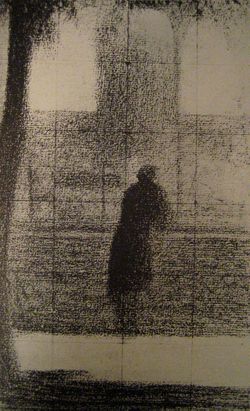
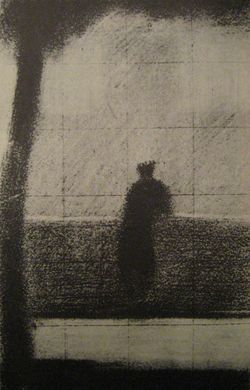
Fig. 1. Georges Seurat, L’invalide (The Invalid) Fig. 2. Georges Seurat, L’invalide (The Invalid)
Conté crayon on laid paper Pastel on wove paper, 1879–1881
Dimensions unknown 9 9/16 x 6 1/16 in. / 24.5 x 15.5 cm
Present location unknown Private Collection [3]
The so-called Invalid was a recurring theme in both art and literature, particularly in Germany and France in the eighteenth and nineteenth centuries, and its popularity may have related to the Seven Years’ War (1756–1763) and the Franco-Prussian War (1870–1871), which left many wounded veterans in their wake. Plays dealing with the subject were popular [4], and a brief passage from Victor Hugo’s novel Les misérables could perfectly fit the figure in Seurat’s drawing: as the protagonist is crossing the Pont d’Austerlitz, he passes l’invalide du pont, a disabled war veteran who collects tolls from those crossing the bridge [5].
It is interesting to note that this sole handicapped man appears amid all of Seurat’s acrobats, musicians, dancers, couples, and merry-makers; certainly many of his drawings have a more melancholic feel to them than his paintings, and of all his darker drawings with street figures, this is perhaps the most pensive and reflective in its overall mood.
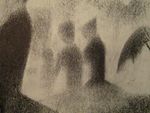
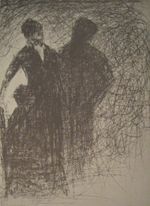
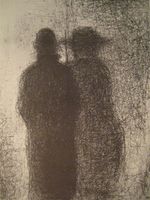
Moving beyond mere subject matter, some commentary on its construction is due. Given the visible grid lines, both versions would appear to be preparatory drawings for a painting—though I’ve not found a similar figure in any of Seurat’s published paintings. Here as in most of his drawings, he works by building up form rather than outlining it. In the early 1880s he spent several years drawing exclusively in black and white, exploring light’s interpenetration and reflection. By rubbing Conté crayon on highly textured paper, his method restricted him to focusing on gradation and varied degrees of contrast instead of straightforward line. This period of “confinement in draftsmanship” (reminiscent of the time Stella spent in his own world of painting, soon after his arrival in New York) is repeatedly referred to by his acquaintance and critic Gustave Kahn: “When he began his confinement in the realm of draftsmanship, he was already obsessed with the magnificence of the night, and also with its solitude, and he was not as insistent as Whistler that the darkness be riddled by lights.” [6]
One might rightly ask—in light of the unequivocally serial pursuits of Seurat’s near-peers Camille Pissarro and Claude Monet—whether these drawings actually are part of a series. Several indicators support the claim that they are: Degas nicknamed Seurat “the notary” [7] not only because of his impeccable dress as he punctually walked the Parisian streets between his studio and his home each evening, but also because of the regularity with which he was seen sketching at vaudeville halls and in the peripheral lanes of the expanding city’s neighborhoods; certainly the concert and vaudeville works are a series of distinct drawings made over time and from various perspectives—alternately focusing on a main performer, then a chorus-line, then the repeating figures of the audience between sketcher and stage, and so on—and the same can be said of the street drawings. Furthermore, his series of street drawings can be subdivided into smaller groupings: solitary figures (tramps, invalids); couples (seated, strolling); laborers (stone breakers, ragpickers, street sweepers, buskers); women (with baskets, with dogs, with parasols, with girls); carriages and carts (with dogs, with horses); and the many Night Strolls.
Another interesting aspect when considering the idea of repetition in Seurat’s work can be traced back to a single term: his well-known pointillist technique was also called divisionist, focusing on the separation of colors on the canvas that will then fuse in the viewer’s eye upon observation; in the very term coined for this approach, a division, a clear break is explicitly noted. Applying this to the drawings in a slightly different way, one could note how they are, essentially, composed of a single line crossing back upon itself, dividing itself, perpetuating itself.
Notes
1. Kahn, Gustave, trans. Stanley Appelbaum. The Drawings of Georges Seurat (New York: Dover, 1971), p. vii; this text is a translation of Kahn’s original French two-volume set, Les Dessins de Georges Seurat (Paris: Bernheim-Jeune, 1928). This comment regards plates 2 and 127, respectively.
2. Illustrated in Frensch, Michael. Seurats Brücke: Vom Impressionismus zur Moderne (Schaffhausen: Novalis Verlag, 2006), p. 6.
3. ibid.
4. See: Hensler, Karl Friedrich, Der Invalide (Vienna, nineteenth century), a military drama in three acts; Bayard, M. (Jean-François-Alfred), Mathias l’invalide (Paris: Marchant, 1836), a vaudeville comedy in two acts; Himmel, Helmuth, Achim von Arnims ‘Toller Invalide’ und die Gestalt der deutschen Novelle (Graz: Selbstverlag des Verfassers, 1967).
5. See Warren, F. M. (ed.). Selections from Victor Hugo Prose and Verse (New York: Henry Holt, 1893), pp. 106–107 and note on p. 207. This description is From Les misérables, “Cosette,” livre cinquième, II—“Il est heureux que le pont d’Austerlitz porte voitures.”
6. Kahn, Gustave, trans. Stanley Appelbaum. The Drawings of Georges Seurat (New York: Dover, 1971), p. vii; this text is a translation of Kahn’s original French two-volume set, Les Dessins de Georges Seurat (Paris: Bernheim-Jeune, 1928).
7. ibid., v.
Thanks for reading; previous Lunar Refractions can be found here, and you'll find for Part IV, the conclusion, on the main site on April 13….