
March 23, 2009
Can You Hear Me, Major Tom?
by Jeff Strabone
Two famous men known for reinventing themselves have spent most of this decade in hiding: Osama bin Ladin and David Bowie. Away from the public eye, Bin Ladin has been busy releasing mixtapes of varying quality over the past few years, but Bowie not so much. Bin Ladin's listeners, at the CIA and around the world, are very devoted to his work: no matter the content or the production values, they really get into each of his new releases and perform close readings in order to make sense of the man and his œuvre. Bowie has his share of fans, too, myself included, who stand ready to parse his latest offerings, but he has not released a new album in almost six years. I think it's time he came out of his cave and faced the music. Aside from a handful of guest appearances with everyone from TV on the Radio to Scarlett Johanson, Bowie has been missing in action as a recording artist since September 2003 when he released his latest album Reality.

My friend Daniel F has suggested that it's far better for Bowie to wait out a potential creative dry spell than to make bad music. I intend to argue the exact opposite: that it is far better for a great artist to make bad work than to make no work. Yes, you read that right: I am demanding more bad art. And in Bowie's particular case, I hope to convince you to join me in asking him to get off the couch and release some new music, no matter how good or bad it may turn out to be.
The premise of my argument is that some artists make more than their work: they make themselves. Part of their art is to generate mythology about their personas. They invent and reinvent themselves as characters that are just as meaningful as anything they write or sing or paint or perform. Like the living sculptures Gilbert and George, some artists are living art.
The idea of the personality as an æsthetic object goes back at least to Walter Pater's Studies in the History of the Renaissance (1873). In the preface, Pater wrote:
'The objects with which aesthetic criticism deals—music, poetry, artistic and accomplished forms of human life—are indeed receptacles of so many powers or forces: they possess, like the products of nature, so many virtues or qualities. What is this song or picture, this engaging personality presented in life or in a book, to me? What effect does it really produce on me? Does it give me pleasure? and if so, what sort or degree of pleasure? How is my nature modified by its presence, and under its influence?'
Pater's student Oscar Wilde put the idea into practice.
Pop music of the past several decades has been a gallery of artful personalities whose legends the public devotes its analytical skills to interpreting. Elvis Presley, Yoko Ono, Bruce Springsteen, and Madonna may or may not be great musical artists, but they have all made their lives the foundations of modern mythologies. Bob Dylan has reinvented himself so many times that it took a company of actors to portray him in Todd Haynes's brilliant film I'm Not There (2007). But before casting Cate Blanchett, Heath Ledger et al. to play Dylan, Haynes made a tribute film called Velvet Goldmine (1999), dedicated to the most restless self-mythologizer of all, David Bowie.
Bowie's reinventions over the years have reflected their times, which makes one want to know all the more how this chameleon man would respond to the wars, terrors, and fears of the age of Bush, and now Obama. We do have the record of his creative response to the attacks of September 11, 2001. At Madison Square Garden on October 20, 2001, he performed two songs at the live benefit known as the Concert for New York City. The second song was 'Heroes', which makes a certain kind of sense if one neglects the original Berlin setting of the song. The first song was the standout: a simple, minimalist, moving interpretation of Simon and Garfunkel's 'America' on a Suzuki Omnichord. Here is the video, which I encourage you to watch. One can only wish that the performance's tone of simple modesty had been more widespread in those trying times. What has Bowie made of events before and since then?
To answer that question, I am going to propose my own periodization of Bowie's career with the intention of focusing on the 1980's: the Reagan and Thatcher years, which I deem a bad decade for Bowie. If you share my dissatisfaction with Bowie's 80's output, then we can use the decade as a test case to answer the original question: is it better for a great artist to make bad art or no art?
First period, the 1960's (1964 to 1968): The young Bowie worked his way through other people's styles on his early singles and self-titled first album.
Second period, the 1970's (1969 to 1980): The golden years of relentless reinvention, restless exploration, and prolific output, framed by Space Oddity and Scary Monsters.
Third period, the 1980's (1983 to 1988): Bowie made middling to bad albums that at first approached the era of excess with a touch of danceable irony and later succumbed to its worst features.
Fourth period, the 1990's (1989 to 2000): Collaborating with Reeves Gabrels, Bowie first stripped away the accretions of the 1980's and then built up new and better ones by experimenting with popular genres and ideas of the 90's.
Now, the 2000's: Just two albums followed by almost six years of radio silence.
There is not much that we can say about Bowie's music in this nearly-over decade. Heathen (2002) is as good an album as he had made since 1980, but it is stifling to try to make critical statements about non-output. So let's go back to those albums, some dreadful, of the 80's and see what they allow us to do: Let's Dance (1983), Tonight (1984), the Labyrinth soundtrack (1986), and the accidentally ironically titled Never Let Me Down (1987). As bad as some of these albums are, they provide essential meaning to the rest of Bowie's work and his mythology, and they challenge us to try to imagine how he could have made these records in the first place. They are as worth thinking about, although not listening to on a regular basis (or at all in the case of Never Let Me Down), as the rest of his œuvre. (Similarly, Dylan's born-again Christian albums, Saved (1980) especially, are disdained by many of his fans, who nevertheless do love to talk about them, and the period is an essential part of the myth of Dylan.)

So, two claims then about Bowie's bad music of the 80's: it gives essential shape to the rest of his work, and it provides exegetical challenges that help us read the mythology. In my periodization above, I placed Scary Monsters at the end of the second period because it provides an explicit closure to the themes and personal demons that haunted Bowie in the 70's. The song 'Ashes to Ashes' revisits the character Major Tom from 'Space Oddity' as an alter ego for Bowie. When we first met him in 1969, he had taken off for outer space where he found himself 'floating in a most peculiar way'. Bowie subsequently took up residence on Mars as Ziggy Stardust, fell to Earth in a Nicolas Roeg film, wound up in Berlin feeling Low, and ended the decade in self-elegy:
Ashes to ashes,
Funk to funky,
We know Major Tom's a junkie,
Strung out in heaven's high,
Hitting an all-time low.

Aside from the five-song soundtrack EP from his BBC production of Brecht's Baal (the only Bowie album I do not have—help me somebody!), his three-year absence from the recording studio makes sense. Scary Monsters was the end of an era, an addiction, and an abyss. He hit the all-time low and was going to start over.
We can see that quite brightly in his next album, Let's Dance, which is unlike anything that preceded it. There is nothing scary or monstrous about an imperative to dance. Bowie, lyrically and visually, is the star of a new set of stories, none of them directly about him. We see him in the music videos from the album dressed in an immaculate yellow suit ('Modern Love'), ironically (one hopes) playing with vaguely colonial Orientalist tropes ('China Girl'), and impassively observing the contradictions of Western consumerism that indigenous Australians face ('Let's Dance').
There appears to be some very stylized critique running through some of this material, but Bowie himself is the one wearing the suit, and we know how his identities tend to take on a life of their own. Here is another image of Bowie in the crisp yellow suit and bowtie. It is from the widely aired 'Coffee Achiever' television ad campaign of 1984, sponsored by the National Coffee Association. The cocaine achiever of the 70's had become the coffee achiever of the 80's. (I can't help but think that Cicely Tyson appears in the ad as a stand-in for that other great cocaine-achieving musician of the 70's, her husband Miles Davis.) Being clean from cocaine is surely a good thing, but I wonder about men in suits and suspenders who are obsessed with achievement in the 1980's. Was Bowie adopting the æsthetics and values of Reaganism?

The albums got worse and worse—to say nothing of the fact that the other half of Let's Dance is utterly forgettable—until the aforementioned Never Let Me Down, which even Bowie acknowledges as his absolute worst. The Wikipedia entry for the album quotes him as saying:
'I know that everything I do is really heartfelt. Even if it's a failure artistically, it doesn't bother me in the same way that Never Let Me Down bothers me. I really shouldn't have even bothered going into the studio to record it.'
That is where we differ. The material excess of the 80's that Bowie fell for once he fell into the yellow suit is part of the legend, as is the dramatic musical break that followed it. This is how Jon Pareles in the New York Times for August 2, 1987 described Bowie's Glass Spider tour:
'Under the dangling legs of a huge (60 feet high by 64 feet wide), translucent spider, Mr. Bowie, a five-piece band and five dancers will present stadium-scale, rock-driven, imagistic music theater, the most ambitious effort yet from rock's most self-conscious actor. […] To tour the United States, two identical setups, each costing more than $10 million and weighing 360 tons, are leapfrogging one another so that the show can go on two or three times a week. A third setup is currently being built. The payroll for the tour involves 150 people (including performers, construction crew, electronics specialists and 40 truck drivers) and adds up to about $1 million a week.'
That ridiculous spectacle brought about its own demise, and Bowie's subsequent revolt against it directly led to the third period, which began in 1989 with the pared-down, spartan-rocking sound of Tin Machine, where Bowie was just a member of the band.
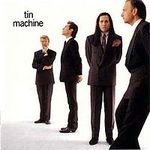
The band wore business suits on the album cover, but the simple image strikes me as less about the dress code of the Reagan years than about getting back to the business of making rock music. Bowie had gone so far beyond the yellow suit and sound of Let's Dance that a course correction—another reinvention—had become necessary. By 1987, it was clear that Major Tom had joined the Reagan Revolution. I think we preferred him as a junkie.
Say what you will about the merits of Tin Machine, but their unfancy sound and arrangements were as explicit an artistic statement against the 80's and Never Let Me Down in particular as the yellow suit was a turn away from the 70's. The Tin Machine direction makes sense to us because we know what choices led to it. All the bad Bowie music of the 80's thus helps us understand the rest of his work.
In a way, Tin Machine was a pre-grunge reaction to aspects of the 80's not unlike Nirvana's cleansing effect on the bad-hair rock of the 80's. 1987 was such an artistically awful time for Bowie, I would argue, because he had adopted an 80's-specific theatricality of excess that was based on intellectual and ethical premises that he did not share. That is why Never Let Me Go lacks conviction. But that question—why is it so bad?—is a question that we can ask only because the album exists. We cannot ask these questions of work that does not exist. That sounds obvious, but the ramifications are important. Even bad art gives us interpretive work to do: how do we explain its place in the artist's œuvre and in his mythology?
What can Burt Bacharach's fans say about the twenty-one album-less years between Future (1977) and Painted from Memory (1998)? Silence. And that's saying nothing of the fact that even a bad Bacharach song (are there any?) is better than most people's best. And now the story continues. Whatever one thinks of Bacharach's collaborations with Dr. Dre on At This Time (2005), it's certainly something to talk about.
What if Bowie were to make an album as bad as Never Let Me Go in 2009? I would say, bring it on. It's time to smoke him out of his cave. Just make the music, David, and let us make sense of it. Give us the material that will generate the exegetical work on our part. And add another twist to your narrative of the restless reinventor. If it's bad, perhaps the album after that will help us understand why.
Sometimes people have less to say than at other times, but what good is six years of artistic silence? I would rather see a great artist make bad art, if that's all that he or she can do at the time, because even bad art by a great artist is preferable to none. So let bad art proliferate. I will welcome it and interpret it just as keenly as good art, perhaps even more so.
Posted by Jeff Strabone at 12:25 AM | Permalink


Comments
An erstwhile Bowie fan, I attended the Glass Spiders concert in London, and subsequently stopped listening to him. The last album of his I bought was NLMD.
Maybe I should check out his later albums.
Posted by: Sagredo | Mar 23, 2009 5:01:17 AM
1. Bowie's "absence" is a post-heart attack phenom. Not to mention the fact that he's finally starting to look his age; the old dame is famously vain, innit?
2. "Was Bowie adopting the æsthetics and values of Reaganism?"
As much as I enjoy his work, Bowie was a major force in popularizing the fascist-lite aesthetic that facilitated cross-demographic (including hipsters and liberals) acceptance of the Reagan Reich's overall look. And looks, in the Real World, are more meaningful than sounds or words. (Media still hasn't shaken off the blonde fixation that Bowie helped spark in order to wipe away the swarthy "ethnic" goodness of the 70s).
3. I saw Bowie in the Glass Spider tour and him doing "Time" in a golden breastplate and extendable/retractable wings... descending on us from high above the arena... was truly wonderful ueber-kitsch.
Posted by: Steven Augustine | Mar 23, 2009 6:45:17 AM
According to the seminal Watch You Bleed, even Guns N' Roses were impressed and frightened by Bowie's devotion to decadence in the late 1980s.
Posted by: Slash | Mar 23, 2009 6:55:15 AM
By the way, I think this piece's initial marriage of Bowie and Bin Laden is brilliant, and could merely have wished for more development of the theme. (Though I am increasingly inclined to think that OBL is really the terrorist equivalent of Nicolas Bourbaki.)
Posted by: Slash | Mar 23, 2009 7:03:00 AM
I also saw the Glass Spider show, at the old Wembley Stadium (don't look for it, it's not there anymore). And in retrospect he did play some interesting selections - not just Time, but Big Brother, All the Mad Men and Up the Hill Backwards. But you could see what was happening, even if you were only 15.
The difference between Never Let Me Down and Saved is that no-one could accuse Dylan of pandering to his fans or to his record company when he suddenly decided to make uncompromisingly Christian records. That is what saves Saved - for all its flaws, it's an authentic expression by an authentic artist. NLMD on the other hand, saw Bowie (the genius of inauthenticity?) completely at a loss, self-parodically aping the multi-platinum sound of Lets Dance and trying to tack on some off the peg "wierdness" to reassure his older fans. Actually, later in the 80's, Dylan went on to make albums like Empire Burlesque and Knocked Out Loaded which are almost as bad as Never Let Me Down, and similarly misguidedly "commercial" (like NLMD they were in fact flops). It's one thing for the artist to risk failure, but it's a little sad when they fail because they have cheated on themselves. Having said that, you are quite right to say that one cannot understand Bowie's (or Dylan's) 90's rebirth without knowing the bad albums, and these days I'm more forgiving about icons pissing away their mystique. But that is what Bowie, the most mysterious, the most iconic of pop stars did in the 80's. He came to Wembley and pissed away his mystique.
Posted by: Daniel F | Mar 23, 2009 9:47:14 AM
Thanks for an intriguing post! There's nothing quite like spending Monday morning thinking about David Bowie instead of Monday-morningy things. While I sympathise with your arguments, I'm not sure that I fully follow you. Because we can point to an album like NLMD, and because we can say it is unlistenable, a disappointment to its author and its audience, we therefore a) have something to point to, and b) something to say (that it is not worth listening to, and pretty much everyone agrees it is bollocks, and that as such, it somehow fits into a schema?) Unless you are going to make the case that there is more to say about something like NLMD, then I hardly think saying it should never have been made is saying something about it worth saying. I would tend to agree that Bowie's "bad art" is a) better than a lot of otherwise acceptable art, and b)likely to be interesting in a way that would generate some possible interpretations, but then "bad art", because it is cracked or wrong, is often easier to interpret - and yet lacking. Pater talks about pleasure, and that is harder to pin down. Perhaps Bowie could produce something that would give us little to no pleasure but that would add in some interpretable way to his oeuvre - would we really want this from a man who has discovered and crafted melodies that cause the angels in Heaven to forget themselves and their place beside God's face? Would you rather that Bowie put out his own version of Metal Machine Music, something that gave nobody in the entire world any pleasure, but certainly constitutes a great moment in Lou Reed's and modern music's itinerary through the twentieth century? Maybe. As a fanboy, I would agree with you - I'd rather hear something from Bowie than nothing, even if that something were to turn out to be NLMD. But I'm not sure I can justify that by appealing to "interpretation"; rather, I would be sustained by the hope that there is something more than interpretation, some gorgeous tune tucked into it, something clever and sad, something beautiful. If I were to be disappointed, maybe I could be disappointed in an interesting way, or you could show me how to be disappointed in an interesting way, and maybe that would be better than silence, and maybe that would not be a waste of money, and maybe it wouldn't be worrying as a possibly sour way to draw a career to a close - maybe.
In terms of "silence", there just might be something of a distinction to be drawn between the silence of Osama Bin Laden, live and uncut, and David Bowie's silence. Bin Laden's silence is pregnant with demons, saturating the air with threats; it is a silence that is imposed by others, and one that would be filled by the neverending sussurrus of a theocracy's constant prayer. David Bowie's silence is . . . not quite the same? Most of us want to bring both silences to an end - but in very different ways; in one case, by ensuring its infinite voiceless, and in the other, by promising to listen to the silence-ending music again and again.
Posted by: sw | Mar 23, 2009 10:06:07 AM
Perhaps what is missing from the thesis is an appreciation of the fact that an artistic silence generates its own mystique that radiates outward into the whole oeuvre, can in fact represent a terribly meaningful portion of the artist's story - indeed, in some ways more meaningful than any of the art itself can be. One thinks of the awesome silences of Salinger or Pynchon or W. Axl Rose, and of course that of OBL (who might well for his part be silent because he is already long time dead). Silence can be an excellent strategy to preserve mystique, even to amplify it beyond all reasonable bounds, rather than, as Daniel F puts it so vividly, pissing that mystique away. An extended silence has its own narrative, performs its own reinventions of what surrounds it.
Music is made up of notes and rests.
Posted by: Slash | Mar 23, 2009 11:00:58 AM
Cool, Jeff! Thanks! And others here too. I'm still waiting for someone other than myself to ponder whether OBL and Julia Roberts don't resemble one another too closely for sheer coincidence to be all that's involved.
Posted by: Elatia Harris | Mar 23, 2009 11:51:55 AM
All artists create bad art.
The question is whether they make the failures available to the world at large, or whether they are kept private.
From a commercial stand point, once you have a certain notoriety and financial stability, releasing the bad stuff may generate funds short term, but hurt your long term sales.
From an artistic standpoint, it does you no harm, as it gives you feedback about the art.
Posted by: icastico | Mar 23, 2009 4:14:12 PM
From one of his early albums
Posted by: missvolare | Mar 23, 2009 9:02:22 PM
Jeff - You asked about Baal. It hasn't been reissued on CD, ever, as far as I know. But it's been available on iTunes for some time now and that's where I got it.
Posted by: Izabella | Mar 23, 2009 9:51:23 PM
It is striking to see other people say that Never Let Me Down turned them off to Bowie. The album had the same effect on me at the time. I gave up on him until his Outside album (1995).
Bowie's susceptibility to what Steven Augustine called the 'fascist-lite aesthetic' of the 80's is hard to explain. Throughout his several transformations of the 70's we can see a discerning mind at work running the show, even through the cocaine cloud. He may not have known what he was doing when he wrote 'TVC 15', but there was clearly a thoughtful mind at work behind all those albums. Did the coffee make him lose his mind in the 80's? Was Ziggy replaced by Zelig?
Daniel F, my longtime Bowie interlocutor, makes a good point about being more forgiving now towards our artistic heroes. Was it just because we were younger then, or did the cultural stakes seem much higher in decades past? It used to feel like a crime when pop stars made ethically or æsthetically dubious music. Nowadays it's hard to imagine getting so worked up about a piece of music. Are we better or worse off for caring less?
SW is eloquent, as always, about Bowie and bin Ladin. Obviously, I would prefer great art to bad art. Almost as obviously, the pleasures of talking about NLMD in retrospect do not match those of listening to, say, Low or any other great work by Bowie. I don't think we disagree.
Slash points out that artistic silences can be meaningful, too. I agree up to a point. Bowie's silence between 1980 and 1983 is eloquent, and I alluded to it as such when I noted 1980 as an explicit closure. A silence of double that length is just a void, particularly during such interesting times as we are living through now when we need our artists to help us understand our world.
As for the availability of Baal at the Itunes store, I just checked and it is nowhere to be found there. Am I not searching properly?
Posted by: Jeff Strabone | Mar 24, 2009 2:07:35 AM
I've just checked iTunes. Search for Bowie, then click on Albums, then click on "More results" until "In Bertolt Brecht's Baal - EP" appears. Right now it's priced at $ 3.49 (Canadian). My browser is showing the thumbnail right next to "Never Let Me Down" - ugh.
If you're not seeing it, the only explanation I can think of is that it's available in Canada but not in the US - not that it makes much sense.
Posted by: Izabella | Mar 24, 2009 2:33:59 AM
In a way, Tin Machine was a pre-grunge reaction to aspects of the 80's not unlike Nirvana's cleansing effect on the bad-hair rock of the 80's.
Not quite, it took Nirvana to push music out of the very shallow end of the pool.
But, who can complain about Bowie? He did not make silence an art form like Pynchon, but the late 80's (actually the late 70's) would have not been the same.
For me, Bowie was more of a 70's artist.
Posted by: Dave Ranning | Mar 24, 2009 2:38:42 AM
Itunes is definitely country-specific, as I have discovered when urging friends in the UK to download episodes of Mad Men before they aired there. Oh well.
Why would Baal be avilable in Canada and not in the States? Hmm, if the Canadian Itunes store is selling it DRM-free, perhaps some generous Canadian soul will e-mail it to me?
Posted by: Jeff Strabone | Mar 24, 2009 2:49:37 AM
Maybe it's because we Canadians have more refined musical tastes. Or literary tastes. Or something.
Or perhaps a major U.S. network is planning to air that BBC production and won't let iTunes sell Baal until that happens. Er, just kidding.
I'm pretty sure that my copy has DRM all over it. I haven't checked whether they now sell it DRM-free. I'm also pretty sure that I've seen "The Drowned Girl" on YouTube and in various other places, but not the rest of the EP.
Posted by: Izabella | Mar 24, 2009 3:07:57 AM
I don't quite understand the basis for Jeff's assertive calculation that a three-year silence can be eloquent but a six-year silence is "just a void". (Nor, perhaps, is a void ever just a void.) Plenty of artists, including the ones I already mentioned, have given us fecund silences that lasted longer.
But more importantly, I fear it does a great disservice to Bowie to demand that he return to "help us understand" our "interesting times". Is that all artists are good for?
What Jeff asks of Bowie is what Bowie himself asked of Dylan long ago, and it was a misunderstanding of the nature of genius back then too.
Posted by: Slash | Mar 24, 2009 5:46:09 AM
Lovely writing Jeff. I'll be a regular reader now. I saw David Bowie in Adelaide, South Australia on his Let's Dance tour in 1983-84 sometime. My major memory is an absolutely searing rendition of Velvet Underground's White Light/White Heat. The derivitive Let's Dance is a shame for an artist of Bowie's clibre and originality. Glad to hear he tried to get through it. He's an artist by nature. I'm sure he's producing something but maybe its for his personal satisfaction now ? All The Best, Baraholka
Posted by: Baraholka | Mar 24, 2009 7:36:55 AM
Elatia. lol.
There hasn't been total silence:
http://www.youtube.com/watch?v=jv6mEv_rDdE
Posted by: Carlos | Mar 24, 2009 8:59:13 AM
Slash raises some interesting points: "nor, perhaps, is a void ever just a void": one might target the use of "perhaps" as a sort of ersatz caution, but the suggestion, once we heave ourselves over the defensive barricade of "perhaps", that a void can be something more than a void, while remaining a void (which "just a void" allows) is intriguing. Slash - what do you mean by this?
Also, I am curious about the "misunderstanding of genius" - to some extent, this goes to the heart of Jeff's piece, about "bad art". Based on what I argued earlier - and not at all inconsistent with Slash's fair gripe that "it does a great disservice to Bowie to demand that he return to "help us understand" our "interesting times"" - it is far easier to talk about and "interpret" genius misunderstood and bad art than genius and art. They open themselves up, solidify something that is ephemeral and fleeting, and allow us to grapple with them. Jeff's point, I think, is that this itself is a worthwhile pleasure, better than nothing (though I am not entirely sure I agree with him - indeed, I haven't even listened to all of Morrissey's new album, proof enough for me that I'm not sure I'd want something bad, or, worse, mediocre, from a beloved star than nothing at all - although I may prove myself wrong when I do listen to it, or perhaps years down the road when I revisit it, re-interpret it, and so on).
Posted by: sw | Mar 24, 2009 10:47:15 AM
I am happy to expatiate, fag burning and fingers idly riffing, on what I mean by "nor, perhaps, is a void ever just a void". Firstly, of course, I mean what I have already said: that a rest (playing no note) gives meaning to the notes around it (on a grand scale, think of the terrifying chasms of silence that yawn through Beethoven's 7th). A silence can never be meaningless as long is there a listener waiting for it to end.
Just so, a period of six years, yes, or twelve, or more, in which an artist whom we revere produces no new work, can never be a meaningless artistic silence as long as there are people like Jeff waiting for it to end and speculating as to what new work might emerge, even if it is work of the terribly boring kind that helps us understand our interesting times.
I can add to this proofs from science: for, so the physicists tell us, the vacuum is boiling with virtual particles; and a black hole emits radiation.
A void, then, is never just a void.
I agree that talk of misunderstood genius is cheap, as though any of us really understood it, and welcome your chastisement on that point. But look, now my fag has gone out.
Posted by: Slash | Mar 24, 2009 10:57:15 AM
I agree with you, Slash. "A void then, is never just a void" - though I don't think we need to find "proofs" from science, because your explanation already suffices and already improves upon "a vacuum boiling with virtual particles" - although I like the idea of Jeff as a virtual particle boiling with excitement in the void of Bowie's silence. It is perhaps - I offer up my own ersatz caution - not fair to compare silence to a void. We have rests in music, pauses in Pinter, the emptinesses on a canvas, the spaces between letters, silences in conversations and in oeuvres, all of which are necessary for the generation of meaning (one might think of Derrida, here) - perhaps it is unfair to characterise these as "voids", and perhaps that is your point. The semantic issue is that a "void" that is no longer "just a void" ceases to be a void at all; such a moment, whether it is a fraction of a second or decades long, is better characterised, as you point out, by such terms as "rest".
I would add that it is not quite - quite! - fair to say that a silence can never be meaningless as long as there is a listener waiting for it to end, unless one is willing to add - as I am sure you are - that a listener is not necessarily required for a silence to become meaningful. It is possible that Bowie's silence is meaningful without merely bearing the promise of its ending; it is possible, for example, that it is meaningful for him.
Posted by: sw | Mar 24, 2009 12:17:41 PM
I think it a lovely suggestion that Bowie is finding his own silence meaningful - a haunting suggestion distinct, as I am sure you intended, from the ordinary idea that he is finding meaning in whatever else he is doing in his life while not releasing records (though we can wish this to be true as well).
But I don't need to adjust my claim in the way you offer to welcome this lovely idea, because in the case you suggest, Bowie himself is the necessary listener of his own silence, thus rendering it meaningful.
Yes, I insist: a listener is required for a silence to become meaningful. Indeed, without a listener, there is no silence, just as without a listener there is no sound - there are only agitations of the air, undulations of the ocean, vibrations of the earth.
(A listener, of course, need not be a human animal.)
Posted by: Slash | Mar 24, 2009 1:18:22 PM
i enjoyed this, jeff. especially, but not only the hook up top, though i must confess to not sharing your overall outlook, which i take to be more the consumptive appetite of a fan than the measured reception of an aesthete.
as slash, sw and others have already offered, surely the thing to do is to go back and listen to the old work and to contemplate how it rings and resonates anew.
and as someone who has only begun writing, i'm thinking i might yet be taken to task by my future fan base for having been silent more or less my entire life.
Posted by: aditya dev sood | Mar 24, 2009 1:39:16 PM
jeff why no mention of 'lodger'? imo, it's far and away the most adventurous/timeless contribution of his frenetic period, what people here are calling the cocaine phase. i know of nothing so feverish, precise, lyrical and unhinged all at once.
thoughts?
Posted by: ed rackley | Mar 24, 2009 2:19:36 PM
Yes, Slash, I did intend to imply that Bowie is listening to, and finding meaningful, his own silence - and now that you mention it, I too find it haunting.
I was specifically taking you to task for insisting that there is a listener "waiting for it to end" or "a listener like Jeff" (that is, another person). My own sentence - "that there is not necessarily a listener" - was intended to capture these two criteria you had previously suggested were necessary to making a silence "meaningful". Does one listen to one's own silence? Yes - I agree with you; there must be a listener. And that it need not be a human animal? I love that little addition, so sweetly and innocuously tucked in at the end, as an afterthought that is so obvious it is almost hiding in embarrassment between those brackets. And yet, of course, it is relentlessly provocative, following on from all of philosophy, and the constant recourse to the human as one who listens and the animal as one who hears . . . Nice.
Posted by: sw | Mar 24, 2009 2:27:15 PM
I agree that Lodger is, perhaps, Bowie's most under-rated album. It is my personal favorite.
As for artistic silence...as a fan of Kate Bush, waiting to put out the good one can certainly be a successful strategy.
Posted by: icastico | Mar 24, 2009 7:10:43 PM
People often overlook the fact that Let's Dance had the guitar stylings of none other than Stevie Ray Vaughn. I actually use the opening riff of "Criminal World" as my iPhone ringtone. Early era fans of Bowie that were turned off by the 80's era Bowie, either because of the pop sensibility of Let's Dance, the over-rotation of "Blue Jean" on MTV, the unlistenable pseudo-homo-erotic Mick Jagger duet, or the inability to fathom the Tin Machine efforts, will likely have missed out on some very solid work by Bowie in the post-Tin Machine era. Reeves Gabrels on guitar is a joy to behold and extends the tradition of great Bowie guitar leads (Alomar, Vaughn, and who could forget Peter Frampton on the NLMD tour, etc.)
I HIGHLY recommend that you seek out the Bowie 50th Birthday performance (New York City) from early in the 90's where Bowie embraces his entire legacy plus songs from the new (very good) albums Outside and Earthling. The concert features Bowie performing live with Lou Reed, Billy Corgan, Frank Black, Robert Smith, the Foo Figthers, and Sonic Youth. It may be the greatest concert of all time.
I don't agree that Bowie should crank out garbage for the sake of mythology. Art requires that you have something to say. Cranking out "product" without artistic voice is called "wanking."
The world doesn't need more wanking. We could all use a healthy dose of Bowie, now in his 60's, making music that we can appreciate because it is, in fact, artistic.
Posted by: Spankky | Mar 25, 2009 12:51:55 PM
"Bowie's susceptibility to what Steven Augustine called the 'fascist-lite aesthetic' of the 80's is hard to explain."
Jeff, I hate to mention young Bowie's infamous Nazi salute at Victoria Station... but... yeah. There was that possibly-brief streak in him. The Britain-could-use-a-fascist dictator quip, too.
*My* favorite song/production has to be Station to Station. The "Kether to Malkuth" line... in a "pop" song! Mind-meltingly exquisite. Next would be Beauty and the Beast... Drive In Saturday... Five Years... back when he was minting not just great tunes but alternative planets.
I was quite shocked when I heard, in the mid-1990s, that he was a near-billionaire (not in song sales but in canny tech investments). One thing you can't say is that he's doing his job for the money.
Check out the YouTube clip of Bowie and J. Schnabel (if you haven't already) on Charlie Rose's show, discussing Basquiat. Again, we see the delightful tension between Bowie, and some nominal equal, in conversation. The will to power is subtly on display.
Posted by: Steven Augustine | Mar 25, 2009 8:47:59 PM
PS I recorded, off the radio, Bowie's 1990 Hammersmith gig (when I was living a ten minute walk away at Baron's Court) on two 90 minute chrome cassettes... the gig in which he claimed he was retiring *all the old tunes*, never to perform them again. Absolutely incendiary versions of Rebel and Ziggy and Ashes and Stay and Wild is the Wind, et al (and some then-current, mediocre co-write with Mr. Belew, I'm afraid).I've never heard these recordings anywhere else... and I lost the tapes!
Posted by: Steven Augustine | Mar 25, 2009 8:54:08 PM
Steven, the 1990 concert that they broadcast on the radio was actually at the Milton Keynes Bowl (I don't think he played Hammersmith that year). I was at the show, and it was certainly a thousand times better than Glass Spider. The horrific Belew song was Pretty Pink Rose
Posted by: Daniel F | Mar 26, 2009 4:53:10 AM
But more importantly, Steven, I can't find the Schnabel/Bowie clip you mentioned. Can you post the link?
You might enjoy this, the first part of David's epic encounter with Jonathan Ross, circa Heathen. It's fascinating to see how Bowie assimilates and masters Ross's cheeky-chappy tone - LIKE HE'S AN ALIEN OR SOMETHING!
http://www.youtube.com/watch?v=PyccCFXd7cE
Posted by: Daniel F | Mar 26, 2009 5:04:06 AM
Daniel!
Memory's a blur on that, I suppose! I know the Ross clip... maybe they've taken the Basquiat clip down... how about *this*, then... ?
MAJOR TOM
Posted by: Steven Augustine | Mar 26, 2009 5:31:23 AM
I have a million things to say in response to all the brilliant comments, but I'm stuck in Virginia for a conference right now. It looks like the conversation is going on fine without me.
The time between the albums of 1980 and 1983 I realize is not a creative void at all. That was the era of Bowie the theatrical actor: The Elephant Man on Broadway, Baal for the BBC. Sadly, I know nothing about either. When I get back to New York, I will see if the performing arts library at Lincoln Center has a recording of the former and report back.
Had I mentioned Lodger, the most underrated album by Bowie or possibly anyone, there would have been room for nothing more in my article. I have a whole slew of ideas swirling around my head about that album and the entire Berlin trilogy. I feel like there is a connection to be made between the melancholic electronica of the Berlin trilogy and the squeegeed memory of Gerhard Richter, but I have not yet found the words for it. Maybe I just need to devote more time. I would love to know whether Bowie and Richter ever crossed paths in the 70's. Bowie's work is haunted by World War Two in ways that go unrecognized.
Consider this verse from 'Fantastic Voyage' on Lodger:
'They wipe out an entire race and I've got to write it down,
But I'm still getting educated but I've got to write it down,
And it won't be forgotten
'Cause I'll never say anything nice again, how can I?'
Am I the only one to hear echoes of Adorno's famous comment about poetry and Auschwitz in that last line?
Finally, for now, I attended the fiftieth-birthday concert at MSG in 1997. My favourite memory from that spectacular occasion was Bowie and Lou Reed singing duets. When will Bowie collaborate with David Byrne?
Posted by: Jeff Strabone | Mar 26, 2009 11:00:04 AM
This is a fascinating post, especially the point about bad work being better than none at all. But I want a word with Slash: dude, do you have a website or something? cause I want to read that too. I sat straight up when you mentioned Nicholas Bourbaki.
I read a good memoriam to Stooges guitarist Ron Asheton recently (in Spin, I think) which made a point of how almost everybody hated and disrespected the Stooges in the first few years... but not Bowie. Somehow, he saw quality where others didn't.
David Byrne's career, incidentally, is as interesting as Bowie's. He has never made a bad record, and some of his solo works are as good as anything done with Talking Heads, which is to say he's still making masterpieces.
Posted by: Tom Buckner | Mar 29, 2009 8:10:32 AM
Post a comment