| ABOUT US | ARCHIVES | LINKS | RSS FEED | MONDAYS | |

3quarksdaily

An Eclectic Digest of Science, Art and Literature

« LUI: Living Under the Influence | Main | Music in the Service of Cosmology: Popol Vuh and Giacinto Scelsi »

March 02, 2009

Asian Food for Thought

By Namit Arora

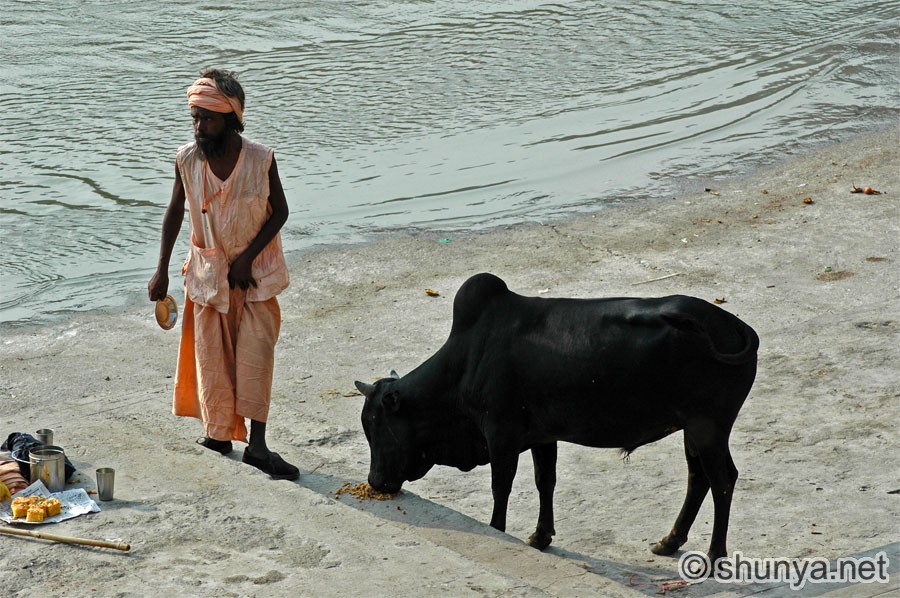
People09 Growing up in India, I ate meat only a handful of times until I left home for college. My mother, a moderately pious Hindu, had a deep aversion to eating animals and wouldn’t allow meat in her kitchen (I also remember her kindness and sympathy towards the ragged animals that shared our city streets: cows, dogs, horses, goats, cats, donkeys, and even occasional elephants and camels). My father was vegetarian for the most part, except when, on rare occasions, he pretended to enjoy a few morsels of meat. I think he did this despite himself, mostly to project the public image of an adventurous, cosmopolitan man. If no one were looking, I’m sure he would have picked a vegetarian option ten times out of ten.

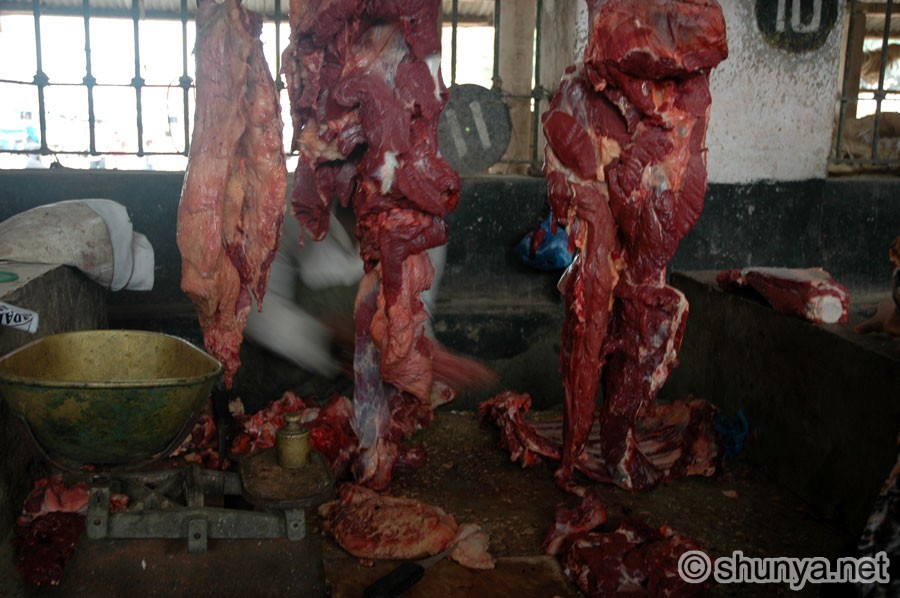
MeatMarket3 The only times I ate meat was when my older sister brought home a chicken or mutton (goat meat) dish from a friend’s place, or cooked it herself on a Sunday morning on a kerosene stove in our courtyard. When she cooked, my task was to procure the meat. I would bike up to the butcher’s shop and await my turn, squeamishly eyeing the goat carcasses hanging on hooks, and gallantly ask the man for ‘the best cuts,’ to which he always replied, ‘only the best for you, son.’ Washing and cleaning the meat, I felt a strange exhilaration—I saw it not as food but as the flesh and bone of a dead animal, hacked to bits just hours ago. Mother allowed my sister to use only the most beaten down utensils from her kitchen and later instructed the maid to scrub them clean thrice as long.

Still, my parents encouraged us to eat meat, holding it to be salutary for growing kids. Their attitude later struck me as similar to Gandhi’s during his early struggle and experimentation with eating animals. Gandhi saw meat as a contributor to the enviable vigor, material progress, and sturdier physiques of people from the West, which conflicted with his own traditional disposition—and of his social class—against eating meat.

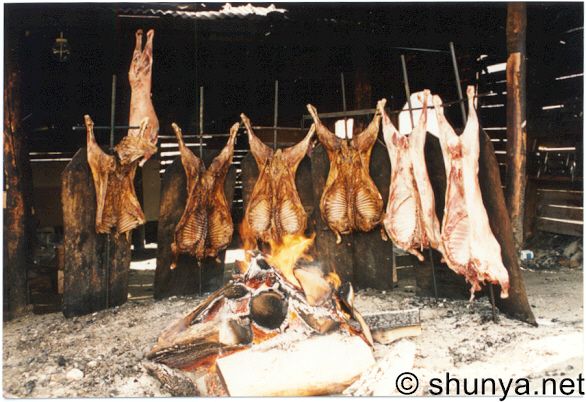
Slow-roasted-lamb I was introduced to eating fish and prawns in college. Thereafter, living outside India, I began eating other animals too—cow, pig, turkey, crab, squid, etc. I had non-vegetarian food several times a week and it became a key part of my cooking repertoire—I acquired a bevy of fans for my spicy lamb curry and barbequed chicken. On my travels, I even sampled lobster, shark, snail, venison, guinea pig, and wild boar. But in the ensuing years my meat intake began to decline. I came to relish it less and less. About eight years ago, I gave up eating mammals, and now almost always choose vegetarian. Long live tofu, beans, lentils, and the huge range of Indian vegetarian cuisine.

BundiSchool Most Indians are far less ‘experienced’ than me, owing to dispositions against eating animals that have existed in India since at least the Jains, Buddhists, and some Hindus 2,500 years ago. Such views arose out of the dominant Indian conception of nature, in which man was not a privileged creation of God but an actor in a vast, ceaselessly unfolding divine play (lila), with its countless veils of illusion (maya) that duped us into seeing reality in dualistic terms: mind/body, self/other, good/evil, etc. The natural world was not something apart from us; it was inseparable from us. John Muir expressed this poetically, ‘I only went out for a walk and finally concluded to stay out till sundown, for going out, I found, was really going in.’ Many Indians saw their moods and passions reflected in the phenomenal world, which came to bear on the deepest concerns of human life, woven as it was into an intricate web of life.

Thali2 This view was also reflected in the Indian idea of reincarnation, where humans are seen as just one type, albeit a coveted type, of creature that a soul may inhabit as it migrates from life to life. Not surprisingly, then, the Indian approach to nature promoted a kinship with and respect for all life, furthering non-violence and vegetarianism, and making the ancient Indians perhaps the first people from whom animals received a de facto right to life. Of course, even before the spread of Islam, India had many regional and caste-based divergences, and attitudes are even more mixed for modern Hindus in a globalizing India.

*****

Menu It is no small wonder then, that in neighboring China things are so different. What mainstream restaurants serve on the other side of the Himalayas would make many a hardy Indian stomach churn. On the right are selections from a typical and popular restaurant that I visited in Beijing. Many Cantonese push the limits even for other Chinese, with their taste for dogs, cats, raccoons, monkeys, lizards, rats, and more, all usually raised as food. In the Guangzhou province in south China, I have walked down a meat market with glistening, skinned dog carcasses hanging on both sides of the street. Chinese cuisine is perhaps the most popular ethnic cuisine in the world but none of this stuff is commonly available outside East Asia. Conversely, international staples like kung-pao and sweet-and-sour chicken are hard to find in China.

Dogforcooking In Beijing, I encountered another gastronomical spectacle near the Forbidden City—a fast-food market with some very unusual items, deep-fried on skewers while you wait: scorpions, snakes, silkworms, beetles, centipedes, emu, starfish, eel, octopus, grasshoppers, etc. Though this isn’t everyday food, the locals were chomping it down. Entrails and obscure body parts of farm animals, which are more widely consumed, were also on offer. Foreigners might sample something on a dare, or for bragging rights back home. Reactions vary of course: a haggis eating Scot may hardly flinch; likewise an American eater of warm pig brain in gravy, or an Italian consumer of pig eye balls or testicles, and so on.

Streetfood06 Grasshoppers Centipede1 Scorpions2_3 Snakes1_2

I wondered: Is it really true that the Chinese will eat any part of just about anything that moves? How did they turn out this way? How can two neighboring Asian countries have such divergent approaches to what they consider food?

Confucius02 A common explanation is that the Chinese, in times of famine, were forced to seek out alternate sources of nutrition, which later weren’t abandoned. But can this be the primary reason? The Indians have suffered famines too. More significant to my mind is that unlike in India, the Confucian tradition is humanistic, i.e., centered on humans. It is also notably short on speculative wonder about the origin of life and the universe, nature of mind and matter, or death and beyond. According to Confucius, trying to understand the forces of heaven and the realm of the spirits is a waste of time; humans should instead concentrate on themselves and their society—that is, on personal conduct and social harmony, honed via education and character development. Animal welfare seems not to have concerned him at all. Indeed, the average Confucian gent’s obligation to honor and respect his ancestors included rites involving animal sacrifices. The Analects of Confucius suggests that the sage himself carried out such sacrifices, attended sacrificial rites, and also ate animals.[1] Mencius, his most notable successor, did advocate kindness towards animals, but he too ate meat and supported animal sacrifices.

Animals therefore remained categorically distinct from and subservient to humans in China, and consequently, readily dispensable for human interests and desires. The moral compass of Confucianism helps explain its dearth of injunctions against treating animals as means to human ends. (Needless to say, the historical Western view of animals is scarcely better, whether Greek, Christian, or Modern, but that, and the morality of eating animals today, are topics for another essay.)

It is true that Chinese Buddhism, and to some extent Taoism, took up the cause of animals, but they were like islands in the vast Confucian ocean. Eight or nine centuries ago, a resurgent Neo-Confucianism marginalized Buddhism—a millennium after its arrival from India—partly under the pretext that it was a ‘foreign faith.’ This reflected their built-in conflicts: despite their shared agnosticism and focus on this world, the Buddhist emphasis on the individual spiritual quest, detachment, and monasticism represented a threat to Confucian ideals. What survived in China was a ‘Confucianized’ Buddhism; most lay Chinese Buddhists are meat eaters; most Japanese Buddhist sects conveniently believe that the Buddha himself ate meat. In modern China, vegetarian diets are associated with poverty, inferior social standing, and Buddhist monks. Many locals have trouble understanding why seemingly prosperous foreigners visiting China should opt for vegetarian food, even though the Chinese still get far fewer calories from meat than their Western counterparts.

Luoyang03 It is easy to see that the ‘innate’ revulsion we so often feel towards certain foods that others eat, whether a species or a body part, is simply an acquired taste. Unlike a tiger cub, the human child does not require meat for survival or good health (especially with today’s alternatives), but in the right (wrong?) milieu, isn’t she capable of relishing just about anything her body won’t reject? India and China offer a striking illustration of the vast range and malleability of the human palate, and the power of ideas in shaping it.

__________________________

[1] Frederick J. Simoons, Food in China: A Cultural and Historical Inquiry, 1990 (p. 32).
__________________________

More writing by Namit Arora?
__________________________

Posted by Namit Arora at 12:10 AM | Permalink

Comments

Very interesting. Maybe the climate also has something to do with the difference? In hot India animals carry a higher risk of transmitting diseases. Some hot spices, which are also used more in India than in China, I believe, are antibacterial.

Posted by: Klausi | Mar 2, 2009 5:50:33 AM

Given the importance in ancient times of sacrifice in South Asia, and its still current practice in many rural and remote areas of South Asia, then we might expect India to be much more like China in this respect today. I think you are right about what happened: Jainism, and to an extent Buddhism, inspired this gradual rejection of sacrifice and animal eating, starting at the time of Mahavir and the Buddha. These more or less non-violent, ahimsic, practices and ideas were also taken up and elaborated in mainline Hinduism, where the idea of sacrifice was internalised and philosophised, and sacrificial acts became something more figurative or ideational than physical.

Posted by: Michael | Mar 2, 2009 9:50:07 AM

Re: Klausi's comment about climate - you can see the divide very clearly in Theravedan Buddhist Thailand and Confucian-influenced Vietnam, which have pretty much the same climate. You'll find lots of vegetarian dishes at Thai restaurants, whereas in Vietnam vegetarianism is less common and seems to feature "mock" meats.
I was surprised to learn that the Dalai Lama is not a vegetarian. But it's not that surprising if you think about it, since grass for grazing animals is probably Tibet's most abundant vegetable crop.

Posted by: Vicki Baker | Mar 2, 2009 2:20:49 PM

You would starve in Tibet being a vegetarian. The Dali Lama tried to be a vegetarian, but his health suffered (I heard this fist hand, at a teaching he was giving).
Theravedan Buddhist are mendicants, and eat whatever is given to them, although they stress vegetarianism, and eating only once a day before noon, you take what the community supporting you gives you.

Vietnamese Buddhism is after the Zen tradition, and the rules are a bit different.
We humans are omnivores, and when fighting against your evolutionary history, you often lose.

Posted by: Dave Ranning | Mar 2, 2009 2:48:47 PM

I agree, Michael and Vicki. Buddhism adapted to local conditions and beliefs like any other expanding religion. I think the ontological foundations of the receiving cultures — from non-dualism to dualism, denial of self to its assertion, and so on — as well as contingencies of the environment, played an enormous role, as India and China illustrate in just their choice of foods. (But I wouldn't be surprised if we soon see a book called "The Taste Instinct" that attempts to explain the cuisines of the world through the evolutionary psychology of the Pleistocene.)

The Pure Land Buddhism of China, for instance, represents considerable local innovations and its own trajectory. These adaptations vary greatly by their emphasis on ritual, devotion, meditation, and such. While non-violence, respect for life, and compassion have been variously upheld as ideals in Buddhist populations, they exhibit divergent views on the priority that's assigned to them, and on what constitutes violence and compassion towards animals. As Dave suggests, accepting vs. commissioning of a meat dish is distinguished by Theravada Buddhists. Btw, I came across this interesting Open Letter to the Dalai Lama (who hasn't lived in Tibet since 1959) by an American Buddhist that sheds some light on his meat eating habits.

Dave> ... when fighting against your evolutionary history, you often lose.

What does "lose" mean here, Dave? Evolution has prepared us for lots of things, including the ability to think and feel, as well as to rationalize just about anything one happens to be invested in. To speak of "civilization", "human rights", or "developing vaccines", is to fight our evolutionary history, no?

Posted by: Namit | Mar 2, 2009 11:37:50 PM

I have spent quite a bit of time in the Theravada community (as a practitioner), both around lay and monastics, and have observed the consequences of ritualized codes and diets.
Both Ajahn Chah and Ajahn Lee in Thailand suffered diabetic issues, and struggled with their health.
Ajahn Pasanno, someone who I frequently did all night sits with, and lived a vigorous and active life, just suffered a heart attack (possible stroke).
I have been active in the Tibetan community (politically, although I did have 6 days of teaching with the Dali Lama), and find they have a much more realistic view toward diet and health.
I think a more equanimous view toward who we are, and how we got here, would greatly reduce suffering and bring better health, and less denial to the picture.
That is what the comment about fighting against your evolutionary history is about-- don't fight against you embedded sensual history as an omnivore.

Posted by: Dave Ranning | Mar 3, 2009 1:01:29 AM

Dave,
Most people who eat pork chops do so not because it is good for their body, but because they have always done so, enjoy its taste, and it is part of their cultural life (analogous words could apply to patriarchy and feudalism). Every one of the ailments you describe also afflicts meat eaters. Indeed, vegetarian diets are now believed to be superior to meaty diets — for reasons that have everything to do with health and nothing to do with morality. As the AHA says, "Many studies have shown that vegetarians seem to have a lower risk of obesity, coronary heart disease (which causes heart attack), high blood pressure, diabetes mellitus and some forms of cancer." Or as the USDA says, "Vegetarian diets can meet all the recommendations for nutrients." I'm afraid you'll have to employ another tactic to defend "your embedded sensual history".

In any case, if you noticed, the point of my essay was not to make a moral case for vegetarianism (that's a whole different essay), but to try and explain what factors led to its adoption in one place and a remarkably different thing in a neighboring place.

Posted by: Namit | Mar 3, 2009 2:09:59 AM

"India and China offer a striking illustration of the vast range and malleability of the human palate, and the power of ideas in shaping it."

'power of ideas' you say. Doesn't the inversion, 'ideas of power' ring equally true. In fact, while explaining Chinese dietary habits that's what you focussed on. As to how a sort of Confucianised-Buddhism finally triumphed, and thus it was okay to eat meat again.

But you do not apply the same reasoning to India.

Who were the people there who issued or framed these 'injunctions' against meat eating in the first place. Is it not true, that vegetarianism in India is primarily a Brahmanical notion ? It was okay for the Kshatriyas (the warrior castes) to be meat eaters. Tribals, again a large group have been meat-eaters for the most-part (when left alone.) Also, the question of Dalits and vegetarianism is an urgent and ongoing debate. Critics of Brahminism like Kancha Ilaiah have criticized the politics of Vegetarianism, calling it a process of Sanskritization.

What percentage of the Indian population do these communities make up ? Quite large, wouldn't you say ? Isn't it fallacious then, to paint the Indian picture, a lush leafy green ?

--

I am no expert, but your article got me thinking about this, so I was just wondering if you'd looked at the 'powers' that really shaped these ideas.

Posted by: Arfi | Mar 3, 2009 6:30:44 AM

Arfi, that's a good instinct: ideas and power have a complex and frequently dubious relationship. But the historical details here are not as you describe. As Michael notes above, non-violence and vegetarianism were first championed by Jainism and then Buddhism. These were rebel movements outside the fold of the dominant Brahminism (precursor to later Hinduism), and Brahmins then continued to be meat eaters and animal sacrificers. Jainism and Buddhism grew to become the majority religions of the masses by the early/mid first millennium CE. Its broad appeal is partly why Buddhism was patronized by major kings (Ashoka, Kushans, Harsha, Guptas, Palas) and it became the religion of power in some parts of India.

Almost as a competitive strategy did Hinduism assimilate many of Buddhism's popular features—vegetarianism, ending animal sacrifices, (insider) critiques of the caste system—and embraced the Buddha as the ninth avatar of Vishnu. (Incidentally, the subsequent decline of Buddhism in India coincided with the rise of Bhakti as a popular Hindu mystical movement, also a rebellion against Brahminical orthodoxy. One could say that the religious market shifted to a more user-friendly product.) So the Brahmins came late to vegetarianism and thereafter they, as well as the Kshatriyas and the Vaishyas, became primarily vegetarian (and the idea got associated with piety and ritual purity; notably, many regional Brahmins remained non-vegetarians, as in Kashmir and Bengal). I agree that the idea found mixed resonance among the Dalits and tribal groups, today around a quarter of the population.

Posted by: Namit | Mar 3, 2009 11:28:04 AM

Namit, great post! Thank you for being here. Does not scarcity also have something to do with diet? And best use of all available resources? Perhaps I skipped something above, but I've read that in the thinking of many traditional cultures the agricultural and dairy uses of livestock exceed their value butchered for meat. Not sure this would help to differentiate India from China, however, except that varying traditions and densities of urban living and ways of handling distribution of foodstuffs would matter. I think it's likely that the demonstrated best use of resources leads to foodways acquiring a religious basis, rather than the other way around.

Posted by: Elatia Harris | Mar 3, 2009 12:39:26 PM

Namit, thanks for the short primer. I realise that it was the influence of Buddhism and Jainism that shaped the dietary mores for Hinduism, as they are today.

What I was trying to get at was that the current situation is not as it's perceived or rather projected. More than 60% of Indians are non-vegetarians.

Vegetarianism itself has increasingly acquired political overtones today, and set against this backdrop, I call it a Brahminical notion.

Posted by: Arfi | Mar 3, 2009 2:06:20 PM

Are there any traditionally vegan societies? It seems that if animal protein in the form of milk or eggs or wool is part of the lifestyle, then somebody is going to be eating meat - otherwise you wind up having to feed a bunch of useless male animals.

Posted by: Vicki Baker | Mar 3, 2009 3:59:22 PM

Hi Namit,
Thanks for the interesting points you raise in this essay. I came here a bit late because I have been thinking about my own experience with Indian vegetarianism in general and the relationship of many Indians with animals, in particular. There are many conflicting issues here - Karela and pomegranate are easy in comparison:-)

I am a bit less sanguine than you about the underlying causes of the practice of Indian vegetarianism as it exists today - whether it is any longer entirely a matter of personal choice based on philosophy alone, even though most vegetarians do explain it that way. I think it is much more a habitual and cultural issue rather than a deeply thought out moral choice for most. I have no quibbles with the historical/ religious background that you point out, of the original no-meat diet of ancient Indians.

The ahimsa and the integrated view of the world where all god's creatures have a role and value in the larger scheme of the universe definitely provided the philosophical underpinning of vegetarianism as adopted by early Jains and Buddhists and later some Hindus themselves. However, down the road, the strict adherence to a meatless diet and the myriad precautions to avoid meat consumption took on the nature of a hygienic taboo where meat is considered a pollutant and any contact with it, polluting. That by itself is not what disturbs me - I have put up cheerfully with Tamil Brahmin friends and elderly Bengali widows within the family. For many vegetarians the aversion to the flesh of dead animals unfortunately extends to a similar contempt for even live ones. Animals, especially meat eating ones are considered "dirty." The integrated and tolerant view of the natural world which initially led to the doctrine of ahimsa, instead becomes an unreasonable fetish. Let me relate an interesting incident.

You must be aware of the famous Jain bird hospital in Old Delhi in the periphery of Chandni Chowk. That is an amazing place where injured birds are known to fly in of their own accord and await treatment by the Jain monks. Some thirty years ago, the hospital made a decision that it was no longer going to treat "non-vegetarian" birds. By this, they meant carrion eating and large predatory birds like crows, kites, eagles, hawks, owls, vultures etc. until they had to be gently reminded that almost all birds eat meat. Even most of the cute looking non-violent birds eat worms and insects when they can find them and the peaceful swans and ducks will occasionally eat fish, frogs and snails.

India is indeed unique in the world as a vast nation where a large number of its population is vegetarian to varying degrees and Indian cuisine is therefore closely associated with vegetarian fare in the mind of the rest of the world. But Indian non-veg cooking is super and the majority of Indians as Arif points out, are meat eaters, also to varying degrees. And some of the strange animals you saw being eaten in China are also eaten in small pockets within India. Dogs, snakes, insects, pig intestines etc. are consumed in parts of the Indian north-east, tribal regions and within Dalit communities. However, they are not common fare as in China. The rarest meat in India of course happens to be beef. I did taste a delicious beef dish in the communist state of Kerala on my last visit - the first time I ate cow meat in India.

Posted by: Ruchira | Mar 3, 2009 4:25:24 PM

Ruchira,

The views of many modern Indians towards animals are indeed dismal, misinformed, and linked to odd ideas of pollution/impurity and such. Culture works out its ideas and ideals in strange ways. We project all manner of fears and desires into animals. Symbols are often confused for the real thing. Much like the Tamil equivalent of "dirty" to describe animals, English too is suffused with words like "beastly" and "bestial" to describe despicable human acts like a massacre, when no beast does so like we do. Why do we say that sharks are "vicious"? The movie Jaws turned "primitive carnivores into conscious criminals just to boost human vanity." Wolves and hyenas are thought of as "cruel" and "treacherous". Wolves have also been blamed in many Western cultures for being carnivores, by people who themselves eat meat and, unlike the wolf, are not compelled by their stomachs to do so. In stories, the fox that kills a hare is not judged by the same standards as the man who kills the fox for exactly the same reason—we call animal predators "savage" but not us when we kill and eat them.

I have two small quibbles with your second and third paragraphs:

a) I have nowhere claimed that the masses in India today arrive at vegetarianism "as a deeply thought out moral issue." I think it is unreasonable for us to expect any large group of people to do so. Just as eating pork chops can be a reflexive part of a culture, avoiding pork chops can be so in another culture. As you say, it is very much "a habitual and cultural issue" and not deeply thought out by every person.

b) As I wrote to Dave, my goal here is to try and explain what factors led to the adoption of these "habitual and cultural issues" in one place and to remarkably different ones in a neighboring place. I take it that you agree that the inspiration came out of a particular ancient Indian ontology. I have also not said that those ancient ideas were better than others in all respects (they were better for animals) vs. say, Confucian humanism, which has its own advantages over the Indian system.

Posted by: Namit | Mar 3, 2009 8:26:57 PM

Or as the USDA says, "Vegetarian diets can meet all the recommendations for nutrients." I'm afraid you'll have to employ another tactic to defend "your embedded sensual history".


Our evolutionary history, from your teeth, to your intestinal and endocrine system has prepared your body to consume meat and vegetables.
Until this changes, we are imbedded in that system.
Culturally, being a product of the counter culture of the 60's and the University of California, eating meat was not encouraged, and was discouraged through peer and social pressure.
I lived years during this time as a vegetarian.
However, I had the luxury of an upper middle life style in one of the riches agricultural areas on earth, available year round.
However, living in Micronesia in the 1970s, the ideological pressure collapsed, as reality of living with resource scarcity became apparent.
I would have starved without eating fish and chickens and pigs, and would have insulted the population for refusing to eat someone who has been using these foods for as long as thy can remember.
I now eat as ethically and healthy as possible, and grow and gather as much of my food as possible.

Posted by: Dave Ranning | Mar 3, 2009 9:05:18 PM

Being half Chinese, growing up in America, and then moving to China, I can attest to what seems like an overconsumption of meat in both nations.

Raising livestock in the abundance that we do is a waste of water, grain, and energy. Meat should not be an every-day food, and if we had to take environmental damage into account, it would be obvious how unnatural and unsustainable our particular mode of meat consumption is.

I am not a vegetarian, however I believe that meat cannot be a staple of any healthy or environmentally concious diet.

I think the posters who raised an "evolutionary" argument for eating meat simply meant to indicate that it is often a purposeful and necessary adaptation to the natural environment.

In the advanced agricultural society of today, though, we do not adapt to the natural environment; we adapt it to us. By making meat a large part of this equation, we are introducing immense amounts of waste into the system. We feed livestock with grain that has been grown with fertilizer synthesized from fossil fuels. This is the cheapest way if all we care about is monetary costs; it is what makes daily pork affordable. However, as Namit indicated in another comment, it is murder on the environment, and it is murder on ourselves. This is something to consider even if you disagree with moral or religious proscriptions against meat consumption.

We do not have to rely on meat as much as we do in some parts of the world. That very reasonable message is what I take away from Namit’s article.

Posted by: 海芋 | Mar 3, 2009 11:19:48 PM

No Namit, I didn't think that you were claiming that most vegetarians in "current" day India are doing so out of any deeply thought out moral concern. I was really making the point to the non-Indian readers here that when an Indian vegetarian eschews the flesh of the cow, goat or the chicken, it is not necessarily because they believe that the slaughtered animal may have been their great aunt or uncle in another life.

Posted by: Ruchira | Mar 3, 2009 11:37:18 PM

Dave: I'm happy for you. Who can disagree that some environments pose special challenges to make vegetarianism difficult, if not impossible? But a quick bit of math shows that a clear majority of people in the world today do not live in such regions.

Vicki: I don't think there were any sizable ancient vegan cultures; this guy claims a tradition in Korea going back 2500 years.

Ruchira: Only (a) in my response was a quibble, (b) was more accurately just FYI. :-) Thanks for the clarification.

海芋: Thank you for leaving that great comment and for your unique perspective.

Posted by: Namit | Mar 3, 2009 11:39:54 PM

Actually, Mesoamerica was almost totally vegetarian (from degradation of the environment), and achieved amino acid balance through food combining (as in corn and beans, being the most quoted).
Almost all game was absent, and edible domestic animals were absent.
This was one of the most violent cultures in history, with human sacrifices of upwards of thousands of people a day.
Vegetarian diet certainly did not equate with a peaceful culture.

Posted by: Dave Ranning | Mar 4, 2009 12:02:06 AM

In the advanced agricultural society of today, though, we do not adapt to the natural environment; we adapt it to us
Unfortunately, this is a short term success strategy, a long term path toward extinction.
Are humans smarter than yeast?

Posted by: Dave Ranning | Mar 4, 2009 12:07:57 AM

Dave, going by the accounts of early Spanish explorers and missionaries, Mesoamerican diets included turkeys, ducks, and other birds, dogs, frogs, many kinds of fish, insects, deer, rabbit, iguana, algae, etc. Meat was not prominent in their daily diet but they were not "almost totally vegetarian". In any case, why should vegetarian diets in isolation correlate with pacifism? Something else is needed there, my friend.

Posted by: Namit | Mar 4, 2009 1:18:52 AM

Aside from the turkey, there were no edible domesticated animals (dogs were also available, but small in number), and were primarily vegetarian (as in most of the population, other than the elite, ate an almost entirely vegetarian diet in major population centers).
Vicki wanted to know if there was an example.
This is the best example we have of a vegetarian culture (by necessity, not ideology).
I was just pointing out it was also extremely violent.
So what is needed? I believe environment is the controlling factor for what we consume as humans, and the cultural emerges from these conditions.
I'm not going to get into memes, as this upsets everyone, and cannot be discussed.

Posted by: Dave Ranning | Mar 4, 2009 11:05:35 AM

Are humans smarter than yeast?

Only if we can rise to the occasion.

Posted by: J. Hawkins | Mar 4, 2009 11:44:29 AM

海芋, that was fascinating. J. Hawkins, we can try to rise to the occasion (hahaha), if the occasion is eating responsibly. Not sure if "choosing to evolve" is an oxymoron, but more of us could choose a mainly vegetarian diet, and 100 years from now, it might look like we had evolved.

I think it's worth looking at some logistical obstacles to consistently making vegetarian choices. The ones I hear --

1.) Being a vegetarian is not necessarily less expensive than eating meat.

2.) Being a healthy vegetarian takes some knowledge of nutrition -- though only a little. Still, it's not as easy as simply eliminating meat.

3.) Being a vegetarian requires time for meal planning, shopping and prep.

4.) If one is preparing the classic dishes of many vegetarian cuisines -- well, that's Indian food every night of the week...

5.) Making personal vegetarian food choices that one knows to be rational and needful have too little impact on the global situation to warrant inconvenience and the expenditure of time, money and effort -- not to mention the sacrifice of comfort, custom and taste.

Okay, I have answers, but I want to hear the answers of others who are struggling with these issues with increasing success. Answers --

1.) It's true, unless you garden for food, you won't save a dime going veggie and trying to eat really well. But you will not spend more than you do at present, buying meat.

2.) Yes, you'll need a very short learning curve, but nothing worse than spending an evening learning a new software.

3.) It's true, meal-planning, shopping carefully for and preparing good vegetarian food takes time. But take-out, restaurants one can afford, and fast food take time too. Add up the hours per week you spend sourcing and fetching cooked food you have not prepared and consider the rewards of this time spent in this way. Set this against the time and rewards of preparing food with your family and friends. That is, do the real math, not the convenience food-marketing math you've been habituated to. If you are like most people, you are spending about 3 hours less per week avoiding the kitchen than using it would take from you. To what excellent and needful use have you put this time saved? That answer, too, is part of the real math.

4.) Not so. Many people are afraid vegetarian food is either too spicy, too bland or too foreign. "Indian food" can be code for everything vegetarian you don't want, you poor soul. The foods of the South of France, Italy, Greece, the Eastern and Southern Mediterranean and Iran are abundantly vegetarian. This is only the beginning. Leave the cuisines of South Asia for later, when you're ready for them. If you already like Italian food, but are thinking it isn't vegetarian, buy Ursula Ferrigno's books.

5.) If everyone who followed this logic got on the road every night after a few drinks because the number of people they might kill was very, very small relative to the entire number of those at risk from DUI accidents, you would see some serious complaints, even some laws. Wait, you do see laws... See how far the analogy takes you.

Posted by: Elatia Harris | Mar 4, 2009 3:43:14 PM

Elatia--
We will all be gardeners soon, but until then, I agree with you entirely.
Having lived both strategies for long periods of time, I must say ethics are involved in both, as most "vegetarian" sources are far from ethical, while feeding fresh troll caught mahi to an island culture could not be more ethical.
I have the luxury of time and a perfect climate, so most of my food I grow myself, or gather from wild sources (mushrooms, berries, wild apples, plums, fish, shellfish, etc). Most people, (including ideological vegetarians) are so removed from the actual biological process of food, that it is humorous to view they're reasoning, but sad to see how alienated they are from the world they live in.

Posted by: Dave Ranning | Mar 4, 2009 4:15:57 PM

I'll say it again... Bill Maher is NOT the bee's knee's.

Posted by: Avery Island | Mar 4, 2009 5:06:34 PM

Dave, it's true that agribusiness ain't pretty, and that abstaining from meat is not sufficient to be uninvolved with how wrong food production has gone. Just the ethics of pineapple consumption are enough to... Well. But you don't have to eliminate everything unwise all at once to be en route to non-participation in practices you think are wrong for most people.

Posted by: Elatia Harris | Mar 4, 2009 5:19:11 PM

Elatia-
Equanimity, not "Food Nazis" is the path. One can just do the best you can, most of the time. Even that colors and confines your choices.
But, I'm a foodie, I must admit, and love the colors, textures, temperatures , etc., it all involves.

Posted by: Dave Ranning | Mar 4, 2009 6:03:42 PM

1.) It's true, unless you garden for food, you won't save a dime going veggie and trying to eat really well. But you will not spend more than you do at present, buying meat.

And let's be sure to compare apples to apples (or pork chops to pork chops): good quality meat is extremely expensive. If you shopped at the A & P for meat, and now shop at the A & P for non-meat, you'll save money. If you shopped at whole foods or farmers markets for meat, and now shop at same for non-meat, you'll save money (as long as you stay away from the really expensive produce like Buddha's hand squashes and heirloom tomatoes.)

Bittman proposes that rather than giving up meat altogether, people reduce the number of meals they have meat with to one or less per day. This is much more likely, in my opinion, to be widely adopted than is complete vegetarianism, and along the way people can work though Elatia's (mild) learning curve without feeling like the ground has fallen away beneath them, which may make a switch to vegetarianism, if it comes to that, an easier and more desirable possibility.

Posted by: Chris Schoen | Mar 4, 2009 6:12:58 PM

Thanks, Chris -- I agree with you and Mark Bittman. I'm not a complete vegetarian by any means, but I notice I'm getting there without really trying.

If your absolute priority is getting the most from your food dollar, going veggie will cost less -- the rice, beans, broccoli and apple model is economical. If your top priority is -- suddenly -- eating variously and well while leaving out meat, you will probably find that you can meatlessly get in a lot of trouble with the grocery bill. The cost difference between a fresh pasta lasagne with sweet potatoes, kale and appropriate cheeses and -- on the other hand -- a roast chicken with mashed potatoes and green beans, is illuminating. I think people are likelier to have fewer nasty surprises if they expect not to save (any) time or (much) money going veggie or semi-veggie. The cost in hours and dollars of choosing what you think is right and good is as high in kitchen matters as elsewhere, and the clearer you are that the ultimate lure -- saves time and money! -- doesn't automatically obtain, the less disappointment you will feel.

I am not saying there's anything wrong with spending as little as you can or must on food -- on principle. But for many people, learning about all the vegetables and fruits there are with an keener eye to pleasure than to thrift will be more beneficial, because the lesson will be lasting and have good associations.

Posted by: Elatia Harris | Mar 4, 2009 7:05:58 PM

Elatia,

Could you recommend your favourite vegetarian cookbook.... I have several in my collection, each of which have one or two great recipes or ideas but they all come well short of being all-round classics. I want one in which the recipes are gorgeously tasty and adventurous, where the photography is luscious (hopefully), where the information/advice is accurate and includes history, food relationships, storage etc - I don't mind if it tends more towards the biblical, I quite like complex processes, grinding spice mixes and slow cooking. But I really want to see how good vegetarian can be at its best.

To give you examples of books I've loved, there's one simply called Spices which follows all the world's basic regional mixes and pastes or perhaps Twelve, which deals with the seasonal foods of Tuscany and what to do with them (and when).

What's you pick?

And Namit, great article and congratulations on the discussion it's stimulated. Personally, with regards to the crisis in resource management for food production, I think we should all be aiming for a much smaller percentage of meat in the diet and looking carefully from whence it came. Out here for example, we should be eating much more of the lean, healthy kangaroo meat culled straight from the bush rather than wasting our precious water resources producing beef on marginal land. The roos thrive and are in plague proportions and require no farming facilities. (I think there's something like 20 million of them) As Dave points out, the time is near when we will be forced in new directions...

Posted by: MattInOz | Mar 4, 2009 9:18:24 PM

MattinOz,

I have four cookbooks to recommend, and they will take you from California to Italy to Iran to India. None is new, and none is rare, so they should be secondary market finds and not too pricey. No book will do all that you would like, but these won't put you wrong, and that's saying a very great deal. Also, they presume no special knowledge or technique or equipment or access to hard-to-find ingredients.

You already like cooking with spices, which is fabulous. If you learned about making perfect rice dishes, and baking, the rest would be easy to add bit by bit. A really fun, cheap vegetarian party to have is a polentata -- you make the polenta, everyone else brings their favorite veggie stew or sauce for it. One of MFK Fisher's best books was a Depression era volume, How to Cook a Wolf. Maybe you'll write How to Cook a Roo (& Other Bush Tick Tips) for our own era.

As folllows --

Madhur Jaffrey's World-of-the- East Vegetarian Cooking

Annie Somerville's Fields of Greens

Najmieh Batmanglij's Silk Road Cooking: A Vegetarian Journey

Ursula Ferrigno's Gusto Italiano: Quick and Simple Vegetarian Cooking

Posted by: Elatia Harris | Mar 4, 2009 10:22:31 PM

It's true, unless you garden for food, you won't save a dime going veggie...

Even growing your own can be expensive. Guy in my town wrote a book: The $64 Tomato based on his first jump into the grow your own racket. I spend way too much every year on cocoa mulch (which I just found out -duh- is toxic to dogs), soil additives, seed and starter plants, lumber for raised beds, deer and groundhog abatement technology (ok screening-but it also keeps the dogs away from the cocoa mulch). Not even worth mentioning all the many sweaty hours beating back the rest of nature to give my beauties a fighting chance. It's for freshness, fun and Heirloom flavors, not economics.

Posted by: Carlos | Mar 4, 2009 11:10:56 PM

Elatia,

Many thanks, let the fun begin!

Carlos, agreed - it ain't easy, but the taste of a mid-sized freshly plucked Tigerella or Green Zebra on hot toast with newly cracked black pepper and a sprig of garden basil..... well, bring on the armageddon if that's how we have to eat :-)

Posted by: MattInOz | Mar 4, 2009 11:50:04 PM

Chris-
I've noticed my meat consumption going down also, some days with none at all, and not intentional, but emerging from lifestyle choices.
Ethically raised grass fed meat can be quite expensive (however, in Humbolt County on the North Coast it is actually less, but Humbolt is a anomaly all around).
I had so many tomatoes last year, I'm still eating the one's I've dried (which intensifies the flavor).
I had Mustard Greens and Russian Kale out of the garden for dinner.
Elatia- I will look into your cookbook suggestions.

Posted by: Dave Ranning | Mar 5, 2009 2:32:10 AM

It seems to me that there are really five major factors that drive people towards non-meat diets.

(1) Traditional / cultural
(2) Cost
(3) Ecological / sustainability
(4) Health / wellness
(5) Moral

The first is what one is generally born into; my guess is that it is not a driver for most readers of 3QD. The second is particularly true for the poor in countries like India, where meat remains much more expensive than veggies. The third appeals to the well-informed, analytically inclined citizens of the world. The fourth inspires those who pay extra attention to nutrition and its effects on their bodies. Our discussion above brought out the second, third, and fourth factors in addition to the first one that I focused on in my essay.

The last, the moral factor (re: our obligation to animals), is the thorniest one to resolve and causes the most trip-ups, the most heat and hand-wringing, accusations of soppy sentimentality and anthropomorphism, exaggerated claims for both animals and humans, instinctive closing of the heart and mind, etc. My limited sample size suggests that the moral driver has no special correlation with self-avowed rationalists with science Ph.Ds either. It is the moral factor that interests and motivates me the most, and I'll try to tackle it directly in a future essay on 3QD.

Good discussion, thanks to all for participating. I certainly learned some new things.

Posted by: Namit | Mar 5, 2009 1:56:12 PM

Post a comment


Subscribe to this blog's feed  

PayAnywhere with iphone credit card swiper

Android Tablet

Bluetooth Headset

2013 New Style Dresses

Compare Car Rental Prices

DHgate.com Wholesale

3QD on Facebook

3QD on Kindle

3QD by Daily Email

Receive all blogposts at the same time every day.

Enter your Email:


Preview 3QD Email

3QD on Twitter

Miscellany

Lijit Search

AddThis Social Bookmark Button

Add to Google

Recent Comments

Josef Stern on Unknown Mathematician Proves Elusive Property of Prime Numbers

Shelley on Is the Brain No Different From a Light Switch? The Uncomfortable Ideas of the Philosopher Daniel Dennett

Bill on The Beautiful German Language

Eleutheria on The Bystander Effect in Medical Care. Why Do I Have So Many Doctors Not Taking Care of Me?

Eleutheria on Tuesday Poem

Raza Husain on the culture animal

musafir on The Bystander Effect in Medical Care. Why Do I Have So Many Doctors Not Taking Care of Me?

KRS on Tuesday Poem

Félix E. F. Larocca, MD on Tuesday Poem

LWR on Tuesday Poem

Joss on Tuesday Poem

LWR on POETRY IN TRANSLATION: CORDOBA

Rashid on Aftermath: Pakistan Elections 2013

Yoann on The Bystander Effect in Medical Care. Why Do I Have So Many Doctors Not Taking Care of Me?

Dave Ranning on Aftermath: Pakistan Elections 2013

sadhana on Aftermath: Pakistan Elections 2013

Carol Westbrook on The Bystander Effect in Medical Care. Why Do I Have So Many Doctors Not Taking Care of Me?

Ken Bryant on Aftermath: Pakistan Elections 2013

Umer Vakil on POETRY IN TRANSLATION: CORDOBA

Kabir on Aftermath: Pakistan Elections 2013

seth edenbaum on Aftermath: Pakistan Elections 2013

Nina on White Indians

Nina on White Indians

Dave Ranning on If Only We Had A Leader Like Chavez, Who Solved Real Problems -- Instead Of Debating Fake Ones Like The Deficit

Mohammed Hassanali on Aftermath: Pakistan Elections 2013

Acclaim For 3QD


"I couldn't tear myself away from 3 Quarks Daily, to the point of neglecting my work. Congratulations on this superb site."—Steven Pinker, Johnstone Professor of Psychology, Harvard University.

"I have placed 3 Quarks Daily at the head of my list of web bookmarks."—Richard Dawkins, Charles Simonyi Professor of the Public Understanding of Science at Oxford University.

"Just wanted you to know I’m one of many who reads and enjoys 3 Quarks....almost daily."—David Byrne, musician, former lead-singer of the Talking Heads, artist, intellectual.

Read more here.

The 3QD Prizes

Subscribe to this blog's feed