By Namit Arora
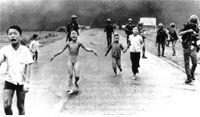 The US pulled out of Vietnam (video) in 1975 after more than a decade and a humiliating defeat. The war had been expensive, the draft unpopular, and too many white boys had come home in body bags. A strong antiwar mood had set in amidst the public and the Congress. Most Americans now believed it was never their war to fight. The Nixon Doctrine held that “Asian boys must fight Asian wars.”[1] At least in the short term, direct military engagement in the third world seemed politically unviable for any US administration.
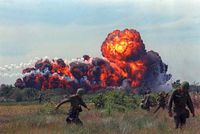 Besides Vietnam, the US had fought and lost another war in Indochina – in Laos – but rather differently. This was a proxy war, sponsored by the US but led by Hmong mercenaries on the ground. It was waged in relative secrecy, far from “congressional oversight, public scrutiny, and conventional diplomacy.” The advantages of such a war were soon evident: “Even at the end of the war, few Americans knew that in Laos, the USAF had fought ‘the largest air war in military history … dropping 2.1 million tons of bombs over this small, impoverished nation — the same tonnage that Allied powers dropped on Germany and Japan during WWII.’”[2]
In the 60s and 70s, anti-colonial and nationalistic struggles were cropping up in Africa, Latin America, and Asia. Blinded by its anti-commie paranoia, the US saw even popular movements for social and economic justice as precursors to communism, their leaders as Soviet proxies, and was determined to combat and crush them. But, given the unviability of direct military engagement on so many fronts, proxy war was the only military option left to the US. There was one minor obstacle though: how to finance all these proxy wars? Many Congressmen asked awkward questions, especially after the disaster in Indochina. When they agreed to fund, they wanted debates and oversight. The idea of a new, recurring source of money — bypassing the Congress — gripped the minds of many.
A source was soon identified: illicit drug trade. In the 19th century, Britain had used opium trade to fund its colonial operations in the East. Now it was the turn of the US. Just when the global opium trade was at its lowest ebb in nearly two centuries (opium is the raw material for heroin), the CIA struck alliances with drug lords to greatly expand drug-production in Burma, Laos, Colombia, and Afghanistan, as well as with the mafia to streamline distribution (some of which ended up in the US, extracting ‘funds’ from the American public in other ways). For protecting their assets or looking the other way, the CIA got a slice of the proceeds that it promptly funneled into covert military operations.
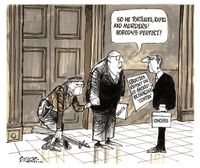 Unbeknownst to most Americans, the Cold War was raging hot in many parts of the world. The US funded proxy wars all over the globe, including (but not limited to) Laos, Cambodia, Congo, Angola, Mozambique, Ethiopia, Iran, Nicaragua, Granada, Libya, Cuba, and perhaps the most significant of all: Afghanistan. The CIA euphemistically called these “low-intensity conflicts” but they were, in effect and tactic, no different from state-sponsored terrorism. The meteoric rise of Colombian drug cartels coincided with US Cold War operations in Central America, especially Nicaragua. Cocaine trafficking (most destined for the US) soon brought dividends to the Contras and made Pablo Escobar one of the richest men in the world.
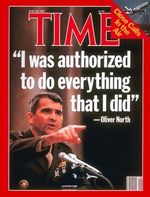 Almost always, the US supported right wing militant factions that opposed popular movements and employed assassinations, kidnappings, torture, and violent terrorism, causing widespread suffering and civilian casualties. In Guatemala, for instance, the US funded and trained “death squads” that killed tens of thousands of Mayan peasants. In Nicaragua, the CIA funded and trained the right wing Contra rebels in advanced terror tactics, including psychological warfare targeting special groups — judges, police officials, tax collectors, etc. The rebels attacked bridges, power plants, rural health clinics, agricultural co-ops, and civilians. CIA commandos even launched a series of sabotage raids on Nicaraguan port facilities. They mined the country’s major ports and set fire to its largest oil storage facilities.[3] In Angola, the US proxy (Unita rebels) starved “civilians in government-held areas, through a combination of direct attacks, kidnappings, and planting land mines on paths used by peasants” (estimates for the number of amputees begin at 15,000). About 331,000 Angolan civilians died due to the war in the 80s and the war cost the country six times its 1988 GDP.[4]
The list of such “low-intensity conflicts” waged by US proxies is pretty long. This worked best when combined with a deliberate campaign at home that encouraged mass hysteria about the Soviet machine. In the 80s, Reagan called it the evil empire, a phrase with strong religious overtones. One couldn’t possibly make a deal with evil. No coexistence was possible with evil—it had to be resolutely opposed, whatever the cost. But the real cost started becoming apparent only a decade later.
*****
Besides drug lords, the US cultivated another ally during the Cold War: political Islam, which dreamed of setting up theocratic states based on Shariah law. The US saw it as a natural enemy of commie Russia and a buffer against popular secular nationalism in the third world that could turn into, heaven forbid, socialism. So the US built alliances with Islamists in Sukarno’s Indonesia, Nasser’s Egypt, and Bhutto’s Pakistan. The rise of Hamas was quietly welcomed as a distraction for the secular PLO, and was allegedly even aided by Israel.
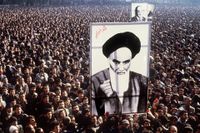 But then came the Iranian revolution, where the mullahs opposed both the Russians and the Americans. This taught the US to “distinguish between two faces of political Islam: the revolutionary and the elitist. The revolutionary side saw the organization of Islamic social movements and mass participation as crucial to ushering in an independent Islamist state. In contrast, the elitist side distrusted popular participation; its notion of an Islamist state was one that would contain popular participation, not encourage it.”[5] Unlike Iran, Islamists in S. Arabia and Afghanistan were elitist (but had no political successes yet to speak of) and were better aligned with US Cold War objectives. To punish Iran, the US allied with Saddam Hussein’s Iraq and openly supported its attack on Iran. The eight-year long Iran-Iraq war “saw the first post-Vietnam use of chemical weapons [by Saddam Hussein] … and America was the source of both the weapons and the training needed to use them.”[6]
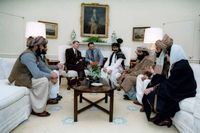 In '78, when a pro-Soviet regime took hold in Afghanistan, the US began investing in an alliance with neighboring Pakistan, where the army led by General Zia, an orthodox Muslim, had recently deposed and murdered Bhutto, the elected prime-minister. After '79, when Russian troops invaded Afghanistan to shore up the Marxist regime, the proxy warriors of the US were the mujahideen. Aid to the mujahideen — rag-tag groups of Muslim conservatives without money or power — had begun even before the Soviet invasion, and authorized by Carter himself. Reagan, rejecting containment or negotiation, raised the aid twenty fold and went full-steam for a Soviet “roll back,” determined to bleed them white and to hand them their own Vietnam. With Operation Cyclone, the CIA and Reagan’s assistant secretary of defense, Richard Perle, now began facilitating the real task at hand in Afghanistan: killing Russians. On the White House lawn in 1985, Reagan introduced the bearded leaders of the mujahideen to the US media: “These gentlemen are the moral equivalents of America’s founding fathers.”[7] One such mujahideen leader was Osama bin Laden.
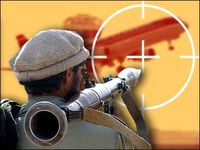 Under Reagan, Pakistan became the third largest recipient of US aid, effectively buying Pakistani cooperation. The CIA allied with Pakistan’s Inter-Services Intelligence (ISI) to identify, recruit, and train the most radical anti-communist Islamists to fight the Soviets, flooding the region with weapons and training camps. The CIA looked for Muslim volunteers from all over the globe. A network of recruitment centers was established, linking key points in the Arab world. To increase their military effectiveness, the recruits were “ideologically charged with the spark of holy war and trained in guerrilla tactics, sabotage, and bombings.”[8] The recruits came from far and wide, including Saudi Arabia, Egypt, and Indonesia. The US supplied these camps with military advisers, tacticians, and equipment such as the heat-seeking, anti-aircraft Stinger missiles. The recruitment drive was stepped up many times. Tens of thousands of Islamists graduated from these camps.
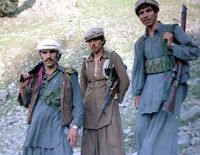 This mobilization of holy warriors in Afghanistan was largely funded by the US and carried out using “Islamic institutions, ranging from banks and charities to mosques and evangelical organizations.” It gave the Islamists “not only the organization, the numbers, the skills, the reach, and the confidence but also a coherent objective.”[9] Here they learned the fine art of using things they could not afford, such as “sophisticated fuses, timers, and explosives; automatic weapons with armor-piercing ammunition, remote-control devices for triggering mines and bombs”[10] alongside “local Afghan skills—such as throat cutting and disemboweling — that the CIA incorporated in its training.”[11] Many of them received from the CIA a salary of $1,500 per month, a sum that even the best doctors and engineers in Kabul didn’t make. The cream of the Islamist crop were flown to camps all over the US for further training (to Fort Bragg, Camp Pickett, High Rock Gun Club, Camp Perry, Harvey Point, etc.) and then shipped back to Afghanistan.[12] An infrastructure of terrorism, integrated with the most sophisticated know-how, was soon in place. Sabotaging the Soviet-backed regime meant blowing up power installations, pipelines, radio stations, government offices, police stations, airport terminals, hotels, cinemas, and more.
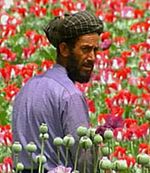
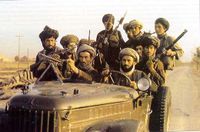 In '87 alone, the US military aid to the mujahideen amounted to $660 million. The US also muscled the Saudis into matching its Afghanistan aid dollar-for-dollar. Another chunk came from opium trading which the CIA encouraged de rigueur. Opium fetched five times the price of wheat and the mujahideen ordered the peasants to plant it, handing out opium quotas to all landowners and greatly expanding production. It was taken to literally hundreds of heroin processing centers at the border in Pakistan, where they were run under the aegis of the ISI. Before the US involvement in Afghanistan, there was no heroin production in this region at all, but soon it became the largest producer of heroin in the world, amounting to a multi-billion dollar industry (today it supplies 95% of the world's heroin).
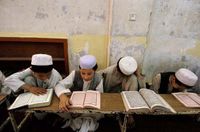 To create additional, frontline recruits, the ISI helped turn local madrassas into ideological training grounds that integrated the authority of Islamic teaching with guerrilla warfare. This fused religious fundamentalism with militant terrorism like never before. Because this innovation only helped the immediate US goal of killing Russians, the CIA turned a blind eye to the central teaching in these schools: Afghanistan was only the staging ground for a holy war that would grow into an international Islamist movement.
Well, not exactly a blind eye. In the 80s, the mujahideen ran an Educational Center for Afghanistan that had “children's books designed for it by University of Nebraska under a $50 million USAID grant … A third-grade mathematics textbook asks: ‘One group of mujahideen attack 50 Russian soldiers. In that attack 20 Russians are killed. How many Russians fled?’ A fourth-grade textbook ups the ante: ‘The speed of a Kalashnikov bullet is 800 meters per second. If a Russian is at a distance of 3200 meters from a mujahid, and that mujahid aims at the Russian’s head, calculate how many seconds it will take for the bullet to strike the Russian in the forehead.’ The program ended in 1994 but the books continued to circulate: ‘US-sponsored textbooks, which exhort Afghan children to pluck out the eyes of their enemies and cut off their legs, are still widely available in Afghanistan and Pakistan, some in their original form.’”[13]
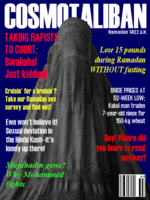 The Americans and the Soviets, having thoroughly used and abused Afghanistan for their Cold War ends, abandoned it completely in the late 80s. Their withdrawal was followed by a civil war that was won by the victorious Islamists, who alone could provide a measure of cohesion and stability amid the chaos. A million Afghans had died, millions more were disabled, maimed, or orphaned. The chief economic product was still opium and heroin; the only schools operating were the madrassas once funded by the US to mould recruits for the holy war against the Russians. The global recruiting and training infrastructure remained, as did the financial networks and Saudi aid. After the war, the ideologically charged mujahideen didn’t just go home and become baby boomers. They had driven the Soviets out and their victory emboldened them to expand their militant jihad. From this cesspool arose the Taliban and “the forces that carried out the operation we know as 9/11.”[14] In a recent article, Pervez Hoodbhoy wrote the following:
One can squarely place the genesis of religious militancy in Pakistan to the Soviet invasion of Afghanistan in 1979 and the subsequent efforts of the U.S.-Pakistan-Saudi grand alliance to create and support the Great Global Jehad of the 20th century. A toxic mix of imperial might, religious fundamentalism, and local interests ultimately defeated the Soviets. But the network of Islamic militant organisations did not disappear after it achieved success. By now the Pakistani Army establishment had realised the power of jehad as an instrument of foreign policy, and so the network grew from strength to strength.[15]
 Clearly, the “unintended consequences of misinformed, cynical, and opportunistic actions can boomerang on their perpetrators.”[16] The same camps that provided money and terrorism training to the Islamists against the Soviets grew tentacles and came back to haunt the US (not to mention Pakistan). An LA Times investigation in the 90s found that in the aftermath of the Afghan War, “the key leaders of every major terrorist attack, from NY to France to Saudi Arabia, inevitably turned out to have been veterans of the Afghan War.”[17] The roots of transnational Islamic terrorism lie not so much in culture and the Qur’an as in politics and the conduct of the Cold War in Afghanistan. For America's opportunistic politics, the society they helped wreck, and the monster they helped create in Afghanistan, 9/11 can justifiably be seen as chickens coming home to roost. Or, if you believe in it, a textbook example of bad karma.
___________________________________
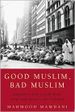 (This essay was inspired by Good Muslim, Bad Muslim by Mahmood Mamdani, Herbert Lehman Professor of Government and Professor of Anthropology at Columbia University. Most facts and figures are from his meticulously researched book which carries detailed notes and citations).
[1] Mahmood Mamdani, Good Muslim, Bad Muslim, p.64.
[2] ibid., p.66. (Inside quote by Alfred W McCoy, 'Fallout: The Interplay of CIA Cover Warfare and Global Narcotics Traffic,' 2002.)
[3] ibid., p.103. (Source: Kornbluh, “Nicaragua”, in Low-Intensity Warfare, pp.142-46.)
[4] ibid., p.91. (Source: Minter, 'Apartheid's Contras,' pp.4-5.)
[5] ibid., p.122.
[6] ibid., p.122.
[7] ibid., p.119.
[8] ibid., p.126. (Inside quote by Hamid Hussein, 'Forgotten Ties: CIA, ISI & the Taliban,' CovertAction Quarterly 72, Spring 2002, p.72.)
[9] ibid., p.129.
[10] ibid., p.138. (Source: Cooley, 'Unholy Wars,' 2000, pp.90.)
[11] ibid., p.138. (Source: Cooley, 'Unholy Wars,' 2000, pp.90.)
[12] ibid., p.136. (Source: Cooley, 'Unholy Wars,' 2000, pp.188-89.)
[13] ibid., p.137. (Inside quote by Pervez Hoodbhoy, 'The Genesis of Global Jihad in Afghanistan,' 2002.)
[14] ibid., p.131.
[15] Pervez Hoodbhoy, Towards Theocracy?, Frontline, Volume 26 – Issue 06 :: Mar. 14-27, 2009.
[16] Mahmood Mamdani, Good Muslim, Bad Muslim, p.121.
[17] ibid., p.139.
__________________________
More writing by Namit Arora?
__________________________
