
Many reviews of Paris, Texas open by describing of the condition and provenance of Travis, its wayward middle-aged protagonist. Though this isn't a review per se, I will uphold the proud tradition nonetheless: Travis shambles into the film from a barren, near-surrealistic desert landscape, allegedly on his way back an extended impromptu stay in Mexico. He's also a scruffy disaster, masked by a scraggly beard and battered baseball cap, walking on, more so than in, a pair of boots that no longer merit the name. He appears to understand little. He says even less.
Such a setup could be taken in hundreds of different tiresome directions. The story of a enigmatic outsider, perhaps, uninitiated in entrenched human mores, who, by way of his noble naïveté, inadvertently strips the ludicrous facade from the cesspool of hypocrisy and parochialism we have short-sightedly come to call civilization? How about a gimmicky yarn revolving around a taciturn Man With a Past, a tale whose teller manipulatively keeps the audience on an artificial drip-feed of detail, delaying as long as possible the exposure of this figure's preposterous, baroque backstory to the harsh light of day? Maybe a lazy odyssey of the bizarre, where the fellow continues to shamble silently through an interminable series of haphazard, dissociated words and images, leading viewers into an interpretational wild goose chase?
From the moment Travis breaks his isolation and crosses into some semblance of a built environment, the possible disastrous creative choices blossom, almost eclipsing from view the possible successful ones. By some miracle combination of calculated cinematic risk-taking and sheer bravado, Wenders and his collaborator, the redoubtable playwright Sam Shepard, pull the film through unscathed. Given that the final product contains both a precocious child actor and no fewer than two interstate road trips, Shepard and Wenders' indisputable victory over cliché looks even less probable, but it shines right there onscreen nonetheless.
When Travis stumbles into a clapped-together saloon and collapses, having unsuccessfully tried to quench his thirst with a handful of ice cubes, an eccentric local doctor brings him back to consciousness. Calling the only phone number on the materials he finds in Travis' pockets, the doctor draws Travis' bother Walt out from Los Angeles to retrieve his catatonic older sibling. Finding Travis unable, even after regaining his speech, to recall the past four years or even take an airplane back to California, Walt struggles to drag him back into reality. This reality seems not to have been entirely friendly to old Travis. Walt and his French wife prove more than hospitable toward a man who, place in the family tree aside, amounts to little more than a disoriented stranger, but complicating matters, he's a disoriented stranger who happens to have fathered the child of the house. Walt took little Hunter in when Travis broke for his extended lost weekend, and upon Travis' return, the seven-year-old soon learns that, yes, he has two dads. And two moms, though Jane, the biological one — Travis' ex-wife — is now practically as unfindable Travis himself had been.
Gradually, Travis' memory returns, his dialogue grows (relatively) verbose and his rapport with Hunter comes to resemble a somewhat functional father-son dynamic. With these waxes his interest in tracking down Jane. Procuring a battered, rusting Ranchero, Travis and Hunter set off for Houston, armed only with a pair of walkie-talkies and the knowledge that Jane deposits cash into a certain bank account on the fifth of each month. A comical stakeout, a highway chase and some bemused wandering later, Travis discovers Jane working in a curious pseudo-voyeuristic operation where men pay to converse with costumed girls who sit, in one of several broadly-themed sets, on the other side of a one-way mirror. In this unlikely setting, the film's most virtuosic passages take place: mediated through a tinny intercom and asymmetrically interrupted by the trick glass, Travis measuredly but strongly reveals to Jane and the audience what, to the best of his knowledge, set off his stint in oblivion and what he must do to justify his return.
A French-German co-production helmed by one of the most respected German filmmakers of his generation, Paris, Texas has been called an American road movie through European eyes and thus one imbued with a distinct European sensibility. That description calls to mind one of those grotesque, disbelieving indictments of all that is perceived to be wrong with United States culture: vast, empty roads; chintzy, cookie-cutter establishments; illiterate, vehicle-addicted, culturally moribund residents. Were that the case, I'd be writing about another movie; the anti-humanism of the polemic doesn't belong in a column of this title. As it is, the script by Shepard — one of the most American dialogue craftsmen alive — and Wenders' wide-open perspective make the film not just a spectator but an inhabitant of the America in which it's set.
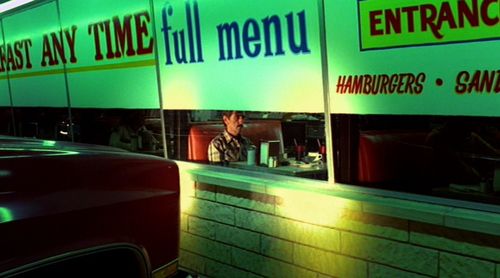
It's not a cartoon America, nor is it a realistic one. The reality the picture contains is so finely observed that it transitions, almost imperceptibly, into an aesthetic surreality. Nights assume a deep red. Uncorrected for the camera, fluorescent lights — and there are many — throw off a pervasive green cast. Layers of winding freeways arc across the sky. Power lines stretch out over the scrubby desert horizon. These and other elements develop organically without abrupt severance by overzealous hands in the editing room.
Wenders' subsequent project, the experiential documentary Tokyo-Ga, followed in the footsteps of revered filmmaker Yasujirō Ozu, searching for whatever magic remained in the locations the master used. Along the way, Wenders' camera lingers on a series of distinctly Japanese phenomena: an indoor driving range built of tier after stacked tier of golfing salarymen, or an artisanal factory that creates the lifelike model food so in demand for restaurant displays. Shot the same year as Wenders' Japanese journey, Paris, Texas looks on America with the same wondering — not to say wandering — eye, seeing folksy motels, sprawling drive-in banks and skyscrapers that actually scrape the sky as phenomena to be absorbed in all their detail rather than mocked, explained away or superciliously critiqued.
It's in this environment and with this attitude that the movie accomplishes its true stuntwork. Perhaps that term makes it sound cheap, but none other quite gets at its netless-tightrope-walk nature. Slightly more than halfway through the film — just before Travis and Hunter's Houston expedition — Wenders found himself working not just without a net, but without a script. He and Shepard had written the screenplay only up to the point that Travis, more or less re-acclimated to the setting he abandoned, has to decide what do to with the recovered pieces of his life. Wisely, they felt that, before a frame had been shot or a line had been acted, they couldn't possibly know the characters well enough to dictate their actions at such a heavy juncture. It was not guaranteed, of course, that the characters' choices would grow any clearer in mid-production, but when the time came to venture forth into open water, Wenders had on his hands a runaway father seeking to make things right, a young mother self-exiled into a form of conversational prostitution, a kid with four parents, two weeks, half a blank script and a film to finish shooting. The incentive had to have been there.
The gambit paid off, resulting in an ending both true to the characters and simply true, period. Though potential distributors still reportedly importuned Wenders to re-shoot a more traditional “Hollywood” ending, it's not a sheaf of loose ends; it's also far from a formulaically tied-up package. Thanks to Shepard and Wenders' respect for Travis, Hunter and Jane as human beings — as distinct from game pieces to be clinked back and forth as demanded by one cherished plot contrivance or another — Paris, Texas completes an arc that isn't simply the one it does have, but the one it must have. The film is priceless on several levels — the vivid, split-focus-heavy Robby Müller cinematography united with Ry Cooder's spare, improvised score more than repay admission themselves — but that its characters take their own actions, not the ones a journeyman screenwriter's calculations indicated would appeal, is the rarest viewing pleasure of them all.