
by Jeff Strabone
The twenty-first century may still be fairly new, but its nameless first decade—the naughties? the zeroes?—is drawing to a close and it’s time to start taking stock. I have noticed something happening in the art of this decade that may indicate a deep change in contemporary attitudes towards the past and its uses. It could be the passing fancy of a handful of artists, or it could indicate the end of the twentieth century’s modern and postmodern obsessions and anxieties. What I have noticed is the return of pre-modern attitudes towards tradition.
Let’s consider some examples. In 2000, Bill Viola made a video called The Quintet of Remembrance which poses actors as figures found in paintings by Hieronymus Bosch, Andrea Mantegna, and Dieric Bouts. Shot in one minute of real time, the video is shown slowed down to sixteen minutes, the effect being a heightening of the actors’ gravity and emotions. The lighting, poses, and facial expressions are clearly not of our era, yet the clothing is, as seen in this still.
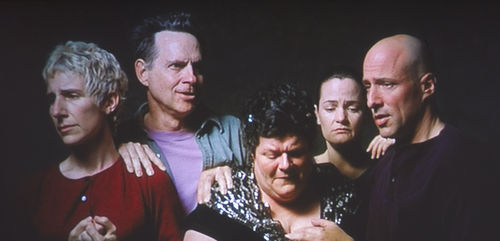
The Quintet of Remembrance was the first piece of video art to enter the Metropolitan Museum’s collection.
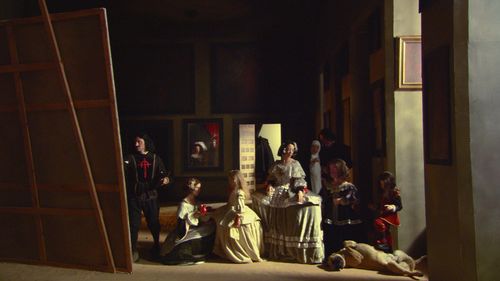
Similarly, Eve Sussman recreated Velázquez’s Las Meninas in a twelve-minute video in 2004 called 89 Seconds at Alcazar. Here is a still from Sussman’s video, which was part of the 2004 Whitney Biennial and was also part of the inaugural exhibition of the MoMA’s new dedicated video gallery when the museum reopened in 2004.
What Viola and Sussman have done in video others have done in painting. Karel Funk, born in the 1970s, has emphasized contemporary fabrics in his neo-Renaissance photo-realist paintings, as seen here in an untitled painting from 2003. The figure wears the hood of a monk, but it appears to be made out of Gore-Tex.

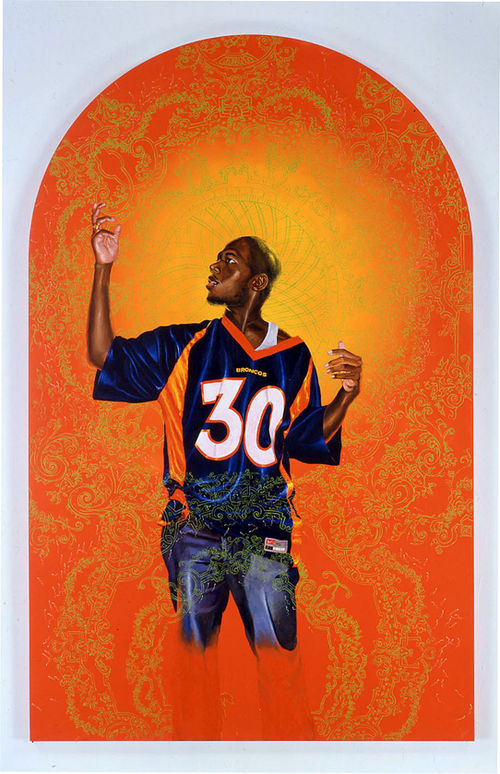
Kehinde Wiley, also born in the 1970s, provides another twist on the neo-Renaissance style by posing African-American men as figures they pick out of Old Master catalogues in his studio. Here is a painting from his ‘Passing/Posing’ series of 2003.
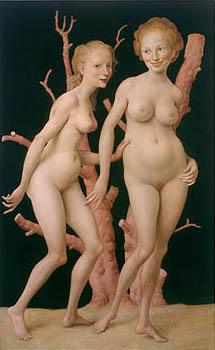
Perhaps the first contemporary painter to revisit the Old Masters in this distinctive new-old approach, John Currin pulls from a wide range of sources, most conspicuously Lucas Cranach the Elder, as seen here in The Pink Tree (1999).
Aside from Sussman’s period garb, all five share a number of features: they faithfully duplicate recognizably old poses and characters in the present without resorting to any undercutting of Old Master æsthetic values like illusion and the fineness of the artist’s hand. One could argue that Wiley is up to something different by putting black men in dead white men’s poses, but even in his work Old Master prestige is less questioned than borrowed, as if to say that these men, too, in their brown skins and sports jerseys, deserve to be objects of heroic portraiture.
The twentieth century was as appropriative as any other period in history, but the century’s approach to the past was typically one of attack and doubt. That holds true whether we are talking about modernism’s smashing of idols or postmodernism’s suspicions of the past. By century’s end, both art and criticism were rife with distrust of the past—why else would so many call for an art of ‘resistance’?—and they suffered from a lingering hangover that culture did not lead to redemption, progress, or upliftment. In retrospect, one wonders why that realization took so long to get over.
From the 1960’s on, more and more art appeared that explicitly rejected æsthetics, as if beauty itself were suspect. (Would it be overstating the case to say that, to some, susceptibility to beauty came to seem like a gateway to docility at best and fascism at worse? Maybe a bit.) By a variety of labels, such art was anti-æsthetic, anti-affect, and, most of all, anti-seduction. Late twentieth-century art was increasingly an art of materiality, process, and space, rather than an art of representation, illusion, and figure.
Let one example suffice to make clear what kinds of art I am referring to. Here is an untitled, and typical, work of Donald Judd from 1989.
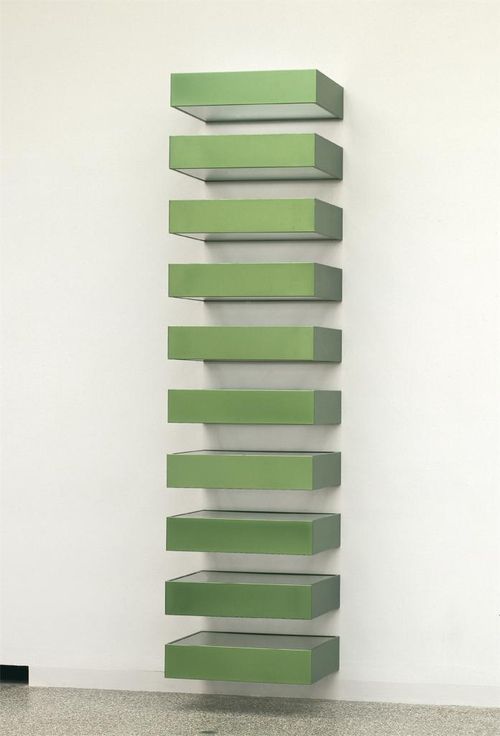
Judd was a brilliant and rigorous artist and thinker whose work I have always admired. In saying that much of the art of the past forty years, including Judd’s, set out to banish æsthetics and affect from art, I am not making a negative judgment, just an observation. But there is clearly something different going on in Judd’s anodized aluminum and clear plexiglas boxes than there is in Funk’s monk.
Ironically—or not—over time the work of Judd and company is increasingly appreciated at least as much for its æsthetics as for its conceptual rigor. Witness Roberta Smith’s review of Judd’s work at Christie’s New York in the New York Times for April 24, 2006:
‘So I’m as surprised to be writing the following as you may be to read it: This exhibition is the most beautiful survey of Judd’s work ever seen in New York, and the first to be displayed under conditions of space and light that the famously demanding artist might have found satisfactory.’
[…]
‘The quantities of natural light and space here, as in Judd’s Marfa displays, bring into sharp focus the way he combined the opposing modernist forces of Matisse and Duchamp—art and anti-art, full-on retinal seduction and the cerebral provocation of the ready-made. Light makes his colors sing and also brings out the differences in his basic ready-made materials: metal, Plexiglas and plywood. Compare the amber color of an anodized aluminum wall stack, for example, with the glowing Plexiglas that surprises you at the bottom of a large floor box.’
I don’t think anyone in Judd’s lifetime would have praised his work with words like ‘beautiful’ and ‘retinal seduction’, but it’s hard to deny the beauty of even some of the most puritanically conceptual art. And it’s getting harder.
The return of the æsthetic to even the most anti-æsthetic settings is popping up all around us. Hal Foster, who edited The Anti-Aesthetic: Essays on Postmodern Culture in 1983, has in this decade criticized contemporary artists for upholding the title of his most famous book. In a review essay in the London Review of Books for December 4, 2003, Foster took practitioners of ‘relational aesthetics’ like Felix Gonzalez-Torres and Rirkrit Tiravanija to task for being too conceptual and showing insufficient regard for the power of the æsthetic: ‘But surely one thing art can still do is to take a stand, and to do this in a concrete register that brings together the aesthetic, the cognitive and the critical.’
I agree wholeheartedly with that statement. And for what it’s worth, Tiravanija, one of whose works is the in-person preparation of Thai food by the artist, is no Donald Judd. Peter Schjeldahl’s reviews in the New Yorker are one of the first places that I encountered twenty-first-century anti-anti-æstheticism, as in his December 15, 2003 review of the John Currin retrospective at the Whitney:
‘I hazard that in Currin’s art manifold pleasure disarms revulsion—without eliminating it. He demonstrates the power of the aesthetic to overrule our normal taste, morality, and intellectual convictions. Beauty and wit occasion holidays from habits of mind which, though our own, seem, for the moment, arid and boring. The subject matter of “Stamford After-Brunch” may appear mean and trivial; but the painting is an inexhaustible joy to behold. Currin hooks us by rewarding capacities for knowledge and experience which most major art of the last half-century repressed. Why that long reign of austerity was a good idea is increasingly hard to remember.’
I think Schjeldahl is on to something. Why did the twentieth century so anxiously repress Old Masters, the Renaissance, Academic painting, and so on? I can recite a range of historically defensible answers, but I no longer feel that ‘modern’ means progress and ‘old’ means regress.
So what does it all mean? What are the implications of this ongoing transformation of cultural values, if that’s what we are witnessing? It may be too soon to know, but let me offer some preliminary findings, however broad, in the meanwhile.
We may be losing the stigma that artists and critics of the twentieth century attached to traditions and values of prior centuries. I don’t believe in transcendence either, but I don’t see why contemporary artists can’t draw on artists who did. The props that one used to get automatically for overturning traditions may no be longer forthcoming. You can still kill your idols, but you may not need to anymore.
Likewise, those idols have been de-vilified. New York’s Dahesh Museum boasts that it is the only museum in the States dedicated to European academic art. It turns out that is quite possible after all to look at academic artists like Bouguereau, Gérôme et al. as something other than bourgeois oppressors defeated by the Impressionist forces of liberation. Like Schjeldahl suggested above, we may no longer feel why the moderns and postmoderns felt so obligated to overcome the past. If—and it’s clearly a debatable if at this point—we don’t share their anxieties anymore, then we don’t need to share their repressions or their resistances.
What makes these twenty-first-century appropriations different from postmodern appropriations is that they neither cast suspicion on the past nor reveal its insufficiency. They are not part of a narrative of failures and letdowns of the past. If postmodernism made a collage of the past, it was not to show that everything was equally good, but to show that everything was equally bad.
The twentieth century’s strategies of form-breaking and appropriation were ways of overcoming the past. The past was something to be gotten over, a burden, perhaps a reminder of disgraceful crimes that art failed to resist. But if we accept, as we should, the twentieth century’s skepticism toward art’s supposed redemptive power, then isn’t art off the hook? Let’s hope so. And let’s hope that a new attitude towards the art of the past is indeed emerging. What the twentieth century held at arm’s length—or on a spit—this century may be prepared to embrace anew on different grounds. The past is over. Long live the past.