
by Judith Goudsmit and Asad Raza
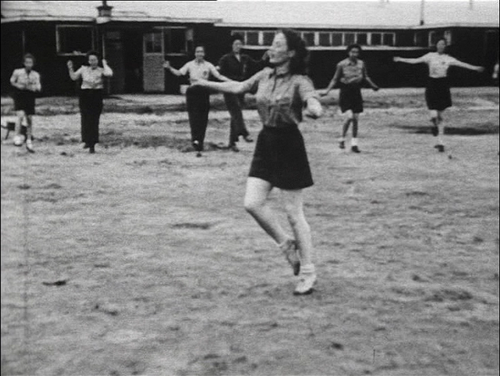
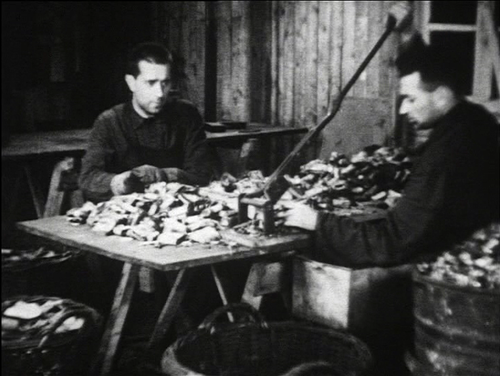
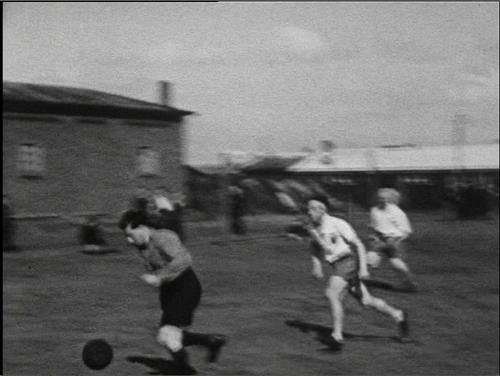
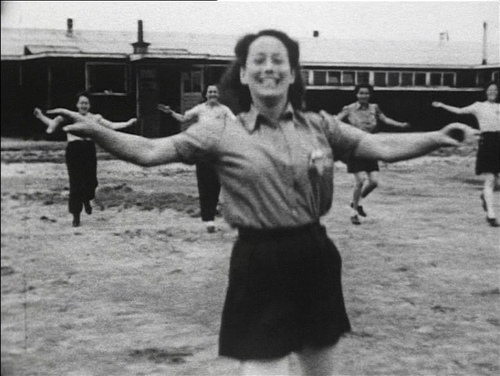
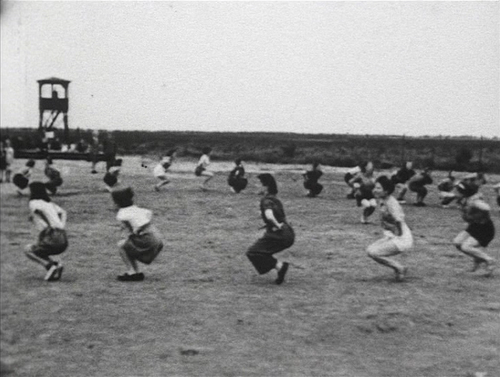
Respite consists mostly of black-and-white film shot at Westerbork, a Dutch refugee camp established in 1939 for those fleeing Germany. In 1942, after the occupation of Holland, its function was reversed by the Nazis and it became a 'transit camp.' In 1944, the camp commander commissioned a film, shot by a photographer, Rudolph Breslauer; this is the footage used in Respite. It shows inmates processing mechanical parts, doing aerobics, mounting stage productions, and other activities. It also shows inmates being loaded onto trains. Before the film could be completed, its subjects, as well as Breslauer, were transferred to Auschwitz and killed. Farocki's Respite, like the original images, contains no sound. His changes to the archival footage are very simple: he edits it and intersperses black title cards on which short texts, usually one sentence, appear.
(All film stills courtesy of Greene Naftali Gallery, New York)
Judith Goudsmit: It's interesting how the texts Farocki provides us with evolve over the course of the film. First, we view the images with short explanations of what we are seeing. Then, as if he is reevaluating his previous interpretations, he repeats certain images with different, more personal texts, pointing out certain details, or emphasizing one aspect of the image. Watching it, I felt like I was being tested, as if he was asking what would be more effective, what would be more shocking, provoking, sad, etc. Maybe because I grew up hearing so many stories about Westerbork, and the Holocaust generally–almost every successful Dutch novel is about the Holocaust or its aftermath–I have become so familiar with the way people tell these stories that these personal notes Farocki gives us almost seem to play with clichéd or contrived notions of the Holocaust and its impact. Also, the images just seem plain joyous at first: genuine fun, jumping around in a circle. Later, with Farocki's comments, this 'fun' gets macabre undertones. I think he is questioning whether we can look at these images without the knowledge we have now, without their context of death. Is it ever possible to look at things just for what they are? Of course he is questioning a lot more, but I'm rambling and just had a phone fight with my mother. What do you think?
Asad Raza: I think Respite is a very honest film, because it admits a really basic truth: not only can we not look at things for what they are, we can't even know what they are. Respite doesn't pose, as most documentaries do, as an objective account of historical reality; it's more like a meditation on its source material. As you said, some of its archival images seem very incongruous to the tragic destiny of Westerbork–people dancing and jumping and smiling. The title cards tell us these images are rarely shown, perhaps because they aren't obviously or viscerally terrible. They aren't symbolic enough of the historical “meaning” of Westerbork. Yet the fleeting smiles of the camp's inmates are possibly more crushing than the standard Holocaust-documentary shot of hills of corpses. Dead bodies are ultimately objects; a woman leading a dance class, who we know will soon be murdered–this is sickness and tragedy. And the film lets us ponder this footage without the distraction of music or other added elements. It doesn't tell us how to feel too directly, which allows our own reactions to emerge all the more powerfully. This way, the film respects the basic strangeness, or unknowability, of these moving images, instead of pretending that they record a reality we already know how to interpret.
Judith: Okay, so there's no Itzhak Perlman playing in the backround, or other obvious way to create emotion, but I actually do think Farocki is coloring the images with his texts (maybe I'm speaking for myself–but think how different the film would be without them). He repeats certain shots with new texts that explicitly point out the impossibility of watching them without overlaying our knowledge of what was to come. When I look at the images, I am also, consciously or subconsciously, looking for my great-grandparents, parents of people I know, friends of my parents who I know went through Westerbork–so in a way I might be doing exactly what Farocki is doing for us. I'm making it more 'real,' or personalizing these images that would otherwise be extremely general. Maybe we always do that, with everything we see. When we recognize things or characteristics of characters in films and novels, we laugh, we cry, etc. I just don't think we, as people, are emotionally equipped to handle the scale of certain events. We can't take on the world.
Asad: I think you're right that Farocki's texts color the (black and white) images. (Even to select this footage at all is a form of inflection, of course.) At the same time, by repeating clips he emphasizes the impossibility of images having fixed meanings. You can consider and reconsider; the meaning changes. But despite admitting this fundamental ambiguity, the film created very strong emotions in me. Some of the title cards are very dramatic: he uses the word “murdered” several times, and at one point he writes that you can “sense the foreboding of death” on a girl's face. These moments break through the placidity of the images. Maybe this is similar to your saying that we can't “take on the world”–by “the world,” I understand you to mean, “the whole world,” or “the world abstractly.” You're saying that we must always familiarize it somehow, find a way to recognize it, yes? Yet our methods of familiarization are different: viewing these images, I don't look for relatives, of course; neither did I know very much about Westerbork before seeing this film. Up above, you mentioned feeling “tested” by the film–it must be a very different test for you than for me.

Judith: Although, of course, I know I won't recognize anybody, the fact that it's in Westerbork, that all these people are Dutch, makes a difference–it becomes personal. These people came from Amsterdam, went to the same high school I went to, lived in my street, knew my family. However, I'm always sort of annoyed when people pull events such as this towards them, as if they have more right to their sadness: as if someone else shouldn't mourn as much for these people as they do, etc. It's always important to keep a balance between sadness for something proximate, and the realization that horrific things happen to people all over the world. In Holland, the Holocaust is singular: no one ever dares to compare its tragedy to anything else. I understand that, of course, but at the same time it's kind of like being an extreme patriot, or never travelling outside of your own country. Wait, am I being politically incorrect? (See, whenever it's about the Holocaust, it's so dangerous to venture outside of its incomparability…)
Asad: Very dangerous, yeah. But I completely share the impulse to resist treating any event as a singularity 'owned' by a certain group. And I think the film cautions against this too–I read it as a critique of extracting meaning too easily. In this it shares the same interests as a lot of Farocki's other work. For example, Deep Play, where he synchronized twelve different live feeds and visualizations of data generated of the 2006 World Cup final. One screen played a timecoded broadcast. Another showed little numbers floating around–an animated graph charting each player, from a company that compiles scouting information for soccer teams. (The little “10” was very active.) Another, internal security surveillance of the stadium. Again, Farocki shot no new footage, just recombined what existed to demonstrate an underlying complexity: the “event” we experienced singularly as Italy v. France is an amalgam of many different kinds of information, all of which illuminate their subject differently.
Respite also continues Farocki's themes by its concentration on labor. His film Workers Leaving the Factory contemplated the meaning of shots of workers leaving factories, in films, newsreels, stock footage, etc. Another film, Inextinguishable Fire, documents the employees of Dow Chemical working to develop Napalm B (a stickier and more lethal version for use in Vietnam). Much of the Breslauer footage in Respite shows camp inmates busily working away, whether checking other inmates into the camp or using a small guillotine-like slicer to cut up mechanical parts. These shots also have the effect of linking the camp's prisoners with workers everywhere. It's a quasi-Marxist point: that workers have more in common with other workers than they do with fellow citizens, co-religionists, etc. In Respite, this restores their everyday, even banal humanity, rather than simply their special victimhood, which has the effect you were talking about: to venture outside of the Holocaust's incomparability.
There is a truthfulness to that effort. So many tragedies, historical and contemporary, global and personal, tug at us, but our feelings have no rational proportionality: mostly we're more affected by an ill relative, a fictional plot, or a friend's breakup than a million victims of genocide on another continent. Speaking of which, have you patched things up with your mom?
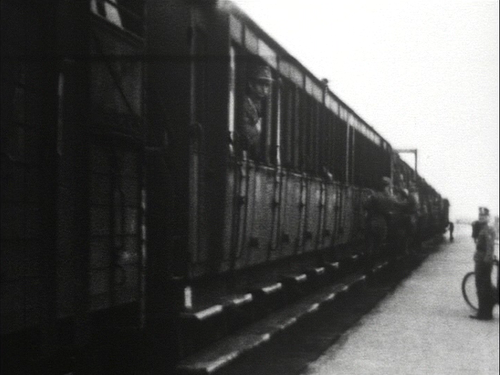
Judith: Exactly: we see the prisoners working, dancing, doing the prosaic things everybody does, but not praying, lighting candles, or exhibiting their 'Jewishness' in any way. The images show the productive action of Westerbork, rather than the inaction, lack of energy, and infinite tragedy of most concentration camp images. I was just thinking, while I'm writing this, that they're actually very similar to the sort of propaganda that Leni Riefenstahl shot, except that the contemporary audience is rooting for the Jews. In my case, being Dutch and Jewish makes the sad images almost easier to look at. Subtext always stings more.
(And, yes, things have been better with my mother, although she is now just ignoring our disagreement. Smoothing things out is overrated anyway.)
And yet the images weren't always easy to watch for me, even though I usually don't 'claim' my roots in that kind of way. It's a bit more complicated. Whenever we would talk about the Holocaust in school, people would always glance over at me (not many Jews are left–I was the only one in my class), as if they expected something from me. Which would make me uncomfortable, not necessarily because I suddenly felt very Jewish, that I was carrying the burden of the entire Holocaust, but because it made me aware of the idea that those kids might think I did. Even during the recent invasion of the Gaza Strip, people were afraid to judge Israel in front of me; as if I would possibly take offense at their disapproval. Did being a Muslim lead to those kinds of repressed confrontations as well, or not?
Asad: I guess a Pakistani Muslim in my old elementary school in Buffalo these days would feel a lot more uncomfortable, more under suspicion, than I did. But “repressed confrontations” resonates with me as a good description of a strange doubleness I sometimes felt in school. Was I “different”? I was never sure how much or why. I knew my family was quite different to others, but so is everybody's–and not having other Pakistani friends meant I didn't know if those differences were cultural or familial. A dialectic happens there: being treated differently and actually being different “to begin with” are all mixed up. And of course, there's the synthesis: having difference imputed to you by others is a difference, in that you experience a treatment that others don't.
I've noticed a similar dialectic in Respite. Do the images, which are, as you say, a kind of counter-propanganda, record sameness or difference? Concentration camp life appears here as a combination of diligent home-front labor and cruise ship-style fun. Yet Farocki, with a confident simplicity of means, shows that the normality the images record paradoxically make the inmates' difference, as victims of Westerbork, all the more palpable. In one of his title cards, Farocki memorably hypothesizes that the filmmaker (Breslauer) avoided closeups of doomed inmates boarding trains to Auschwitz: some of their faces showed terror too clearly, destroying the sunny picture of camp life he was meant to produce. Breslauer's images don't picture a tragedy, but they still record one. We know where those trains were headed. And so the images, in dialogue with the title cards, flip back and forth in meaning from counter-propagandistic appeasement to authentic record of trauma. They're both.
Judith: What is the most astonishing to me, and the most tragic moment in this film, is the lady in a wheel chair who is carried into the train with utmost care. Her suitcase is neatly packed, blanket around her legs, waiting patiently for someone to lift her up. As you said before: an elderly woman ready for her Caribbean cruise adventure. The idea that some of these people had no idea what was to come, or were in denial of its horror, gives me goosebumps. Farocki's title cards do not allow denial or ignorance of this woman's fate, almost as if he wants to warn her in retrospect, channeling his warning through us. In the end, the texts also tell us something about Farocki's viewing of this material. While watching he is always reassuring himself of what happened after these moments, that these people are dead, not wanting to be fooled by the laughter and 'liveliness,' of the people in the footage. And yes, a pile of dead bodies doesn't mean anything; a laughing woman leading an exercise group for other young women, does.
Judith Goudsmit grew up in Amsterdam, and is currently getting her MFA in playwriting at the New School in New York City. Asad Raza lives in New York and writes regularly for 3quarksdaily.