By Namit Arora
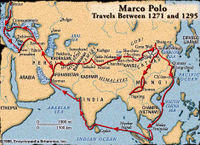 Returning home from China in 1292 CE, Marco Polo arrives on the Coromandel Coast of India in a typical merchant ship with over sixty cabins and up to 300 crewmen. He enters the kingdom of the Tamil Pandyas near modern day Tanjore, where, according to custom, ‘the king and his barons and everyone else all sit on the earth.’ He asks the king why they ‘do not seat themselves more honorably.’ The king replies, ‘To sit on the earth is honorable enough, because we were made from the earth and to the earth we must return.’ Marco Polo documented this episode in his famous book, The Travels, along with a rich social portrait of India that still resonates with us today:
 The climate is so hot that all men and women wear nothing but a loincloth, including the king—except his is studded with rubies, sapphires, emeralds and other gems. Merchants and traders abound, the king takes pride in not holding himself above the law of the land, and people travel the highways safely with their valuables in the cool of the night. Marco Polo calls this ‘the richest and most splendid province in the world,’ one that, together with Ceylon, produces ‘most of the pearls and gems that are to be found in the world.’
The sole local grain produced here is rice. People use only their right hand for eating, saving the left for sundry ‘unclean’ tasks. Most do not consume any alcohol, and drink fluids ‘out of flasks, each from his own; for no one would drink out of another’s flask.’ Nor do they set the flask to their lips, preferring to ‘hold it above and pour the fluid into their mouths.’ They are addicted to chewing a leaf called tambur, sometimes mixing it with ‘camphor and other spices and lime’ and go about spitting freely, using it also to express serious offense by targeting the spittle at another’s face, which can sometimes provoke violent clan fights.
 They ‘pay more attention to augury than any other people in the world and are skilled in distinguishing good omens from bad.’ They rely on the counsel of astrologers and have enchanters called Brahmans, who are ‘expert in incantations against all sorts of beasts and birds.’ For instance, they protect the oyster divers ‘against predatory fish by means of incantations’ and for this service they receive one in twenty pearls. The people ‘worship the ox,’ do not eat beef (except for a group with low social status), and daub their houses with cow-dung. In battle they use lance and shield and, according to Marco, are ‘not men of any valor.’ They say that ‘a man who goes to sea must be a man in despair.’ Marco draws attention to the fact that they ‘do not regard any form of sexual indulgence as a sin.’
 Their temple monasteries have both male and female deities, prone to being cross with each other. And since estranged deities spell nothing but trouble in the human realm, bevies of spinsters gather there several times each month with ‘tasty dishes of meat and other food’ and ‘sing and dance and afford the merriest sport in the world,’ leaping and tumbling and raising their legs to their necks and pirouetting to delight the deities. After the ‘spirit of the idols has eaten the substance of the food,’ they ‘eat together with great mirth and jollity.’ Pleasantly disposed by the evening entertainment, the gods and goddesses descend from the temple walls at night and ‘consort’ with each other—or so the priest announces the next morning—bringing great joy and relief to all. ‘The flesh of these maidens,’ adds Messer Marco, ‘is so hard that no one could grasp or pinch them in any place. … their breasts do not hang down, but remain upstanding and erect.’ For a penny, however, ‘they will allow a man to pinch [their bodies] as hard as he can.’
 Dark skin is highly esteemed among these people. ‘When a child is born they anoint him once a week with oil of sesame, and this makes him grow much darker’ (replaced since by ‘Fair & Lovely’ creams!). No wonder their gods are all black ‘and their devils white as snow.’ A group of their holy men, the Yogis, eat frugally and live longer than most, some as much as 200 years. In one religious order, men even go stark naked and ‘lead a harsh and austere life’—these men believe that all living beings have a soul and take pains to avoid hurting even the tiniest creatures. They take their food over large dried leaves. When asked why they do not cover their private parts, they say, ‘It is because you employ this member in sin and lechery that you cover it and are ashamed of it. But we are no more ashamed of it than of our fingers.’ Among them, only those who conquer sexual desire become monks. ‘So strict are these idolaters and so stubborn in their misbelief,’ opines Marco.
 Though the king here has 500 wives, he covets a beautiful wife of his brother—who rules another kingdom nearby, and as kings are wont to, also keeps many wives—and one day succeeds in ‘ravishing her from him and keeping her for himself.’ When war looms, as it has many times before, their mother intervenes, knife in hand and pointing at her breasts, ‘If you fight with each other, I will cut off these breasts which gave you both milk.’ Her emotional blackmail succeeds once again; the brother who has lost his woman swallows his pride and war is averted. But it is only a matter of time, thinks Marco, that the mother is dead and the brothers destroy each other.
The region breeds no horses but imports them from Aden and beyond. Over 2,000 steeds arrive on ships each year but within a year, all but 100 die ‘due to ill usage’ and lack of horse-handling knowledge. Marco believes that foreign merchants ‘do not send out any veterinaries or allow any to go, because they are only too glad for many of the horses to die in the king’s charge.’ Further north, in a little town near modern Chennai, is the tomb of St. Thomas the Apostle, a place of pilgrimage for both the Christians and Muslims of the region.
 After the eastern Coromandel Coast, Marco sails up the western Malabar Coast, but his observations are sparse, partly because most of the same customs—the kind accessible to a foreign traveler—prevail there too. Of the flora and fauna, he says, ‘everything there is different from what it is with us and excels both in size and beauty. … lions, leopards, and lynxes abound,’ as do peacocks and scarlet and blue parrots of which there is ‘no lovelier sight in the world.’ Some monkeys in the region have ‘such distinctive appearance that you might take them for men.’
 He notes pepper and indigo plantations, incense, a date wine that is ‘a very good drink.’ Further north, workshops make cotton and leather goods, shiploads of which go west every year. With such precious cargo plying the sea, piracy too operates on a large scale. In Aden, the cargo is transferred to smaller ships and carried via rivers and camels to the Nile and downriver to Alexandria and beyond. These goods include cushions and ‘mats of scarlet leather, embossed with birds and beasts and stitched with gold and silver … of more consummate workmanship than anywhere in the world. … so exquisite that they are a marvel to behold.’
*****
 What kind of a man was Marco Polo? Raised in the cosmopolitan and mercantile city-state of Venice, Marco embraced something of its spirit and brought a merchant’s pragmatic eye to bear on the world. His father and uncle—both enterprising merchants of Venice who accompanied him on his famous journey but left no records of their own—were early role models. When Marco began this journey he was only seventeen. He returned in his late-thirties and a few years later, in 1298 CE, teamed up with a romance writer, Rustichello of Pisa, to tell his story—a vast panorama of nations largely unknown to his fellow Venetians. As his translator, Ronald Latham, says:
‘Persians, Turks, Tartars, Chinese, Tibetans, Indians, and a score of others defile before us, not indeed revealed in their inner thoughts and feelings, but faithfully portrayed in all such particulars as might meet the eye of an observant traveler, from the oddities of their physical features or dress to the multiplicity of strange customs by which they regulated their lives from the cradle to the grave.’
Marco was supremely inquisitive, attentive to a region’s geography and natural resources, birds and beasts, climate and flora, foods and drinks. He was also drawn to the local arts and crafts, and assessed their commercial value for fellow Venetians. In Marco’s day, cultures were classified by religion, and so arriving in a new place, he described the locals simply as Christians, Jews, Saracens (Muslims), or idolaters (catchall for Tartars, Buddhists, Hindus, Jains, and others). He admired hard-working, law-abiding people, and criticized indolent, unruly ones. There are hardly any personal incidents in the book. What makes his account truly worthwhile are his vignettes of social life, such as how the tartars pitch their tents or go to war, how some central Asians extract musk from gazelles, how a girl’s virginity in Cathay is verified before marriage, why men in a Tibetan province prefer to take as wives women with lots of prior sexual experience, or how the Great Khan’s ‘admirably contrived’ postal service works.
Marco was no scholar, however, and had scant interest in history, philosophy, or language (unlike, say, Al-Beruni, another famous traveler to India in early 11th century). He was a pious Christian and admired other cross-cultural expressions of piety. He believed in magic, incantations, and the power of astrologers to ‘bring on tempests and thunderstorms when they wish and stop them at any time.’ He used superlatives too readily and was prone to wild exaggeration (for example, he claimed the city of Hangzhou had 12,000 bridges, the Great Khan went hunting with 10,000 falconers, and every tree on the 7,448 islands in the China Sea gave off ‘a powerful and agreeable fragrance’). He was gullible too, lending credence to hearsay about giant birds that lift up elephants, men with tails as thick as a dog’s, and a legendary Christian king of Asia called Prester John (were some of these Rustichello’s embellishments?). He could also be very naive about human relationships, relying too much on surface appearances. For instance, he claimed that the multiple wives of tartar chieftains live together happily, with no conflict whatsoever.
In Ceylon, he relates the story of the Buddha with admiration, adding that ‘had he been Christian, he would have been a great saint with our Lord Jesus Christ.’ While largely tolerant towards idolaters, particularly those with a developed material culture, he betrays a garden-variety prejudice against Muslims, best assessed in light of a post-Crusades Christendom. For instance, he deems Christians ‘far more valiant than Saracens.’ Taking sides in a conflict, he declares that ‘it is not fitting that Saracen dogs should lord it over Christians.’ But these and other expressions of contempt—the ‘quite repulsive’ women of Zanzibar, tartars who live like ‘brute beasts’ because they smear food on the mouth of their gods, Indians being ‘paltry creatures and mean spirited’—are vastly outnumbered by expressions of admiration, fair-mindedness, and wonder. He had no role models in his writing and the result such as it is, warts and all, is nothing short of a miracle.
Marco Polo spent many months, perhaps the better part of a year, in India. Except for a brief mention of an inland kingdom that is ruled by a queen and is known for its ‘high standard of justice and equity,’ and which produces all of the diamonds in the world, his account of India is limited to a coastal belt and ends with this tantalizing remark, ‘Of the inland regions I have told you nothing; for the tale will be too long in the telling.’ We would have happily read on, Marco.
________________________________
Photos (top down):
Map copyright Encyclopedia Britannica.
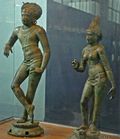
Sri Rishaparudar and Amman, 11th century CE(?), Tanjore Palace museum.
Statue of Nandi, Shiva's bull, worshiped in South India. Chamundi Hill, Bangalore.
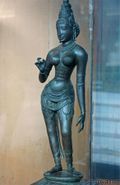
Parvati, 11th century CE, Tanjore Palace museum.
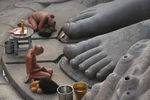
Jain devotees at Sravanabelagola, copyright GafferBee.
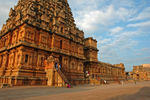
Brihadishwara Temple, 11th century CE, UNESCO world heritage site, Tanjore.
Common Indian monkey.
Pepper plant.
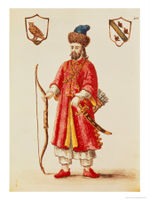
Marco Polo in Tartar costume (resemblance to the man not guaranteed!) copyright Allposters.com.
__________________________
More writing by Namit Arora?
__________________________
