
| ABOUT US | ARCHIVES | LINKS | RSS FEED | MONDAYS | |

3quarksdaily

An Eclectic Digest of Science, Art and Literature

« A trumpet with an uncertain (but compelling) sound | Main | Her Brother's Keeper »

January 29, 2009

Homesick

ID_NC_MEIS_WYETH_AP_001 Morgan Meis in The Smart Set:

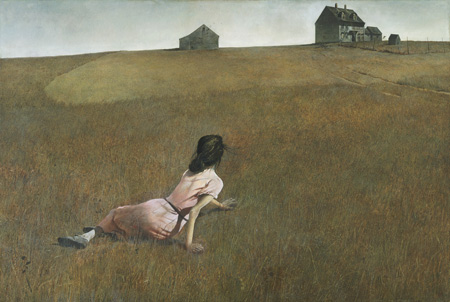
I remember seeing a reproduction of Andrew Wyeth's "Christina's World" when I was a child. It disturbed me. I felt that something horrible had happened to Christina and that she was left out there in the field, maybe to die. And what was happening in that lonely house up at the top of the hill?

There is, perhaps, no other American painting as recognizable and as loved as "Christina's World." The only other painting that comes to mind is "American Gothic" by Grant Wood. But for all his popularity (or because of it), Wyeth has generally been scorned by the critics. He has been called a cheap sentimentalist applying painterly tricks in the service of an empty nostalgia. New Criterion founder Hilton Kramer said simply, "he can't paint." Dave Hickey said Wyeth's palette was "mud and baby poop."

I keep coming back to the strangeness, the sense of unease that always bubbles up whenever I look at "Christina's World." Look at her hands and arms, spindly and wraith-like. Look, in particular, at the strange contortion in her right arm as she holds herself up. Something is wrong. Wyeth himself saw in Christina a kind of heroism. She was a real person living near his vacation home in Maine. She had been crippled by polio as a child but refused to use a wheelchair or to have much help at all. Wyeth admired her.

Still, I don't see much heroism in the painting. If this is nostalgia, it is not the nostalgia of wistful and pleasant longing. It’s a nostalgia closer to its Greek roots. The "algia" part of nostalgia comes from the Greek word "algos," meaning pain and grief. The pain and grief, the longing for a home, is not necessarily a curable condition. Wyeth has often been criticized for his nostalgia for a pre-modern, rural America shot through with Puritanism and a fundamental simplicity. I think the case is slightly different. Wyeth was fascinated with those kinds of solitary American scenes because they evoked for him a feeling, a not-quite-tangible sense of painful longing that is always gnawing at the corners of our experience.

Posted by Robin Varghese at 02:48 PM | Permalink

Comments

Sounds like saudade.

Posted by: K | Jan 29, 2009 4:35:08 PM

Post a comment


Subscribe to this blog's feed  

PayAnywhere with iphone credit card swiper

Android Tablet

Bluetooth Headset

2013 New Style Dresses

Compare Car Rental Prices

DHgate.com Wholesale

3QD on Facebook

3QD on Kindle

3QD by Daily Email

Receive all blogposts at the same time every day.

Enter your Email:


Preview 3QD Email

3QD on Twitter

Miscellany

Lijit Search

AddThis Social Bookmark Button

Add to Google

Recent Comments

Jalees Rehman on The need for critical science journalism

Dredd on Why Rational People Buy Into Conspiracy Theories

Dredd on Why Rational People Buy Into Conspiracy Theories

Scrutineer on Why race as a biological construct matters

prasad on the culture animal

Mitt Romney's Dog on Why race as a biological construct matters

Elatia Harris on The Moral Status of Rocks

prasad on The Moral Status of Rocks

Raza Husain on The Moral Status of Rocks

Fred on Unknown Mathematician Proves Elusive Property of Prime Numbers

Joel Grant on Why Rational People Buy Into Conspiracy Theories

Tomboktu on Why is Europe so Messed Up? An Illuminating History

Joe on Why Rational People Buy Into Conspiracy Theories

Jalees Rehman on The Science Mystique

Dredd on The Moral Status of Rocks

sjg on Why Rational People Buy Into Conspiracy Theories

Dredd on Why Rational People Buy Into Conspiracy Theories

Ken Pidcock on The need for critical science journalism

Louise Gordon on Why race as a biological construct matters

Louise Gordon on The stories of two Palestinian villages: From Al-Araqib to Susiya

musafir on a pretty funny book

freddie on The stories of two Palestinian villages: From Al-Araqib to Susiya

freddie on The stories of two Palestinian villages: From Al-Araqib to Susiya

Junaida on Tuesday Poem

rafiq on Tuesday Poem

Acclaim For 3QD


"I couldn't tear myself away from 3 Quarks Daily, to the point of neglecting my work. Congratulations on this superb site."—Steven Pinker, Johnstone Professor of Psychology, Harvard University.

"I have placed 3 Quarks Daily at the head of my list of web bookmarks."—Richard Dawkins, Charles Simonyi Professor of the Public Understanding of Science at Oxford University.

"Just wanted you to know I’m one of many who reads and enjoys 3 Quarks....almost daily."—David Byrne, musician, former lead-singer of the Talking Heads, artist, intellectual.

Read more here.

The 3QD Prizes

Subscribe to this blog's feed