
For his birthday, my father asks me to hypnotize him.
“Just tell my body to tell itself to heal me,” he says.
This sounds too complex a method to be undertaken by someone like me. I imagine that when I tell his body to heal itself, Dad’s insides will play a game of telephone, his brain passing instruction to his bones, bones to blood, blood to cells, and so on, and so anatomically forth, until the original message garbles and wends its way stomach-ward, where it beds down beside the remains of my father’s most recent meal. I’m bad with telephones. This isn’t a call I want to make.
But for nearly a year now, my father’s been dealing with a condition that doctors will classify one day as morbidly urgent, and as a simple but mysterious allergy the next. All we know, all we see, is that his skin is overwhelmed by sores of parable proportions, and if he’s allergic, then he’s allergic to the world, because touching just about anything sets his skin to shudder and flash with heat. In response, he restricts his diet, handles dyed objects with gloves, and institutes a uniform of billowy white clothing. I can never decide if he looks like he’s about to go on safari, or be baptized, but this indecision hardly matters, as I’m not certain either would be of any use.
—-
I’m not a good candidate for a hypnotist, as inopportune laughter is a specialty of my personality, and while the practice no longer ranks as a pseudoscience, I’m still uncomfortable with being placed in a position of authority over Dad’s brain, and given the opportunity to do so, would prefer to take him for a dip in the Dead Sea, or a skeptic’s tour of Lourdes.
We wouldn’t go to the faith healer I once saw on a painful whim of an experiment, with a woman willing to be paid for her services in exchange for the tutoring session of her son. Beyond the cold I came down with soon after my visit, this experience was notable only for two items:
1. Outside the home, there was a garden with a statue, and a dog affectionately licking its stone hand, obviously convinced of realities unobservable to myself.
2. In tutoring the healer's son, I assisted in the writing of a paper that demanded the use of many synonyms for fakery. False. Forgery. Ersatz.
—-
Tell-tale signs of a dark servant under the age of two, according to a popular book in Nigeria written by supposed prophetess Helen Ukapbio of Liberty Gospel Church, are high fevers, declining health, and disrupted sleep. She herself is a mother of three, and her own offspring have unsurprisingly avoided this diagnosis.
Other Nigerian children have not been so fortunate as to escape identification as witches by extremist churches where evangelical Christianity and traditional beliefs have merged to create an environment in which individuals suspected of harboring the power to cast spells—specifically, enchantments disturbing the prosperity and health of their families—may be fed to fires, confined with chains, or doused with acid, in the interest of both controlling evil machinations and forcing confessions of demonic possession. The occurrence of these episodes are frequent, as religious leaders travel in search of these small witches, inform families of the risks in exposing themselves to such children, and then perform exorcisms—deliverance rituals no different from many others held elsewhere in the world, complete with the violent shaking of brief bodies, the use of extraordinary liquids, and the desperate intonations of parents—that can cost up to a year’s worth of wages.
And still, there’s no guarantee that the child will be found free of evil spirits at the ritual’s conclusion. More often, there is a pronouncement that the darkness is inextricable, and the child is declared worthy of death or banishment. Poisons, machetes, and live burials carry out the first sentence, and the second, while supposedly merciful, doesn’t appear charitable when one considers that the priests end their days in the comfort of lavish homes unavailable to the general population, homes provided for by the children they’ve sent into a perpetual state of wander, and that the refugees will be subjected to further injury and rejection by those they encounter. Unable to apply reason to this ordeal, many of the children come to the conclusion that they are what they are told.
—-
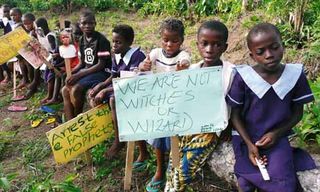
In considering sorrows like this, it doesn’t seem like such a bad thing that my father is currently classified as allergic to the world. In bleaker moments, I’d be tempted to even think of this allergy as something that recommends him, but I know he wouldn’t want me to take this view, so I look at the signs in that photograph—with all their emphatic capitals—and see that they read as proof that help can be given. In a way, this seems like its own magic, and the only magic we need to believe in.
The children holding the signs are in a protest organized by the Child Rights and Rehabilitation Network. Camped for four hours outside the Governor’s home in the state capital, Uyo, with the intent of urging him to employ the Child Rights Act (the measure was passed five years ago by the Nigerian government, making abuse illegal, but it failed to be adopted by every state), it seems that they have found success when he claims that the Act will finally be put to use. Sadly, the protestors have yet to see any religious leaders held accountable for their crimes, hospitals continue to turn away those that have been condemned, and a priest boasts of taking a hundred and ten lives through his witch-cleansing methods.
A hundred and fifty lives can be differently claimed by Sam Itauma, a Nigerian who turned his house into a children’s shelter five years ago, after encountering four children who failed to escape the stigma. With the assistance of a five person staff, he not only addresses the immediate needs of his houseguests, but often attempts reconciliation with their families. To hear him speak, one imagines that Mr. Itauma is aware of every new footstep that enters his house
“Every day, five or six children are branded as witches,” he says. “Once a child has been stigmatized as a witch, it is very difficult for someone to accept that child back.”
In one scene, Mr. Itauma is shown taking two sisters—an infant, Utibe, and a five-year-old, Utitofong—back to their mother’s village. He returns to the shelter with Utitofong.
—-
“I’ll teach you what you’ll need to know,” my father offers, and he goes on to tell me how I should speak, what I should say, how we should begin.
I ask him if it would be possible to read from a script.
“That probably wouldn’t work. You’d need to really be comfortable with what you’re saying. Like you believe it.”
And that’s the problem, and the problem remains, sulky and immovable, a disreputable blight on my ostensibly well-meaning nature.
He’s practiced hypnosis himself, long ago, first as a teenage prankster, and later as a man who’d spend years tunneling through various belief systems, before settling on convictions that I don’t share, but find impossible not to respect, given his compassionate approach to people, and his attention to injustices enacted in the name of religion. For these demonstrations alone, I owe him.
But I haven’t yet been able to give what he’s asked for, to put him in a trance and instruct his body to sign all the treaties required to cut a deal with good health. Instead, I change the subject, tell a joke, inquire about his work, and we talk about other, distant matters, those still further from our control, matters in which our only real action may be acknowledgement, even as there’s no want to believe what occurs, and no choice but to.