
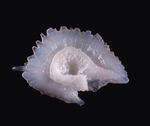
The black granite Ka’ba, the cubical structure that stands as the holiest center of Islam, features at its eastern vertex a small black stone about the size of a grapefruit, the al-hajar al-aswad, which may or may not have fallen to earth in the time of Adam and Eve. Supported in a silver frame, this obsidian-like cipher structures space for some billion Muslims, standing as it does at the culminating point known as the qibla—the direction to which devout followers of Mohammed address their five daily obeisances. Tradition has it that the rock was once snowy white, and has darkened over time through exposure to human sin. A snowy white stone that gives shape to the universe: as it happens, we all carry within our skulls the vestige of such a thing, a kind of existentially reversed qibla (this one perspectival, the other metaphysical) that gives us our sense of being at the center of things, the sense that we are upright at the origin point of a three-dimensional space. The “otolithic organs,” as they are known, are a pair of sensors—the utricle and the saccule—nestled in the labyrinthine architecture of the inner ear. Grossly speaking, each consists of a bunch of tiny pebbles (of the white rock known as calcium carbonate) embedded in a gooey wad that sits atop a carpet of delicate hairs. The saccule is roughly vertical in our heads, and the utricle more or less horizontal. Together they orient us in the world, since they work as tiny inertial references: raise your head suddenly (or get in a jerky elevator), and the pebbles of the saccule get momentarily left behind as your skull starts upward; this bends down the hairs against which those pebbles lay, and the sensitive hairs function like switches, sending signals to your brain that you register as a feeling of ascent.
more from Cabinet here.