
December 24, 2008
The Economic Crisis and Economic Power
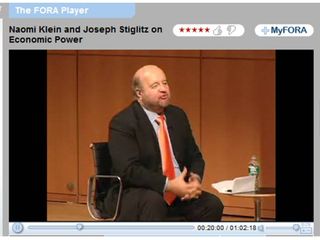
Joseph Stiglitz, Naomi Klein, and Hernando de Soto in a discussion moderated by David Harvey:
City University of New York (CUNY)
New York, NY
Oct 20th, 2008What is the role of the U.S. in the disposition of the world's economic and environmental resources? How are financial markets best defended from economic shock? Does liberalization ensure prosperity?
Journalist Naomi Klein speaks with economists Joseph Stiglitz and Hernando de Soto in a conversation moderated by David Harvey, Distinguished Professor of Anthropology at the Graduate Center - City University of New York (CUNY)
Posted by Robin Varghese at 02:12 PM | Permalink


Comments
The current financial debacle is really not a “liquidity” crisis as it is often euphemistically called. It is a crisis of overgrowth of financial assets relative to growth of real wealth—pretty much the opposite of too little liquidity. Financial assets have grown by a large multiple of the real economy—paper exchanging for paper is now 20 times greater than exchanges of paper for real commodities. It should be no surprise that the relative value of the vastly more abundant financial assets has fallen in terms of real assets. Real wealth is concrete; financial assets are abstractions—existing real wealth carries a lien on it in the amount of future debt. The value of present real wealth is no longer sufficient to serve as a lien to guarantee the exploding debt. Consequently the debt is being devalued in terms of existing wealth. No one any longer is eager to trade real present wealth for debt even at high interest rates. This is because the debt is worth much less, not because there is not enough money or credit, or because “banks are not lending to each other” as commentators often say.
Can the economy grow fast enough in real terms to redeem the massive increase in debt? In a word, no. As Frederick Soddy (1926 Nobel Laureate chemist and underground economist) pointed out long ago, “you cannot permanently pit an absurd human convention, such as the spontaneous increment of debt [compound interest] against the natural law of the spontaneous decrement of wealth [entropy]”. The population of “negative pigs” (debt) can grow without limit since it is merely a number; the population of “positive pigs” (real wealth) faces severe physical constraints. The dawning realization that Soddy’s common sense was right, even though no one publicly admits it, is what underlies the crisis. The problem is not too little liquidity, but too many negative pigs growing too fast relative to the limited number of positive pigs whose growth is constrained by their digestive tracts, their gestation period, and places to put pigpens. Also there are too many two‐legged Wall Street pigs, but that is another matter.
This basic concept, which none of the panel members want's to confront, is the issue.
One cannot expand indefinitely in a finite system. That is as superstition based as the Psychopathic Space Daddy.
Posted by: Dave Ranning | Dec 25, 2008 8:08:59 PM
Post a comment