Dear Reader, there are no algorithms at 3QD—just six human editors trying to keep a human-curated corner of the internet alive. But recent changes in Google search and other AI-driven shifts have cut our already modest advertising revenue to less than half of what it was just last year. 3QD remains mainly a labor of love, but we do need enough income to cover basic costs.
If you value what we do, please consider supporting 3QD with a contribution by clicking here. Thank you in advance!
OpenAI released GPT-3 in June of 2020, though not to the general public. Those who had access to it were variously impressed or stunned: Is this it? Is AI really coming at long last? Though I was not in the direct access circle, I had indirect access and was deeply impressed, using that access in an interview with Hollis Robbins that I published in 3QD on July 20, 2020: An Electric Conversation with Hollis Robbins on the Black Sonnet Tradition, Progress, and AI, with Guest Appearances by Marcus Christian and GPT-3. That August I issued a working paper: GPT-3: Waterloo or Rubicon? Here be Dragons. I stuck this at the top of the first page:
GPT-3 is a significant achievement.
But I fear the community that has created it may, like other communities have done before – machine translation in the mid-1960s, symbolic computing in the mid-1980s – triumphantly walk over the edge of a cliff and find itself standing proudly in mid-air.
This is not necessary and certainly not inevitable.
As far as I can tell, the AI industry is now well out over the edge of that cliff. While I see prospects for a brilliant and productive long-term future, I fear that the next decade or two will be chaotic.
Here’s how ChatGPT put it to me in a recent dialog:
The engineering success is real. LLMs [large language models] and related systems have given us access to a new conceptual continent. They work, and at extraordinary scale. But the institutional failure lies in the monoculture: too much intellectual, financial, and training-path dependence on one family of architectures and one style of thought about intelligence. The result is that we are building out the utility before we have adequately explored the space of possible successor technologies or developed the conceptual tools needed to understand what these systems are revealing about language, cognition, and cultural structure.
The paradox we are facing, then, is that the unexpected and extravagant success of the transformer technology has resulted in a furious maelstrom of entrepreneurial, investment, and commercial activity that may inhibit the further development of that technology. Read more »
Tony Trischka in Residence: NY Banjo Night, at Symphony Space, New York City, March 12, 2026.
For several centuries, as we moved from farm to city, the human ear has engaged in a ceaseless battle against the noise caused by human ingenuity.
The ears are losing. It is loud out there, even in my bucolic and serene New York City. Just getting around can be sonically disruptive. Trucks, especially the multi-axel ones that go through 10 forward gears while they bang-bang-bang over winter-roughed asphalt. Buses, whether newer ones with their air brakes, pneumatic doors, and kneels, or the older version tricked out with diesel engines that sound like an aging warthog with catarrh. Cars—the ones driven by those whose keen sense of anticipation allows them to lean on their horns before the light turns green or who have retrofitted their sound or exhaust system to resemble either a mobile disco or a shooting gallery (and sometimes both).
Want to see New Yorkers come together? Place on the ballot a referendum mandating three days in the stocks for the worst of the worst. Second offenders must limit themselves to Smart Cars with dealer-installed elevator music.
What about our glorious Central Park? Surely, it’s largely carless (except for the odd official vehicle or ambulance)? Yes, it is a place where my running buddies and I can thock-thock, scrape-scrape, wheeze-wheeze to our ears’ delight, but that doesn’t make it intrusion free. Not only does it harbor lurking delivery guys in spacesuits and oven mitts, but it’s also home to high-speed pelotons shouting out the occasional “ON YOUR RIGHT!!!” Those guys flashing the upscale gear and first-class lungpower don’t have a lot of patience for the hapless pedestrian or runner in or out of his designated lane.
OK, that’s way too much complaining about a place that gives me so much satisfaction. The fact is we need quiet, and we need sound. Most of all, we need to communicate. It’s a human thing to do. It also may be a Neanderthalic thing to do. According to the all-knowing AI, musical instruments like the flute have been around for at least 40,000 to 50,000 years.
What’s the perfect “pH” for sound and silence? Surely, it’s based on the idiosyncratic needs of both the person and the community.
The play (and movie) Children of a Lesser God gets at this. Read more »
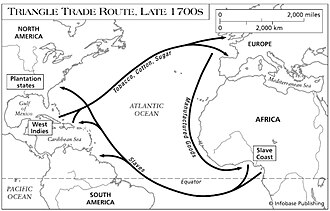
I met Paul Gilroy at a conference on racial identity at Yale in the early 1990s. I was finishing my training and eager for new ideas. He was soft-spoken and thoughtful, but his presentation was quietly electrifying. He seemed to be rethinking race, culture, and identity in a radically creative way. The presentation distilled many ideas he would soon publish in The Black Atlantic: Modernity and Double Consciousness, a book that has influenced the field for more than thirty years. A key argument is that, over centuries of the Atlantic slave trade and beyond, a transnational culture has emerged that isn’t solely African, American, Caribbean, or British, but a blend of all these. It arose from the history of slavery and colonialism, but what holds it together isn’t its shared history or ongoing oppression. Gilroy argues that this common culture, which he calls the Black Atlantic, is maintained through the continuous movement of people, ideas, and creative works across the ocean. Its fluidity, hybridity, art, music, and literature are its defining features.
As I revisited Gilroy’s ideas over the years, they grew more impressive in their explanatory and predictive power. The Black Atlantic feels more alive and enduring than many nations, cultures, and institutions. Yet the question remains: how did it attain that durability, and how did art and music play such a central role in its flourishing?
Living in multiple subjectivities would seem bound to produce conflict and fragmentation. The Black Atlantic is nothing if not a plurality. In collectives such as nations and cultures, the multiplicity of subjectivities would seem to put them at constant risk of coming apart. W.E.B. Du Bois introduced the concept of double consciousness to capture this tension. Gilroy embraced double consciousness and hybridity as constitutive features of the Black Atlantic, not as problems to be overcome but as sources of its vitality. What kind of psychology could make this possible? What enables hybrid identities to flourish rather than fragment?
The idea of intersubjectivity, a shared world constituted by mutual recognition, may provide an explanation. Read more »
Zurich’s electorate went to the polls earlier this month on an Abstimmungstag, or “voting day”, to choose its new city parliament, the Gemeinderat; its new city council, the Stadtrat; and its new mayor, known in Zurich as the Stadtpräsident*in, or Stapi. The Gemeinderat, with 125 seats, is the largest municipal legislature in Switzerland, since Zurich is the country’s largest city; the Stadtrat, made up of nine members, each the head of a Departement or ministry, is Zurich’s government; and the Stapi, who is also a member of the Stadtrat, presides over meetings of the council, manages the city’s administration, and represents Zurich in the Swiss capital, and internationally.
The voters this month returned a Stadtrat with a composition much like that of the outgoing, already left-leaning executive, in which Zurich’s main parties were represented roughly in proportion to their citywide share of support, now however with a slight further shift to the political left. Of the nine newly elected (or re-elected) members, four belong to the Socialist Party (SP), three to the Greens, who are traditionally allies of the SP, one to the Green Liberal Party (GLP), representatives of a more business-oriented ecological movement, and one to the Free Democratic Party (FDP), the center-right party that usually views itself as the generator of Switzerland’s “natural” leaders, having formed governments at the national level from the Confederation’s earliest days. Zurich’s leftward shift this cycle came with one of the two seats on the city council held by the FDP in the previous period being won by the Greens, who had brought in a candidate with name recognition and considerable experience in Bern explicitly to “attack” that FDP seat. The Bürgerliche or center-right parties—the FDP and GLP—have thus now had their minority in Zurich’s government further eroded, from three to two seats out of nine.
The Gemeinderat also saw an increase in seats for parties on the left of the spectrum, with the SP the big winner in virtually all city districts, and the SVP, Switzerland’s reactionary right-wingers and the country’s most popular party, remaining very much in the minority at the Zurich city level.
As for the Stapi, Raphael Golta, the SP candidate, was comfortably elected to the Stadtrat as an incumbent (he had headed the Sozialdepartement during the previous legislature) but faces a runoff election for mayor in May, having failed to achieve the required absolute majority in the mayoral race. But unless another member of the Stadtrat chooses to run against him—an unlikely scenario—Golta’s election as Stapi, and the maintenance of the mayor’s office in SP hands, is all but certain Read more »
“Failure is the foundation of success, and the means by which it is achieved,” says the Tao Te Ching. The current competition between our two parties to gerrymander the country—Texas, California, Virginia, Florida—is a stunning failure for democracy reform efforts. Gerrymandering transfers power from the people to the parties, and Americans hate it. By the time this year’s mid-term elections are over, huge numbers of us will have representatives who, we feel, don’t represent us and won unfairly. Many of us will live in states without a single official in Congress from our own party. Nevertheless, we all support this district grab, because we can’t let the other party seize power by gerrymandering more districts than we do. Where are the means to success in failure this big?
Spilt Milk
No one is feeling more defeated than the good-government activists who have worked so long to end gerrymandering and make our elections more fair. The need to respond to extreme gerrymanders has forced them to support the torching of their own work. They are “backpedaling furiously,” as one such activist bluntly puts it: “Decades of reformer work is going up in smoke.” Renewing forward movement will require understanding what happened. Alarmingly, there are signs that the reform community will learn nothing, that it will interpret this defeat as an aberration rather than a refutation of its past work and will return stubbornly to its failed strategy. A different response to failure, though, could build a foundation for success.
What the reform community appears to be overlooking is the golden opportunity this ugly war to gerrymander everything actually presents. It is the opportunity not only to formulate a better strategy, but also to use the power of public anger to solve the problem of creating fair districts once and for all. Redistricting has been mostly a wonkish, back-burner issue, briefly irritating to the public from time to time, but never before commanding the intensity of concern it does now. Right now—with huge amounts of money, political power, and public outrage all focused on gerrymandering—now is when reform can succeed. Read more »
A neighbor I ran into out walking his dog in our Brooklyn neighborhood asked me about my recent trip to Chile and relayed his own experience there. He loved the skiing, the landscapes, the wine, but he could not abide the stray dogs.
Hazel photobombing two neighbors out celebrating Bangla New Year.
But stray dogs, more than anything, had brought me to summertime-Chile this January towards the end of the first year of Trump’s second term. Hazel, my wife Angela’s and my large yellow mutt, had died a terrible death a few months before, and, in my mourning, I was besotted by dogs. And similar to shorter humans who are only attracted to much taller humans, I am a smaller man with a taste for larger beasts. The dogs of neighbors and friends, the dogs on the Internet, were just not enough. In Chile, I knew dogs would be everywhere, big ones.
I visted three places: Puerto Montt, a rugged medium sized city in the south, looking out on the Reloncavi Sound, which connects to the Pacific, Castro, a smaller city on Chiloe, the large island off the southern coast, then San Pedro de Atacama, a tourist town in the desert far in the north.
Dogs in Chile straddle a line between housed and unhoused. I don’t know their real stories, and I romanticize what I observe. They appear healthy, friendly, cared for on some level, but free to do as they please, providing glimpses of true dog nature that we don’t get with fully domesticated canines. Fifteen years ago, I watched a pack of them chase madly after passing vehicles on a desolate boulevard in Punta Arenas in Patagonia. Dogs strolled and slept just about everywhere around Villarica in the Lake District when I visited just before the pandemic. Read more »
In one of my first columns for 3 Quarks Daily, I began by noting that my law firm had just filed, along with other firms, a petition for habeas corpus relief in federal court in Dallas. Our client was Leqaa Kordia, a Palestinian woman living in New Jersey, who was imprisoned in a detention center in Alvarado, 40 miles away. Last week, almost exactly one year after she was detained, Ms. Kordia was freed. We are, of course, relieved and beyond happy that she has been released from detention. But her case was an utterly grotesque abuse of the American immigration justice system.
Leqaa grew up in the West Bank. Her parents divorced when she was young and her mother moved to Gaza, and eventually to the United States where she remarried and had other children. In 2016 Leqaa joined her mother in New Jersey, obtained a student visa, attended classes and worked as a waitress and at other jobs. At home, she took care of her mother, who is severely asthmatic, and her autistic half-brother.
Her mother, who is a U.S. citizen, filed a “family-based” petition for Leqaa to begin the process of obtaining permanent residency. This petition was approved, but this also created a tripwire that ultimately seriously disadvantaged her: a teacher told her, mistakenly, that with the family-based process underway, she did not need to maintain her student-visa status.
On October 7, 2023, Hamas attacked Israel from Gaza, killing approximately 1200 people, mostly civilians, and taking 250 hostages. Israel responded with unrestrained fury, bombing Gaza into ruins for two years and destroying the basic infrastructure of life there. Nearly 30 months into the war, conservative estimates are that at least 75,000 deaths have occurred in Gaza. The Israeli army itself has accepted a figure of 70,000 deaths. These numbers may well be undercounts, but even if they aren’t, they indicate that for every single Israeli killed by Hamas on or after October 7, 2023 (including hostages who were later killed or who died in captivity), nearly 50 Gazans have died.
Among those tens of thousands of victims are close to 200 of Leqaa’s extended family. Read more »
In his Confessions, Augustine remembers his state after the death of a beloved childhood friend. He writes: “Everywhere I looked I saw death. […] My eyes sought him everywhere, and did not see him. I hated all places because he was not in them.” An unfailingly moving passage, and a testament to Augustine’s power as a thinker – for profound as his account of his loss is, we are already being led along for a much bigger point. Almost immediately, Augustine moves on to chastise his former self: “fool that I was then, enduring with so much rebellion the lot of every man”. A soul that tethers itself to mortal things, rather than lifting itself up to God, will naturally be bloodied when it inevitably loses them.
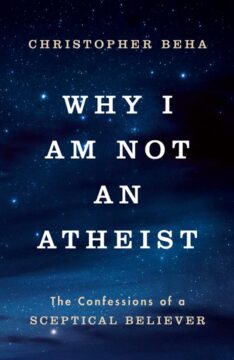
I was brought back to these passages by the parallels with Christopher Beha’s account in Why I am not an atheist (2026). Beha is modest enough to suggest less exalted models, but of course he is aware of the echo of Augustine. It’s not just that this is another account of an intellectual who returns to the Catholic faith. Beha also shares with the Church father the admirable skill of rendering now-abandoned perspectives with a language that makes their original pull understandable. Here he looks back on his thoughts after nearly losing a friend:
“I still had so much to lose, and I would eventually lose all of it. Everyone I loved would be taken from me, unless I was taken from them first.”
Like Augustine, Beha finds powerful and honest words for a state of mind he used to inhabit, but makes sure these words contain the seeds of self-criticism too. At this point in the narrative, Beha’s meditations on suffering and death push him away from religion; after a book-long journey through godless alternatives, however, he will find a less self-absorbed form of love, one presumably more resilient to the thoughts that dislodged him from his faith. Read more »
I’m peeling back a page reading a new day by the light of a new sun.
Mom died years ago, or was it yesterday?
I once read something similar by Camus but was too new to understand that time bleeds, its dyes are not fast but run between years and sometimes as in old cloth the colors of time become homogeneous,
……but here’s this day blaring like a fanfare ……from a new horn crisp as frost on glass ……its brink sharp as the edge of a blade ……slicing off another piece of eternity
by Jim Culleny 4/29/12 from Odder Still Leana’s Basement Press, 2015
Enjoying the content on 3QD? Help keep us going by donating now.
Champions Calvin Atkin, Griffin Bennett-Nguyen, Bernardo Jimenez, Victoria Phinizy, and Alanna Lopez. The 2026 APPE International Ethics Bowl® Winners!
Having previously discussed Ethics Bowl here, I can’t resist bragging just a little, tiny bit.
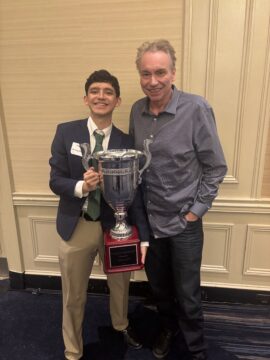
On Sunday, May 8 in St. Louis, Missouri the Ethics Bowl team from William & Mary – our team! – became the 2026 APPE International Ethics Bowl® Champions. The crew on the stage, led by Team Founder/Coach Bernardo Jimez, won the trophy with the support of the whole William and Mary team. For discussion, research and analysis, participation in other Bowls, and practice, practice, practice, the team also includes Teddy Friesz, Chaewon Kang, Nicholas Leonard, Lydia Kipp, Sheoli Lele, Dani Munrayos, Ben Schatz, and Harper Willim. Oh. And me. The humble Faculty Advisor/Coach.
Bernardo and me.
Ethics Bowl focuses on a small number of sensitive, controversial, and challenging cases of applied ethics with new cases coming out every semester. The Championship Bowl featured fifteen cases including, what to do about a hypothetical billionaire experimenting with geoengineering to mitigate global climate change without cooperating with any nation or group? Can medical professionals who refuse to be vaccinated or give vaccinations be justifiably limited in completing clinical rotations or securing a residency? How are our views of consent and intimacy perniciously influenced by reality television? Is it immoral to idolize so Luigi Mangione, the man who shot the CEO of UnitedHealthcare?
It interesting to watch such a diverse and intelligent and motivated group of people – not just my team, all the teams – focus so single-mindedly on a relatively small set of ethical questions. It taught me a few lessons over the last few years – or at least raised some issues I am still ruminating over. Here are three. Read more »
Something about Hamlet makes us want to love him, some mysterious quality of his being. I was maybe 15 or 16 when I first met the Prince and sitting next to Boots Schneider at the Olivier movie which had just opened in New York. Yet Hamlet held my attention even more than her hand because somehow he was saying things I had always wanted to say, but not only did I not know how to say them, up to that moment I didn’t know I wanted to say them. What I wanted to say had something to do with authority, something to do with those large figures who hold in their hands the powers of the world, something to do with the joy of saying to Polonius “Excellent well, you are a fishmonger,” and some kind of recognition of Hamlet’s deep sense of betrayal. This is the Prince’s dominant emotion, the feeling that lacerates his being, and his perception of the world is accurate; he has been betrayed.
There are the human betrayals: his uncle usurps his throne; his mother marries with that uncle so fast, so fast; his girl withdraws her presence; his young friends come and, for a moment, he looks to them for comfort, but it is soon clear that he is their stepping stone to royal favor. He is betrayed by the old as well, by what they have learned to call wisdom and how they are satisfied with it – for surely it is true that for the first part of the play Hamlet’s real opposite is Polonius. What is more opposite to the philosopher than the philosophizer?
There are the non-human betrayers. As he is betrayed by Wisdom, he is betrayed by Vocation. He is called to be a king and yet he is not king. He is betrayed by Death who has carried his father away (and by his father who has allowed death to carry him off – for is that not one of the great betrayals? Our parents die and leave nothing, no barrier, no guard for us between this world and the next). And as fearful as this is, when his father returns, there is a worse betrayal, for his father wants revenge, and what worse thing can a parent do to a child than to make that child live out or finish up the parent’s destiny and not urge the child to find his own own? Revenge would be the completion of the older Hamlet’s life, not the growth of a life out of the seeds of the young man’s own being. Some too have suggested that Hamlet is betrayed by his own five wits. Read more »
There are many things about who we are that we take for granted yet can still find mysterious. Why do we sleep? Why do we dream? Why do we sing and dance? Why do we laugh? Another, perhaps, is why do we get angry at inanimate objects? You might pinch your finger on a closing door and pound the door in payback. Your car won’t start in the morning and you slap the steering wheel. Your laptop crashes and you swear at it.
We all know better. Doors don’t act on their own. Cars don’t have minds. Laptops don’t have feelings. Yet we still behave, at least in the moment, as if they do. The Stoic philosopher Seneca in his essay “On Anger,” written two thousand years ago, observed how irrational it is to get angry at inanimate objects. He commented we can be angry at “inanimate things, such as the manuscript which we often hurl from us because it is written in too small script or tear up because it is full of mistakes, or the article of clothing which we pull to pieces because we do not like them.” He went on: “But how foolish it is to get angry at these things, which neither deserve our wrath nor feel it! . . . it is the act of a madman to get angry at things without life …” (Trans. John W. Basose; Loeb Classical Library.)
Even Jesus is not spared from this apparent madness. One morning Jesus was hungry and “he saw a fig tree in the way, he came to it, and found nothing thereon, but leaves only, and said unto it, Let no fruit grow on thee henceforward ever, And presently the fig tree withered away.” (KJ V Matthew 21:18-19.) Yes, even Jesus could get “hangry,” and getting angry at a tree makes no more sense than getting mad at a rock. (Maybe for that reason some take the story as an allegory about the spiritual barrenness of the times.)
Stoics had a term for immediate, involuntary, automatic reactions, such as blushing, or yelping when jostled: “propatheia,” which roughly means “pre-emotion.” These reactions are treated as essentially forgivable human physiological and psychological reactions of the moment. Immediately hitting back at a door that pinched your finger might fall in this category. But according to Stoics letting such a reaction grow into sustained anger means surrendering to unnecessary and unhelpful passion. And to allow the reaction to blossom into full-fledged destructive acts like tearing up manuscripts or clothes, as Seneca suggested, is irrational and unacceptable.
Nevertheless, there is a long history of taking formal and deliberative actions against objects where the concept of “propatheia” seems not to apply. Read more »
Evil also resides in the innocent gaze itself which perceives Evil all around. —Hegel. [1]
I have always been vaguely irritated by the song ‘Mad World’, by the duo Tears for Fears, without being clear just what I find so unbearable about it. You may not know the song: it was a hit back in 1982, and although it has been covered since, most notably in the soundtrack of Donnie Darko, (2001), it’s hardly current. It is, though, a good example of what Hegel called the ‘Beautiful Soul’ phenomenon in his Phenomenology of Spirit (1807). Bear with me: the song itself doesn’t matter as much as the attitude, which is one you will find everywhere today. There’s a link to the lyrics below [2].
In “Mad World” a social world is experienced as repetitive, hollow, and emotionally alienating. Everyday routines appear emptied of meaning, and social interaction is depicted as mechanical rather than genuinely human. The song’s voice is lucid, reflective, and sensitive. The song, aided by its plangent melody, sold in the millions. Why? We get, and the listener is invited to inhabit, this outlook: the world is drab, crazy, empty. But I, sensitive me, am sadly aware of it all, as I stand there witnessing the melancholy human carnival. This is the stance of the beautiful soul: a consciousness that sees the world’s disorder clearly while refusing engagement with it. It is the world as seen by someone stuck in an adolescent stage of moral development.
The Beautiful Soul has intense concern for moral purity and inward sincerity. It wishes to preserve the goodness of its intentions while avoiding the risks of action. For action involves particularity, compromise, and the possibility of failure; to expose oneself to judgment and misrecognition. So, the beautiful soul recoils from the world, judging it from a position of moral inwardness while refusing to participate. It’s a recognisable stance in contemporary culture, one that is self-pleasuring in its sense of warm melancholic impotence. It does not merely express alienation; it aestheticises the ethical impasse Hegel diagnoses.
Rather than calling for revolt or collective transformation, the song dwells in sadness and resignation. A reflective suffering. The subject knows that something is wrong and stops there, demanding purity from the world and thereby ensuring its own impotence. Read more »
There’s a certain problem with the status of the word “criticism” in the phrase “literary criticism.” The critical part seems to be concerned, as criticism is in general, with separating the wheat from the chaff, but the literary part seems already to have made a judgement about quality – as long as we take term “literary” to be evaluative and not referring to a particular genre, distinct from the many forms of popular, commercial fiction. There is a curious void between judgement and analysis in literary studies; in one sense, you are working with a set of texts that have “survived,” that have survived a crucial filter of judgement to become worthy of intense study. Even if literary critical methods can be fruitfully applied to “forgotten works” or even non-literary cultural artifacts, this is an elevating of the object’s status; we don’t do the work of digging out a novel from some hidden corner of the 19th century just to pronounce, finally, that it’s worthless. Literary criticism has thus evolved into thinking of itself as something like an empirical study, which observes but is expected, like polite patrons of a theater, not to judge, at least not too loudly.
In my years as a student of literary studies, I don’t think I encountered – from my professors, at any rate – much literary criticism which was devoted to the evaluative enterprise. If a work of secondary quality was to be discussed, it was under the assumption that it had something of value to say, faults and all. I don’t think much has changed in this regard. Perhaps, as we struggle to define a place for literary study in universities being run like intellectual private equity funds, we ought to reconsider this approach. When evaluation is occurring, it usually happens on the basis of some political failing, some inconsistency with modern moral standards in the object work. I’m talking about something much more basic: students, quite simply, are not being told they have permission to say “this sucks” on a strictly aesthetic basis. This is a shame, because there is both value and a kind of joy in not only declaring that something sucks, but also in carefully teasing out exactly why it sucks. Read more »
Dear Reader, there are no algorithms at 3QD—just six human editors trying to keep a human-curated corner of the internet alive. But recent changes in Google search and other AI-driven shifts have cut our already modest advertising revenue to less than half of what it was just last year. 3QD remains mainly a labor of love, but we do need enough income to cover basic costs.
If you value what we do, please consider supporting 3QD with a contribution by clicking here. Thank you in advance!
I’ve been under the weather for about three weeks now: not so incapacitated as to make watching bad TV the only respite, but not quite well either. A persistent, on-off sniffleupagal achiness. The CDC says respiratory illness rates in Iowa right now are Very High, the highest it’s been in years, and I was relieved to hear I was not imagining my woes. Anecdotally, I know something has been going around (many of my friends and 1/3 of my singing a.k.a. breathing in each others’ faces group was sick last week). But some part of me still thinks perhaps I am making up my own symptoms, afraid that my physical lackadaisicality is just moral lassitude, an excuse for avoiding my book and other productivities.
I have written before about how my best friend and I luxuriate in those times when we feel totally “off the hook” from the things we feel so much pressure to accomplish: times of sickness and travel, when you are socially privileged to find respite in creature comforts. But to be only mildly malaised is to be in purgatory, and I feel anew for those with chronic illness and fatigue—to be not just under the weather but under the climate. Esme Wang famously offers a course on writing with limitations—the Unexpected Shape Academy—which includes tips for bursts of writing on the phone or notecards or from bed, rather than long laptop sessions. I wrote this column mostly via texts to myself, and now I sound rather virtuous, but I assure you I do not feel that way.
The other night, in a limbo state of foggy brain, I was lolling about the house in the presence of someone who I admired as Very Efficient. He had been home-schooled and unlike other home-schooled kids who wasted their time without official structure, he finished his schoolwork and then read several extra books a day. Before we started dating, he went to the library’s private closet-sized study rooms on weekends to do college physics problems without interruption for 10 hours straight (he does not study or work in anything relevant to physics). That night, he was reading a thick book about the Cold War, after having already read a thinner book on it. He felt like a laser, and I felt like a lump.
And I noticed how I wanted to have him be gone, so I could be an unperceived potato by myself, which is what I like about living alone. Read more »


 OpenAI released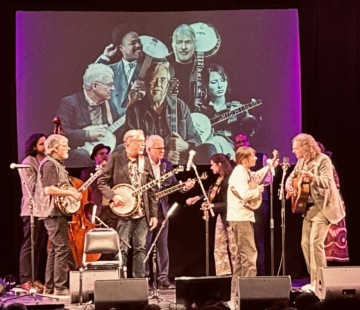




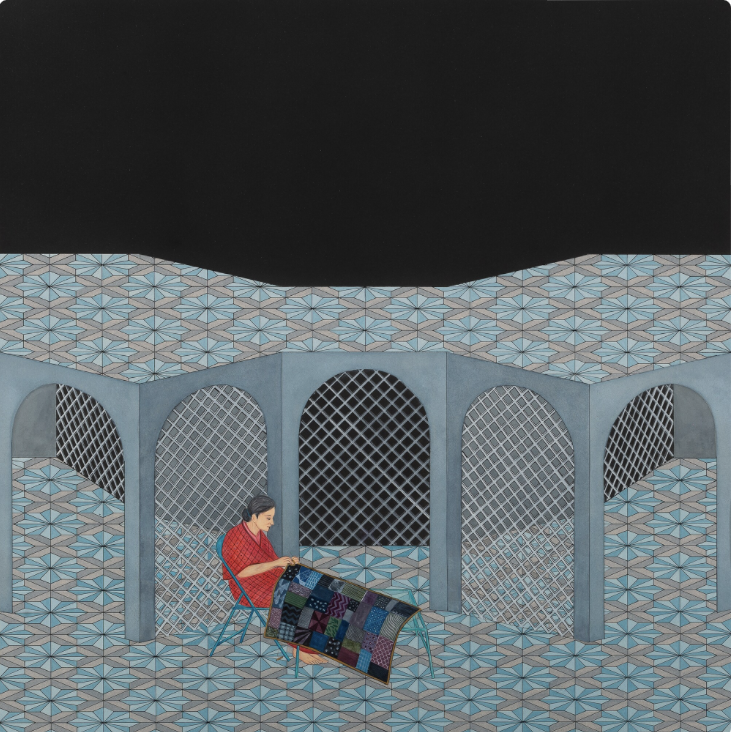 Utkarsh Makwana. Detail from ‘Finishing Touches’, 2022. Courtesy: Akara Art.
 In his Confessions, Augustine remembers his state after the death of a beloved childhood friend. He writes: “Everywhere I looked I saw death. […] My eyes sought him everywhere, and did not see him. I hated all places because he was not in them.” An unfailingly moving passage, and a testament to Augustine’s power as a thinker – for profound as his account of his loss is, we are already being led along for a much bigger point. Almost immediately, Augustine moves on to chastise his former self: “fool that I was then, enduring with so much rebellion the lot of every man”. A soul that tethers itself to mortal things, rather than lifting itself up to God, will naturally be bloodied when it inevitably loses them.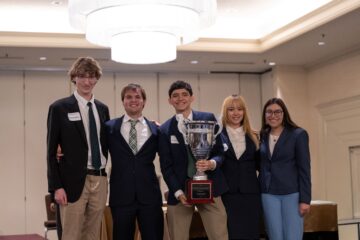
 Something about Hamlet makes us want to love him, some mysterious quality of his being. I was maybe 15 or 16 when I first met the Prince and sitting next to Boots Schneider at the Olivier movie which had just opened in New York. Yet Hamlet held my attention even more than her hand because somehow he was saying things I had always wanted to say, but not only did I not know how to say them, up to that moment I didn’t know I wanted to say them. What I wanted to say had something to do with authority, something to do with those large figures who hold in their hands the powers of the world, something to do with the joy of saying to Polonius “Excellent well, you are a fishmonger,” and some kind of recognition of Hamlet’s deep sense of betrayal. This is the Prince’s dominant emotion, the feeling that lacerates his being, and his perception of the world is accurate; he has been betrayed.