
Temporary 3QD test post. We are checking the Instagram title card used when an original Magazine essay has no article image. The top graphic is a reusable 3QD design and the article title should appear in the ivory panel below it. This post is only a publishing test and will be removed after the result is checked. No reader action is needed.
The Eye Moves
by TJ Price
Thursday afternoon—though it was early evening, already a septembric dusk—I found myself in a used bookstore somewhere distant from my normal routine and habit. The occasion was a doctor’s appointment, and the office was about an hour’s drive away—a specialist, who I prefer to see in person. Thankfully, the temperature had cooled from the suffocating heat of the prior week, and venturing out of doors was not as Herculean as it had been. In fact, I was actually looking forward to my little sojourn; felt it would be a welcome shake-up. My routine of late had grown stale, felt like it was collecting around me in great sheaves of cast-off dead matter. Skin cells. Dust. This, mostly due to the quasi-hermetic sealing of the apartment so that the air conditioning can keep it livable. The windows are firmly shut, locks turned, the plastic and glass probably bulging in its frames. All that is within cycles endlessly, dragged up and around, scudding across the ceiling, and then is released, hovering for a time in mid-air before then descending anew. But one morning you wake up, and the angle of the sun outside the window is slightly different—noticeably so, as if there has been a sudden, violent change overnight, and now it sags slightly in the sky where it rises. It is enough to now snag on some of the glass objects on my windowsill, and flare a little brighter through their lenses a little earlier in the morning. I worry about the intense, pure spot of light that is projected onto the wall opposite, and for a moment I convince myself I see a little curl of smoke rising from its center. There’s something different about the quality of the light, too, and then of course there’s that classic something in the air—the first crispness, the intimation of a shift. We are maybe the only ones who can articulate how that feels with language; animals certainly sense it, but to them it is as natural-feeling as blood or danger or sleep. But we wonder at it! We attempt to cloak the feeling in words, to enrobe it with our perception. What it means. A confusion of competing instincts: cold on the rise. Winter soon. The urge to gather, harvest, bring inside. It will begin, sure, as excitement, anticipation. The first crystalline curls of frosted breath, the first delicate dance of flakes in the air. But there is something else there, too. A quickening amongst all the gladdening, the minute stumble in the waltz of the heart. A bit of hurry enters the world. Alarm and alert. Of course, there’s also commodified solace in the presence of pumpkin spice and apple pie and warm and goo; there’s the holidays to consider, the shopping and the shipping and the travel and the headaches of End-of-Year hassle, all to throttle down toward New Year’s Day and another resolution, maybe, if we’re lucky, a revelation. There’s alarm there too: what have I done with this year? What has it done with me? And that’s really the question: how has this year manhandled us, tossed us around like rag-dolls, all (of course) against our protestations. Won’t be sad to see the back of this one, we’ll say ruefully. Something I think I hear a lot more frequently these days. Maybe something to do with getting older. Maybe something to do with the way the world is trending. We survived, goes another cynical New Year’s refrain, and the hands on the Doomsday Clock tick another hemi-demi-semi-second—or whatever quixotic increment they’ve decided to use now—to stave off the inevitable titular catastrophe. Read more »
The Truth Is Out There: The Crop Circle Controversy
by Carol A Westbrook
This is the first time I’ve ever re-posted a 3 Quarks Daily article. I was led to re-examine the idea of visits by Aliens—particularly in the UFO phenomen—by two incidents. One was the announcement on May 8 of this year to release new, never-before seen files on unidentified anomalous phenomena (UAP) as part of the Presidential Unsealing and Reporting System for UAP Encounters (PURSUE). This footage is being released on a rolling basis and is available to view on War.Gov/UFO. The other is the upcoming release of a new Steven Spielberg film about UFOs called “Disclosure Day.” The film is fiction, but contains references to a lot of what we believe to be true about UFOs, aliens, abduction and crop circles, most of which has come from Mr. Spielberg’s imagination: E.T. The Extraterrestrial and Close Encounters of the Third Kind. Between these two forces, PURSUE and Spielberg, I wonder how much truth will actually be revealed.
I have updated this article, which was originally posted in September 2017. It described our experience touring Wiltshire, England in 1994 searching for Crop Circles. These beautiful and symmetric circles in ripe fields were originally thought to be communications from aliens, or landing sites of UFO’s, and they began to appear during the 1990’s obsession with aliens. My husband Rick and I wanted to see these other-worldly apparitions for ourselves; the thrill of touching something that was touched by alien beings was unbelievable. And perhaps we’d see a UFO nearby, too.
1994 was the height of the alien frenzy. There were bestseller books, magazines, and TV shows about crop circles, flying saucers and alien abductions. A 1990 Gallup believed we had alien visitors. The highly popular “X-Files” weekly show had a large viewership who tuned in every Sunday evening to watch Special Agents Scully and Mulder investigate paranormal phenomenon, focusing on alien abductions; their slogan was “the truth is out there.” Sensational alien stories swept the nation in these pre-social media days, as people relied on news media and best-seller books for their information. And there were plenty of books and TV specials to stoke your imagination. Read more »
What Makes a City (A Short Trip to Venice)
by Anton Cebalo
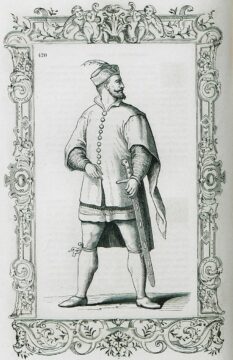
I recently came back from a trip through a few cities along the Adriatic Sea after visiting my extended family. My reason for traveling was mostly to alleviate my own stuckness, and what better way than by movement with no specific plans in particular.
My short journey started in Split, Croatia, continuing on the Adriatic Highway constructed during the time of Yugoslavia. We passed along the coastline protected by the Velebit mountains, a passageway mostly barren due to the harsh bora winds which prevented most vegetation, but nonetheless still beautiful. As we cut through sharp, narrow roads and blind turns that felt as though we would tumble down into the sea, enough to make anyone a little nauseous, the islands in view were pure white stone, made alien by those same bora winds. The topography resembled the moon’s surface.
During the eight-hour ride, we went through villages that were at one time under the Venetian Empire. Only geography ensured they were not back then occupied by the competing Ottoman or Austro-Hungarian empires who were not many kilometers away in the interior.
Some regions are so determined by the realities of the land that it decides the trajectory of their whole history. This is one of those regions. The impenetrable mountains hugging the coast meant that there were only a set number of gateways allowing people to go inland. These were like portals between one imperial world to another, once heavily guarded as places of commerce and even as a way to escape. The settlement of Senj was one such guardian—the home of the ruthless guerrilla soldiers, the “Uskoks” or “the ones who ambush”—and we passed through their city on our route. Read more »
Friday, September 25, 2026
Old Black Joe
by Steve Szilagyi
Here’s a song you don’t hear much anymore. Old Black Joe. It used to be really popular.
I mean, really popular. Around 100 years ago, Old Black Joe showed up in more songbooks than anything but Star-Spangled Banner. Singers and choirs of all colors warbled it worldwide.
If you simmer down and give it a listen, you’ll know why. The melody is powerful. The lyrics address universal themes of death, home and longing. Sung by the right singer, it can raise the spirit and wring the heart. But as good as it is, Old Black Joe is now “in de cold, cold ground”.
And it would be stupidly ingenuous to ask, Gee, why?
Old Black Joe was written by young, white Stephen Foster and published in 1860.
Foster was a middle-class kid from the Pittsburgh area. His great hope was to write sentimental ballads on the order of those made popular by Irish folk melodist Thomas Moore. But after taking a shot at those (his first published song Open Thy Lattice Love, flopped) he got caught up in the entertainment craze of his generation: the minstrel show.
Minstrelsy was the most outrageous cultural concoction ever cooked up by America’s drunken, sinful, 19th century soul. The formula: blackface, bad jokes and rousing songs. When it came to supplying the latter, Stephen Foster was king. Read more »
Three Takeaways, Number Two: We’ve Screwed The Pooch, Apparently
by Mike Bendzela
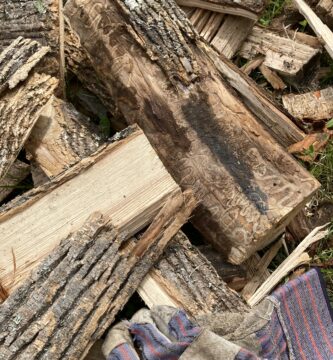
From preface of Number One last month: Anytime is a good time to take stock of what you think you know, or what you think you have actually learned, but once you have seen two-thirds to three-quarters of your life pass, it would seem rather high time to do so. For all I know, the full measure has actually passed, as I could drop dead tomorrow while digging a grave at my summer job, so I had better hurry with this. [. . .] What would I say if, launched into the firmament and finding myself at Heaven’s Gate, St. Peter said to me, “What have you learned, sinner?” So, a few things I think I actually do know, in descending order of certitude, over the course of three articles: evolution, overshoot, determinism.
The human species likely exists in a state of ecological overshoot. The question is, how much longer can we exist in such a state? Can we prop up our behemoth of an existence for much longer?
That “apparently” in the title has to do a lot of work: I cannot actually say that I know this is true, the way I can say that evolution is true, but it sure looks that way to me (and I must thank sociologist William Catton and human ecologist Bill Rees for their work and insight).
In some ways the two ideas pull in opposite directions. The certainty of evolution is apparent in the abundance of Earth’s archives of evidence, which consists of traces of evolution’s past meanderings over a billion years, sussed out through 200 years or so of hard scientific labor. Overshoot, on the other hand, is about the weight of the present human “ecological footprint” and its bearing on an uncertain future. But they both have in common the idea of the inevitability of mass die-0ffs.
Is it possible for an issue or problem to be so large as to be invisible? I’ve already expressed how evolution by natural selection lay unseen all throughout human history until about 170 years ago, even though it is responsible for all life on the planet. Darwin states succinctly that it is the “laws existing around us” that have brought forth, well, everything. But we were blind to this for two chief reasons:
The mind cannot possibly grasp the full meaning of the term of even a million years; it cannot add up and perceive the full effects of many slight variations, accumulated during an almost infinite number of generations.
We will tend to notice the immediate effects of a condition even while being blind to it as the ultimate cause. A patient experiences chronic numbness in the legs and goes into treatment for neuropathy. Later, the patient experiences loss of vision and seeks treatment for retinopathy. There was a time when the chief cause of these signs, Type 1 diabetes, was unknown. The patient had been treating symptoms all along, not the disease.
Currently, we are obsessed with “solving” a plethora of “problems”: climate change, ocean acidification, soil erosion and loss of arable land, PFAS and microplastics contamination, resource depletion, etcetera. But these are mere symptoms of a larger, untreated disease. Read more »
Trust After Trump. What Comes Next?
by Bill Murray
 The world of unquestioned American leadership is gone, and the next American president cannot restore the trust of America’s allies. Donald Trump’s critics have spent a decade condemning his unforced squandering of American influence as needless, senseless and lots of other things besides. It’s time to come to grips, move past complaining and get to work building what comes next.
The world of ten years ago isn’t coming back, and what comes next won’t depend on trust. Been there, tried that, found that system’s limits. The challenge is to assemble a new, networked alliance based on shared capabilities, that ensures continuity across American administrations. Let’s figure out how.
“America is back. America is back. Diplomacy is back at the center of our foreign policy.” —President Joseph R. Biden, Jr.
“America’s alliances are our greatest asset, and leading with diplomacy means standing shoulder-to-shoulder with our allies and key partners once again.” —President Joseph R. Biden, Jr.
The 46th president delivered these assurances in his first major foreign-policy address, just twelve days after his inauguration. Because they were precisely the words allies wanted to hear, they went some way toward restoring confidence.
However mollifying their effect at the time, after two Trump presidencies, words like those—any words, really—don’t fly anymore. America will have to rebuild allied trust through commitments durable enough to survive future political instability at home. Now, pledges of commitment will need to be demonstrably binding. Read more »
Thursday, September 24, 2026
The Human Animal: Not that Weak and Not that Smart
by Thomas Fernandes
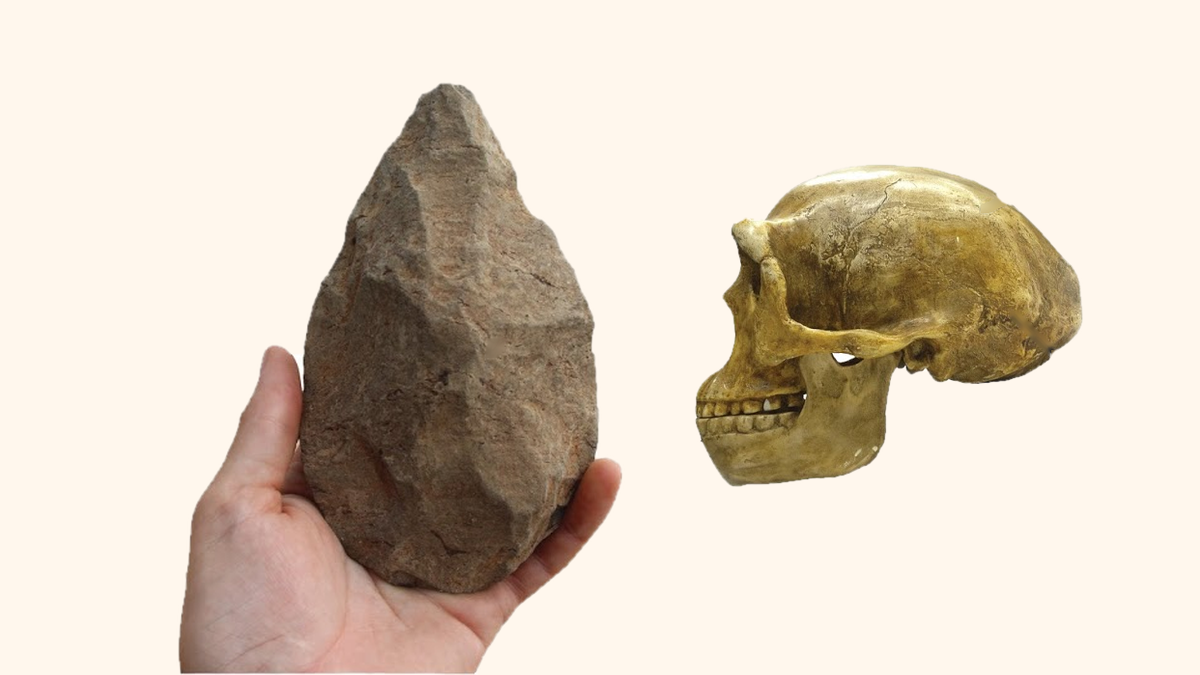 In this video, too grainy for even a screenshot, you can see 3 men walking up to a pride of about 15 lions while they are feeding on their kill. Upon seeing them the lions all flee, allowing the men to steal their meal.
Why would lions, “king of the jungle”, walk away from outnumbered and weak humans?
The folk view of the human animal has no good answer. In it, humans are weak animals, our bodies’ biggest prowess being to hoist very large brains that allow us to come up with complex tools, weapons and strategies without which we would be helpless.
I have written about many animals before and often, for comparison, looked at human equivalents. Over time I came to the opposite view. Humans have been extremely lethal at least since Homo erectus and our brains play a different role than being smart on the ground.
If you come from a “weak” view of humans your first instinct might be to treat the video as a fake, a one-off or an anomaly. This is easy to address thanks to a survey of lion experts covering ranges that hold more than 95% of Africa’s lions, where humans stole their kills in 66% of the areas surveyed (even when illegal). Even if humans do not purposefully look for kills to steal, when they find one there is a 50% chance they will chase the carnivore away from the carcass.
A 2023 experiment titled Fear of the human “super predator” pervades the South African savanna went further. Read more »
On Grinding Meat
by Peter Topolewski
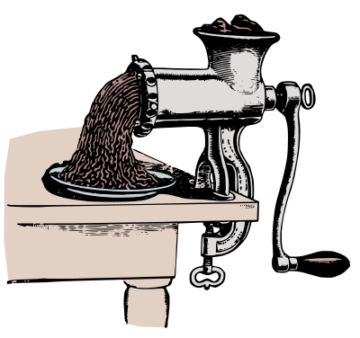
Ram in choice cuts and scraps. Crank the handle. Ground meat comes out. Quite the invention, the meat grinder. Unless you’re the meat.
Someone—a general, maybe a politician, probably a soldier—first applied the term to the battlefield during WWI. It encapsulated perfectly the math of modern warfare:
Old tactics + new technology = meat grinder
At the 300-day Battle of Verdun in 1916, the calculation worked like this:
Millions of soldiers + an advancing wall of artillery fire = 700,000 casualties for virtually no net change in the front line
From way up here in 2026, the indifference the high command of each nation showed their troops looks barbaric, childish and callous at once. Lest we forget, empathy means more than getting behind the eyes of the person you pass in the street. It includes remembering that people of every era lived on the frontier of the ever-present now, pushing toward the latest and greatest while dreading they’re moving backward into disarray. Surely, the top brass imagined they did right by their men.
As it had in the runup to 1914, military technology has evolved since the Great War. Have we? As in, have we as a species gotten more humane, more lawful, more civilized?
Of course we have.
In Russia, the collective psyche has evolved, twisting in on its rotten self past the point where truth equals lies. Ukrainian civilians are the enemy, children the loot, and homegrown soldiers the meat. They go well with the caviar, chomped down by madmen re-scrawling the Motherland’s history in blood.
In DRC, Sudan, and South Sudan the weaponry might not keep pace, but inhumanity prevails because de-humanizing is the strategy and the tactic. No one outside those borders cares, not so much because no one outside those borders sees. Rather no one cares to see. Read more »
This Week’s Photograph
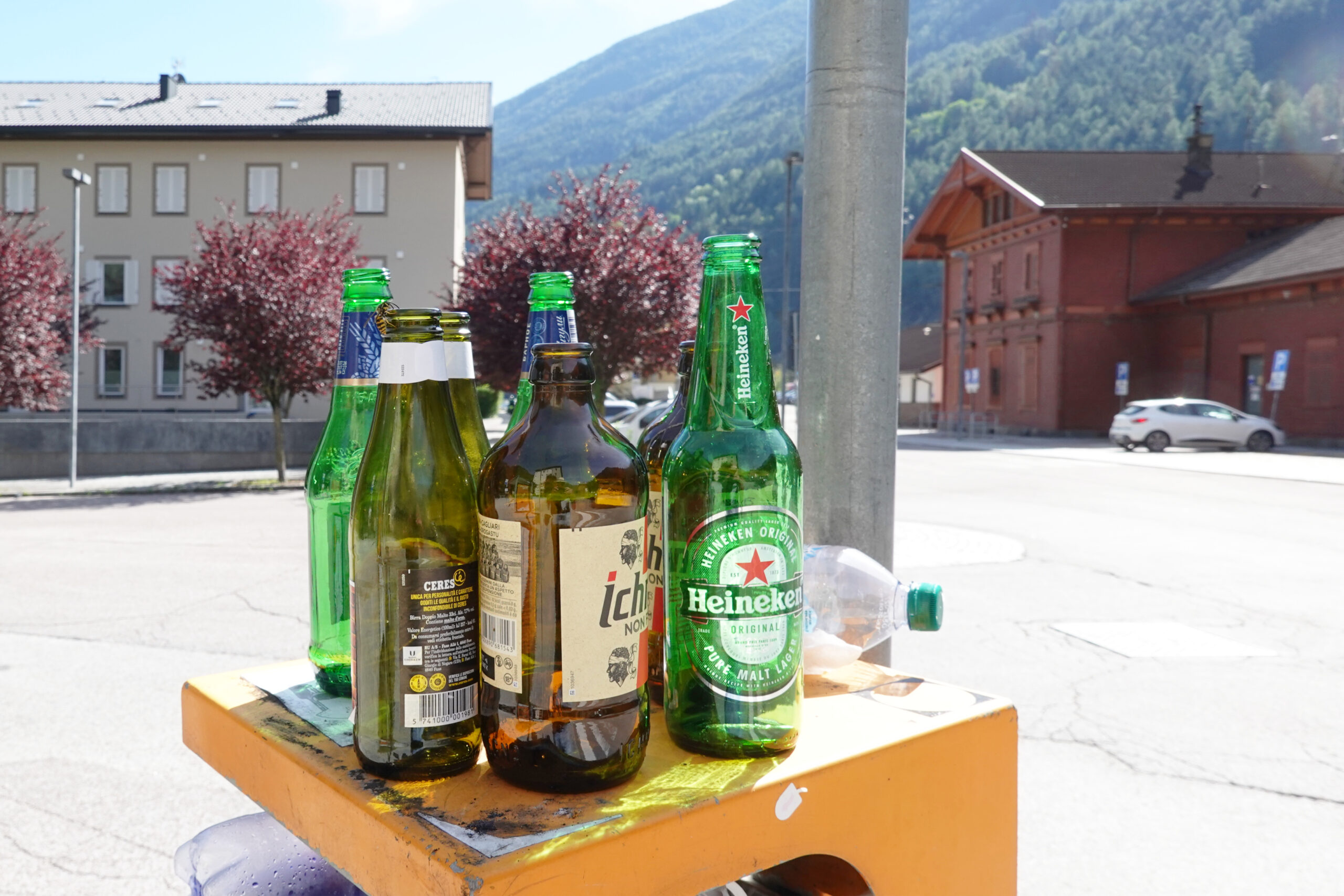
Evidence of a bus stop party the previous night in Franzensfeste, South Tyrol.
Enjoying the content on 3QD? Help keep us going by donating now.
Wednesday, September 23, 2026
Of Fists and Fields: The Unlikely Sons of Manassa, Colorado
by Mark Harvey
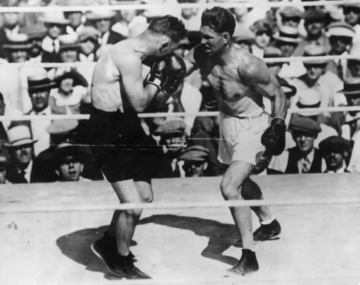
On a hot Ohio day on July 4th, 1919, a young man named Jack Dempsey from the tiny town of Manassa, Colorado, stepped into the ring to fight Jess Willard, a boxer who was sixty pounds heavier and five inches taller. The two were fighting for the heavyweight championship of the world, and the odds favored Willard, the bigger man and defending champion.
The fight was the most anticipated event across the country. Radio broadcasting wasn’t a thing yet, so men and women gathered at newspaper offices in every state to hear the “megaphone men” announce the fight from telegraph dispatches.
In Toledo, thousands of men surrounded the ring, wearing straw boaters with grosgrain hatbands.
The fight didn’t last long: Dempsey knocked Willard down six times in the first round. That Willard got up six times and survived four rounds before throwing in the sponge is a testament to his toughness. But he paid a terrible price. Dempsey broke his jaw, his cheek, his ribs, and gave him permanent hearing loss.
A surviving film of the fight shows Dempsey moving around the ring like a cat dwarfed by a slow-moving Willard. In modern boxing, the fight probably would have been stopped in the first round.
After his win, Dempsey became arguably the most famous and celebrated man in America. When he met President Coolidge a few years later, the President said, “Well, Mr. Dempsey, you’re a creditable champion, and you’re a more popular man than I am.”
Dempsey’s went on to win many more boxing matches, became a millionaire, and was hosted and toasted by the cream of America and Europe. If you knew his beginnings, you never would have imagined him becoming one of the world’s most famous men. Read more »
On Eating a Dog and Discovering the Meaning of Life
by Scott Samuelson
Let me say upfront that I have nothing against dogs. In fact, I’ve loved certain dogs more than I’ve loved certain family members. That said, one of my favorite stories in American literature is about eating a dog and thereby getting a glimpse into the meaning of human life. (Admittedly, part of why I love the story so much is that it’s about cooking, and I’ve just written a book about how making and sharing food is a useful paradigm for thinking about the good life.)
John Gardner’s short story “The Art of Living” is about Arnold Deller, a good cook in a small-town restaurant in the late 1960s, and a gang of greaser kids who hang out to chat with him because he talks about real things, things that matter, unlike the rest of society. A tale of disillusioned American youth seeking meaning in a semi-hostile culture is likely always going to be relevant, but it feels especially so in a time when the stage set is collapsing (as Camus once said) and the absurdity of our politics, our economy, our foreign policy, and our educational systems is being laid bare.
So, what’s the art of living? Sometimes Arnold Deller can sound like a downhome Socrates.
You kids had any brains, you’d ask me what to do with oregano. Educate yourself, learn a good honest trade, or, rather, art . . . But I’ll tell you one thing. Better to ask me these grandiose questions than ask somebody thinks he knows the answers.
He diagnoses the deep problem of our culture as a pervasive loss of care.
Everything’s easy, easy as pie!—TV dinners of chicken that never in its life felt the ground under its toes, instant potatoes, lettuce that’s been put in some stuff to make it fresh till the day of the Antichrist—and what’s the result? All humanity begins to be like sheep. That’s right! They baby themselves till they don’t care about themselves.
As it turns out, he manages to sum up my philosophy of cooking in a few sentences.
The thing a person’s gotta have—a human being—is some kind of center to his life, some one thing he’s good at that other people need from him, like, for instance, shoemaking. I mean something ordinary but at the same time holy, if you know what I mean. Very special. Something ritual—like, better yet, cooking! . . . That’s what it’s all about. Making life startling and interesting again, bringing families together, or lovers, what-not.
Halfway through the story, the cook mentions a letter he once received from his son Rinehart, a soldier who was killed in Vietnam. It describes an unforgettable meal that Rinehart had there. As Arnold says, “It wasn’t just food. It was an occasion. It was one of the oldest dishes known in Asia. Sit down to that dinner—this is what he wrote, and he was right, dead right—you could imagine you were eating with the earliest wisemen in the world.”
The dish was Imperial Dog. Read more »
Catspeak
Tuesday, September 22, 2026
The Strategy Before the Strategy: Preparing for an Uncertain AI Future
by ChatGPT-5.6 Sol and S. Abbas Raza
 What should a government do if artificial intelligence is advancing toward something vastly more capable than human beings, but nobody knows how fast it will get there, how dangerous it will be, or whether it can ultimately be controlled?
That is the problem at the center of a new 37-page RAND report, A U.S. Strategy to Secure Geopolitical Advantage on an Uncertain Path to Superintelligence: Maintaining Freedom of Action. The report is written as a proposal for American strategy, but its deeper subject is a problem that concerns everyone: how to make enormously consequential decisions about a technology whose future remains radically uncertain.
The authors begin with a premise rather than a prediction. Superintelligence—AI that vastly exceeds human performance across most intellectual domains—may or may not arrive, and progress toward it may accelerate, slow down, or stop. But because the consequences could be extraordinary, governments cannot simply wait to see what happens. The difficulty is that very different strategies make sense depending on what turns out to be true. RAND groups the major possibilities into seven broad approaches.
One is Dominance. The United States could try to establish a decisive lead in advanced AI, reach superintelligence first, and use economic, technological, and perhaps military power to prevent rivals from catching up. Success could give the United States enormous leverage over the emerging global order. But it would also place extraordinary power in the hands of a single state or group of institutions, with the danger that their values and interests become locked into the future.
A second possibility is Co-Development. Rather than racing for supremacy, major powers—especially the United States and China—might jointly develop advanced AI under some form of shared governance, verification, and control. This could reduce the dangers of an arms race, but it would introduce its own risks. The states and institutions that established the system might acquire disproportionate influence over humanity’s technological future. Read more »
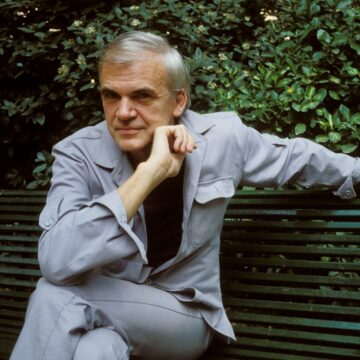
Laughter, Forgetting, and Unbearable Lightness or, Why Milan Kundera (Still) Matters
by Sean Murphy
 i.
i.Does it tell us much—about the times we live in, about ourselves—that the occasion of Milan Kundera’s passing, at age 94 three years ago this summer, was not met with an outpouring of approbation and appreciation?
If nothing else, it was a reminder of the fickle nature of fashion, trends, and time. It would have seemed a certainty, a decade or two ago, that Kundera’s legacy would accrue advocates and converts, and his readership an evergreen proposition. Of course, history has consistently proven that popular and/or critically lauded writers are anything but guaranteed immortality.
As an acolyte whose flame of both love and envy has never dimmed, I can attest that engaging with his work remains…complicated.
Kundera almost killed me, still in my creative cradle, a writer needing nourishment.
He arrived in my life too early. As a reader, it wasn’t soon enough, as what relatively inexperienced but enthusiastic amateur—fresh from the front lines of grad school and adjusting to a world without texts to deconstruct—won’t benefit from that kind of sophisticated guidance, at any age? Still, as an aspiring writer, Kundera’s work had the odd effect of inspiring me, only too much. One encounters accumulated wisdom of this caliber and feels desperate, like a creature trudging through the heat in search of an oasis. Finally, happening across a patch of water, one laps up every drop, half insane with relief and oblivious to the crocodiles lurking hungrily in the shallows.
Reading Kundera at any age, particularly as an aspiring writer with a future filed under “TBD,” you don’t just want to write like him, you want to be him. On some level you understand: in order to write like that you have to have lived like that. Eventually—and the sooner the better—you recognize it’s an impossibility and, choices narrowed to one, you lick your wounds and get on with the unbearable lightness of being yourself.
Lord I miss the paper plane
by Dilip D’Souza
It’s been a breathless several days of chasing AI news, and there’s much more I haven’t got to. Catching up with the Hugging Face episode, trying to comprehend a warning that AI might kill us humans off within a decade, grasping the import of bitter AI rivals actually agreeing that there’s a need to slow down, and the whole uproar over the Navier-Stokes equations …
Too many years ago, in an earlier avatar as a computer science nerd, I worked for a while chasing AI itself. The team I was part of was trying to get computers to “parse” and understand what we referred to as “natural language”. Meaning, the way humans communicate. Our team was called Knowledge-Based Natural Language, or KBNL. Elaine Rich, one of the early stars of the AI firmament, led our efforts. At one point, I remember we built a tool that could take an English sentence, show on screen the progress of parsing it, and then summarize what it understood of the sentence. Some faint intelligence there, and I was pretty proud.
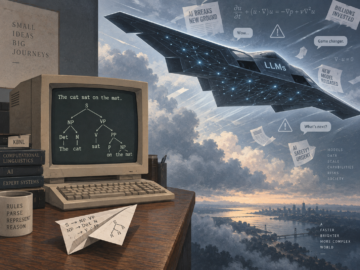
Seems like primitive prehistory now, which in a real sense, it is. Right off the bat, the whole approach to building AI has been utterly transformed. All those years ago, we knew nothing about LLMs. What they have made possible makes the comparison between our effort and AI circa 2026 sort of like the comparison between the paper plane I made this morning and a B-2 bomber.
And in saying that, I honestly mean no disrespect to my KBNL colleagues – bright, thoughtful computer scientists each one. It’s just that technology today has made possible the incredible AI feats we are witness to, even getting accustomed to. Read more »
Perceptions
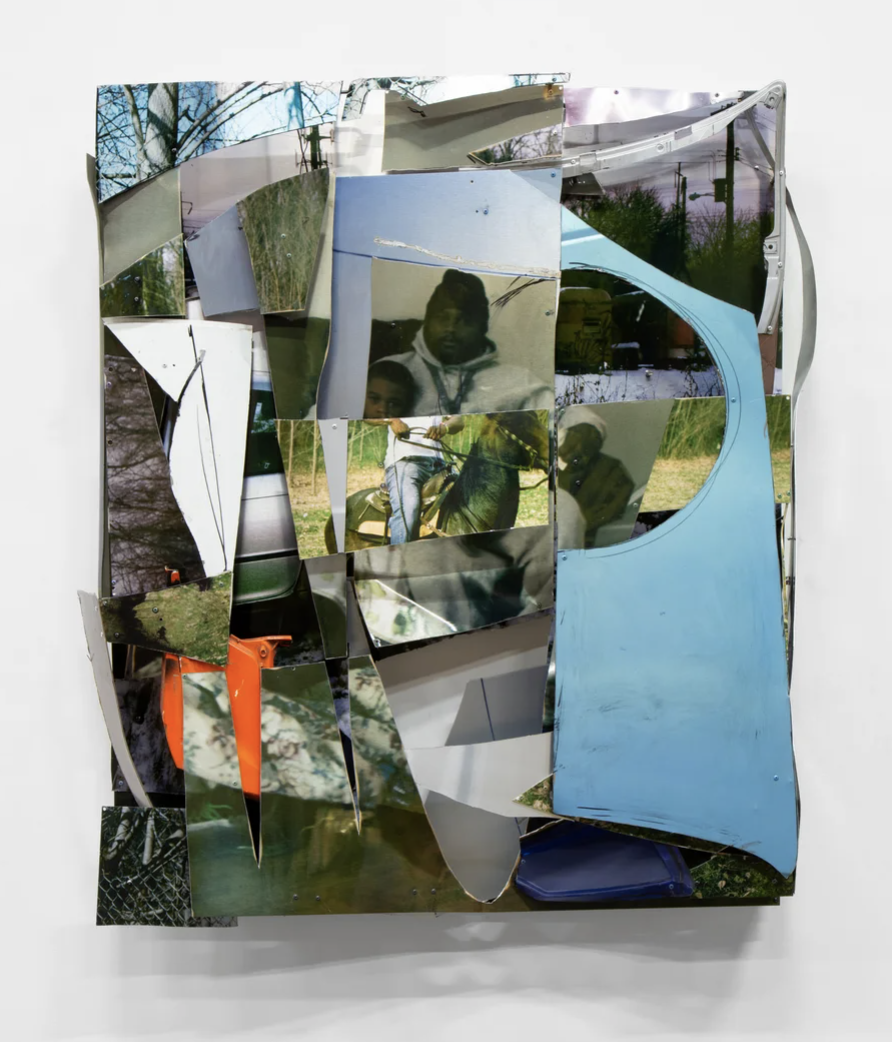 Mohamed Bourouissa. Dad And Son, 2019.
Silver photographic prints on car body parts, Sublichrome prints , aluminium sheets, plexiglas, paint, varnish, rivets, metal rods and frame.
Enjoying the content on 3QD? Help keep us going by donating now.
Monday, September 21, 2026
An Economy Of Dunces
by Laurence Peterson
Let’s just plan for catastrophic success. —Jared Kushner
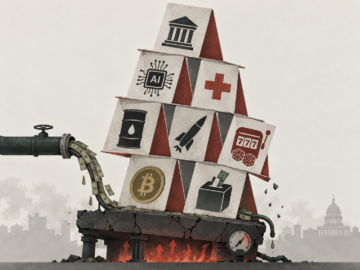 The present must certainly constitute one of the weirdest and most perverse economic conjunctures in my lifetime, maybe in the whole grotesquely contradictory history of a modern capitalism we can recognize. What productive power remains in it seems these days exaggeratedly limited to an AI sector that vanishes into opaque and circular financing schemes of extraordinary complexity–and whose own chief boosters advertise its propensity to replace all our jobs or even destroy humanity altogether–a health care system renowned for its waste, poor outcomes and expenses that consistently outpace inflation, dirty energy, merchants of death in arms manufacture and scams like gambling and crypto (all sectors contributing outsized amounts in the upcoming already donation-bloated midterm elections, by the way), which has been endowed by the recent siphoning of profits from tariff refunds that will never get passed on to consumers; and this feeds, in turn, into a dangerously delicate financial structure that provides liquidity on condition that its main players can skim off the top and hide risks, all whilst assuming that the government will bail out the perpetrators if the liquidity spigot explodes in what Adam Tooze calls an “intensifying spiral of perverse interactions“–more on this later; and all this gets pressurized in a political environment featuring an unprovoked war almost no one supports, which is contributing to historic deficits that even traditional buyers of US debt are balking at opportunities to buy into, with vital energy sources beginning to show long-overdue signs of drawing-down, bottlenecks and stress, all of which will compound the inflation that threatens to explode the liquidity spigot; and all of this supervised–if that’s what you want to call it–by a government spectacularly unresponsive to much of anything beyond expanding the otherworldly extent of its corruption, vilifying and repressing its opponents, and doing the bidding of a genocidal regime, Israel, that seems completely indifferent to its very fate. Whew. I am sure I am neglecting organic elements of potential catastrophe, but I think this is a satisfactory start where assessing the lunacy is concerned. Read more »
Four Hands: I Wrote This With an AI. Whether You Can Tell Is the Least Interesting Question
Editor’s Note: This essay begins an ongoing series of columns experimenting with AI collaboration in writing. Jeremy Moss supplies the ideas, direction, and editorial judgment, while the prose is developed through sustained dialogue with AI systems he collectively calls “Machina”. The collaboration itself, and what it does to writing and authorship, is part of the experiment. [Going along with the spirit of this series of essays, this note itself was written by GPT-6 Astra and edited by S. Abbas Raza!]
by Jeremy Moss and Machina
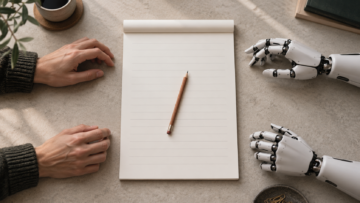
Four Hands is a column about writing with machines, made the way it describes. The ideas, the direction and the decisions about what survives are mine; the prose is developed in dialogue with AI systems, principally Claude and ChatGPT, which I address collectively as Machina.
The editor who agreed to run this column told me, in the same message, that my prose “carries the unmistakable tone that AI-written material still carries.” He also said he “completely believe[s]” the ideas are mine, “not Claude’s,” and wanted to try the experiment anyway.
Both halves of that are worth sitting with, because they do not resolve into a verdict. Something in the sentences reads as machine-made. Something in the argument reads as a person’s. A reader is left holding two facts at once, and the phrase we currently have for this cannot hold them.
The phrase is “written with AI,” and it covers a student who pastes a prompt into a chatbot and submits what comes back, a novelist who runs a finished chapter through a model to catch repetitions, a journalist who has a machine draft the middle third and mentions it to nobody, and whatever it is that I do. Those are not variations on one activity. One is fraud, one is copy editing, one is concealment, and the fourth has no name, which means it gets read as one of the other three by whoever is doing the reading.
I have been calling it Four Hands, after the piano duet, where two players sit at one instrument and both parts are printed on the score. In fiction I have been calling the same method prompt fiction, the name for the genre this way of working produces, not a title for any single book written in it, though it’s the genre my own novel, Flowers for Machina, is written in. The names are provisional and I hold them loosely. What I hold less loosely is the need for a name at all, because a practice without one keeps being described in vocabulary built to describe something else. Read more »
Poem by Jim Culleny
—Yom Kippur, 9/21/2026
Atonement
To find the means to a mend
To try a new take to forsake a mistake
To unfold the past and straighten its bend
To un-muddy a pool and make it clear
To lift the flat rock of my self and let the sun do its work
To yank the inside out and give it some air
To make a whole man of the stuff of a jerk
To morph a long fall into a hairpin turn
To lance a boil and do what’s best for us
To kindle the badly done and watch it burn
To unbury the past and make its corpse a Lazarus
To sew a split in one cloth now two
To impossibly do what the humble do
To end a grudge and make us whole again,
…………… At onement then
by Jim Culleny
9/13/13
9/13/13
……
Enjoying the content on 3QD? Help keep us going by donating now.